
About This Video
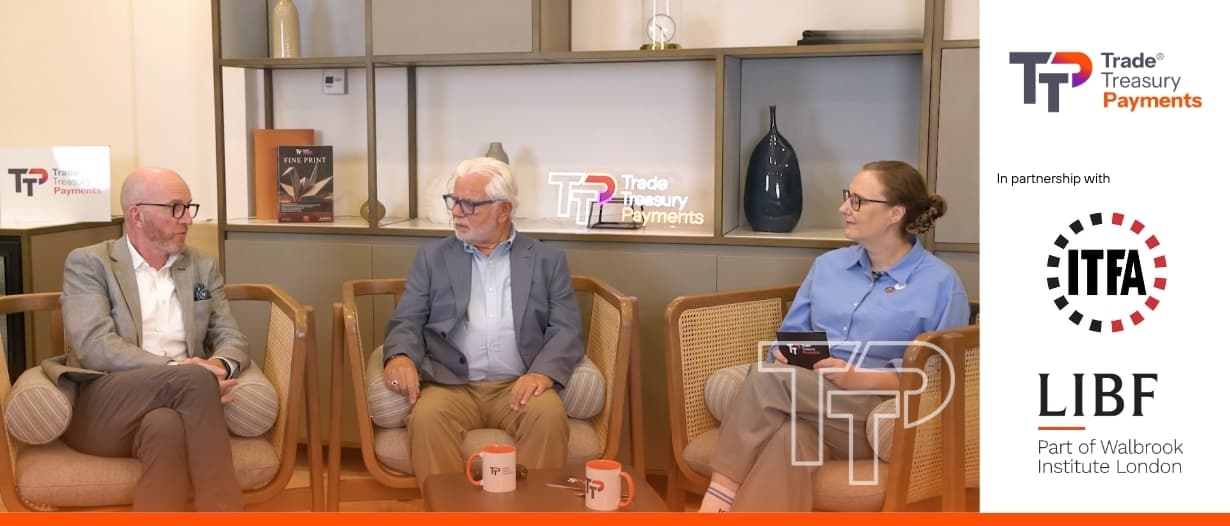
At the ITFA Americas Annual Conference in Miami, Trade Treasury Payments (TTP) sat down with Michael Mandell, Managing Director for the Americas at Komgo, to discuss the evolution of digital tools in trade finance and how institutions are progressing from manual processes to integrated platforms.
Mandell said, “Komgo’s focus is on removing paper from the process and automating the workflows that have been manual for decades. We’re looking across the entire technology stack, helping both financial institutions and corporates handle complex, high-volume trade activities in a more efficient way.”
While innovation in trade finance has often lagged behind other areas of financial services, that is beginning to change, driven by the growing application of artificial intelligence (AI) to targeted use cases. Rather than getting caught up in hype cycles, Mandell sees real value in narrowly applying AI to repetitive and error-prone tasks.
“For example, we’re using AI to extract information from draft invoices and populate trade instruments within platforms like GTK. Other solutions, such as Konsole and Market, have also seen significant enhancements,” Mandell said. “We’re also using AI to compare documents, helping to automate document checking, an area that has traditionally been labour-intensive and highly manual.”
The benefits are tangible. One Komgo client has shared that GTK reduced their average issuance time of trade instruments by 50% and allowed them to shift 70% of new guarantees to fully automated workflows.
Mandell noted that the most forward-thinking companies are those using structured data to improve reporting, enhance connectivity, and replace static documents with dynamic platforms.
“They’re starting to treat our platform as a golden source of data,” he said, “instead of relying on Excel files or stacks of paperwork.”
Reflecting on the conference, Mandell remarked that technology has become central in the trade finance conversation. “Every panel I’ve seen today has touched on technology,” he said. “It’s gone from being something you needed to have to being the starting point for solving industry-wide challenges.”
And his message to the broader market? Stay curious.
“Be open-minded. Talk to organisations. Learn what best practices are out there,” Mandell said. “There’s no one-size-fits-all solution, but there’s a lot to gain from understanding how others are applying technology to improve their operations.”
Key Topics
- Digital transformation in trade finance
- Artificial intelligence in trade operations
- Connectivity across banks and systems
- Data management and reporting
- The evolution of trade finance structures
Expert Analysis
Michael Mandell explains how trade finance is undergoing a steady but meaningful transformation. Much of this change is driven by the need to move away from paper based processes and towards more efficient, digital solutions. From his perspective, the real value of technology lies in its practical application. Artificial intelligence is not being introduced for its own sake, but to solve specific challenges such as document handling and data extraction. These are areas where manual processes have traditionally slowed things down and introduced risk. He also points to the growing importance of connectivity. Businesses want their internal systems, such as treasury management platforms, to work seamlessly with banks and external partners. This level of integration helps organisations manage complex and high volume trade activity more effectively. Another key theme is the role of data. Companies that are further ahead in their digital journey are treating data as a trusted source of insight, rather than relying on fragmented or outdated information. This shift supports better reporting and more confident decision making. Overall, the direction of travel is clear. Trade finance is evolving in response to both market pressures and new technologies, and organisations are increasingly open to adopting tools that support efficiency, transparency and growth.— Michael Mandell
Key Findings
- Manual workflows continue to slow down many trade finance processes
- Artificial intelligence is proving useful in targeted areas such as document checking and data input
- Platforms that support multiple banking relationships are improving efficiency and visibility
- Forward thinking organisations are placing greater value on structured and accessible data
- Technology is now shaping both the direction and pace of change across the trade finance sector
Implications
- Greater use of artificial intelligence is likely to reduce reliance on manual processes and improve operational efficiency
- Businesses will continue to seek stronger connections between their internal systems and external financial partners
- Investment in data capabilities will increase as firms look to improve reporting and oversight
- Digital platforms will play a more central role in linking corporates with banks across global markets
- New and evolving trade structures will require flexible and adaptable technology support