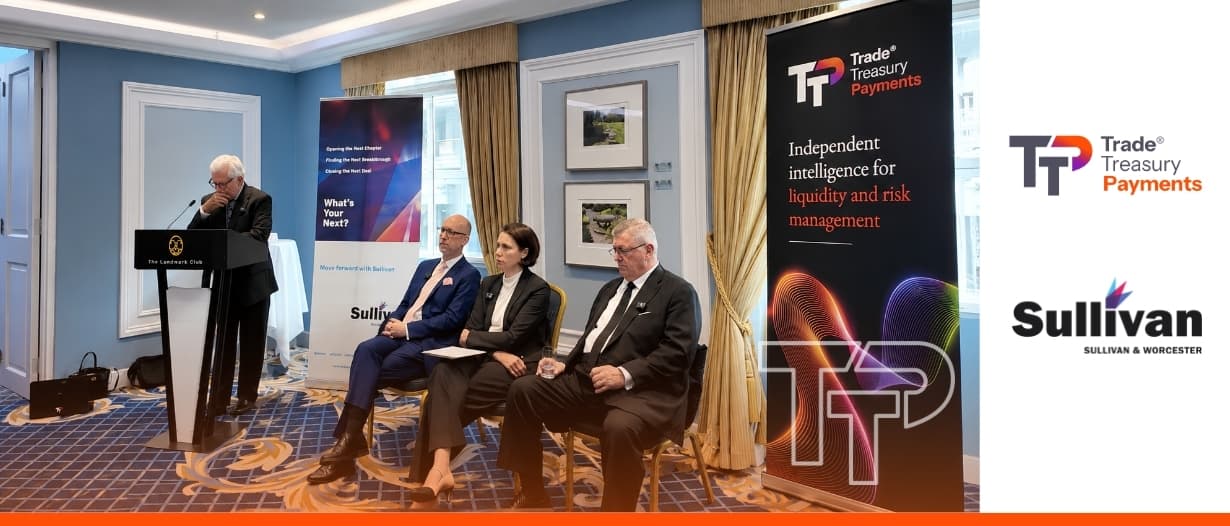
André Casterman on what trade finance needs next
By: Scott Sanchon
The debate around digitalisation has been running in trade finance for years. What is changing now is the increasing adoption and legal upgrade of national laws.
André Casterman, an independent consultant and a board member of the International Trade and Forfaiting Association (ITFA), has been part of that transition since its earliest stages. With 24 years at SWIFT digital innovations in payments, trade, and securities, he brings a perspective shaped by the ambition to build a more digital trade finance market.
At the ITFA Americas 29th Annual Conference in Miami, TTP spoke with Casterman to explore the future outlook for trade finance modernisation and how we can turn that progress into momentum.
What has happened
The definition of the next phase of trade digitalisation for Casterman is compelling. The focus is not innovation – it is proof.
“Ten years ago I would say a lot has to happen, and indeed now we can see that a lot has happened because as a community we have learned from our mistakes,” said Casterman. “We have also engaged regulators to do the appropriate legal upgrade of national laws – in particular to enable digital trade with negotiable instruments.”
Over the decades, the trade finance industry has been building infrastructure, innovations, and methodologies that are now ready to be deployed.
“We need more early adopters,” he says. “We have delivered early adopters across digital negotiable instruments, securitisation, and AI in compliance. And we’re going to continue to deliver more and more early adopters across multiple use cases – tokenisation, stablecoins, and beyond.”
Casterman demonstrated confidence in the market about digitalisation. Still, the only thing that has to happen to drive trade finance is for early adopters to provide proof points that the market is really embracing those innovations.
Capital markets and the liquidity question
One of the most important questions in trade finance right now is where the liquidity to support it will come from.
“In addition to bringing early adopter banks, I’d like more and more partnerships between non-bank lenders and capital markets,” said Casterman. “This is where the liquidity will come from over time.”
As they have always been, banks will continue to be a key engine driving this space, particularly where they can offer the most competitively priced liquidity. But for non-bank lenders and SMEs, bank liquidity is not always available. This is where capital markets need to step in. Casterman’s vision is pointing toward SMEs and non-banks.
“I’m focusing a lot on the non-bank space and the capital market space,” he said. “So we talk about non-banks at the origination level, non-banks at the distribution level, and making sure we can serve more open account flows aiming at financing SMEs.”
The new perspective from ITFA Americas 2026
Despite being on the global organisation’s board since 2017, this event in Miami was Casterman’s first experience attending one of the Americas’ chapters’ conferences.
“I’m really surprised how open the community is to commodities,” he says. “Whereas in Europe, commodities have been a no-go for some banks – for good reasons, given fraud cases and regulatory trends on the ESG side… There is no negative approach in the US, as I see in Europe. I think we have to rethink the approach in Europe and really look deeper into what the American market is doing.”
He also flags the US Clarity Act as a development worth watching.
What this means for the industry
What becomes clear is that trade digitalisation is no longer a question of possibility, but of pace. The legal infrastructure for digital trade finance is improving. Capital markets are becoming a more serious part of the liquidity. And adopters are multiplying.
What the market needs now are the proof points that turn early adoption into the mainstream. If 2026 delivers these initiatives, it will prove to be the year trade finance digitalisation moves from promise to pipeline.
Prefer to listen? The full conversation is also available as a podcast below.
Key Topics
- Trade finance digitalisation requires legal upgrades to national laws that enable digital negotiable instruments and modern trading methodologies.
- Early adopter banks and financial institutions are essential to providing proof points that drive mainstream adoption of digital innovations in trade finance.
- Capital markets partnerships with non-bank lenders offer a critical source of liquidity for SMEs and open account flows that traditional bank financing cannot serve.
- Digital innovations in trade finance now span tokenisation, stablecoins, digital negotiable instruments, securitisation, and AI in compliance.
- Regulatory frameworks such as the US Clarity Act and evolving approaches to commodities trading are reshaping opportunities across regional trade finance markets.
Key Insights
Expert Analysis
André Casterman, independent consultant and ITFA board member with 24 years at SWIFT in digital innovations, frames trade finance digitalisation as now entering a proof phase. He emphasises that legal upgrades to national laws enabling digital negotiable instruments are established, and the industry has learned from past mistakes. The critical next step is scaling early adopters across digital negotiable instruments, securitisation, AI in compliance, tokenisation, and stablecoins. Casterman identifies capital markets partnerships with non-bank lenders as essential to unlocking liquidity for SMEs and open account flows, and flags the need for European markets to reconsider their restrictive stance on commodities trading given the openness demonstrated in US markets.
Key Findings
- Legal infrastructure for digital trade finance is now in place and improving, particularly through upgrades to national laws enabling digital negotiable instruments and modern trading methodologies.
- Early adopters have already been deployed across digital negotiable instruments, securitisation, and AI in compliance, with further adoption anticipated in tokenisation, stablecoins, and broader use cases.
- Capital markets are becoming a more serious source of liquidity for trade finance, particularly for non-bank lenders and SMEs where traditional bank financing is unavailable or uncompetitive.
- Trade finance digitalisation faces a pace challenge rather than a possibility challenge; proof points from early adopters are the key driver to mainstream adoption.
- Regional divergence exists in commodities trading approaches, with US markets remaining open whilst European banks have adopted restrictive positions due to fraud and ESG regulatory concerns.
Implications
- Banks must decide whether to adopt digital solutions early or risk market share loss to non-bank lenders and capital markets platforms that serve SME and open account demand.
- Capital markets infrastructure will need to scale rapidly to meet the liquidity demand currently unmet by traditional banking channels.
- Regulatory frameworks like the US Clarity Act may create competitive advantages for jurisdictions with forward-looking commodities policies, potentially requiring European regulators to recalibrate ESG and fraud risk approaches.
- Standardisation of digital negotiable instruments and tokenisation frameworks across regions will become critical to unlocking cross-border trade flows.
- Proof points from early adopters in 2026 will determine whether trade finance digitalisation becomes mainstream or stalls on adoption barriers.
Key Takeaways
- Trade finance digitalisation is no longer a question of possibility but of pace; the legal and technical infrastructure exists, and early adopters must provide proof points to drive mainstream adoption.
- Capital markets and non-bank lenders are essential liquidity providers for SMEs and open account flows, complementing traditional bank financing.
- Early adopters have already been deployed across multiple use cases including digital negotiable instruments, securitisation, AI in compliance, tokenisation, and stablecoins.
- European and US markets are taking divergent approaches to commodities trading in trade finance, with implications for regulatory harmonisation and market competition.
- The industry's ability to scale proof points by 2026 will determine whether digitalisation transitions from promise to active market pipeline.