












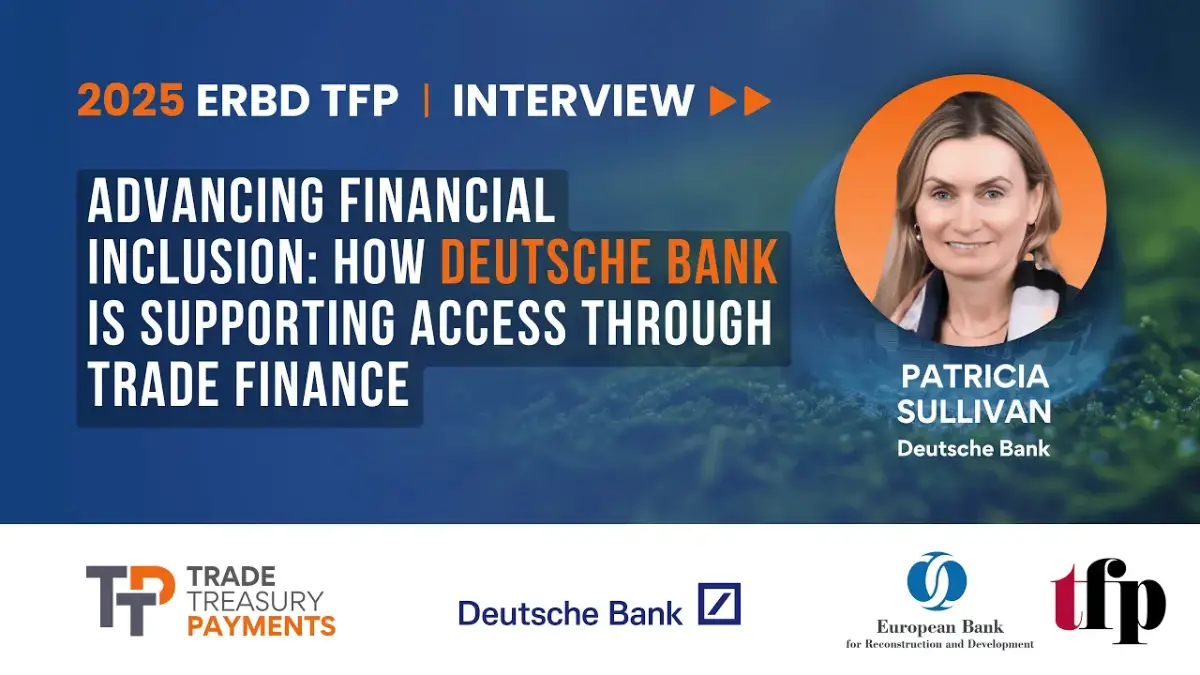

Advancing financial inclusion: How Deutsche Bank is supporting access through trade finance
At the European Bank for Reconstruction and Development (EBRD) 2025 Annual Meeting and Business Forum in London, Trade Treasury Payments (TTP) sat down with Patricia Sullivan, Global Head of Institutional Cash Management at Deutsche Bank, to explore how the institution is navigating the intersection of financial inclusion, risk management, and the global shift toward more sustainable trade.
Sullivan, who also oversees the bank’s institutional trade finance sales team, said, “The trends in de-risking have been building since 2008. We’re now seeing similar consequences from the use of tariffs, both are reshaping supply chains and capital flows in ways that can have unintended social and environmental impacts.”
With economic headwinds mounting and financial institutions under growing pressure to exit higher-risk markets, there is a growing risk of exclusion. Stepping away from certain countries or banks, even when done in the name of external risk management, can quickly translate into lost access to basic financial services for entire communities.
Sullivan said, “When banks take a reactive step back to manage risk, it can have a very quick impact on the access those communities have to financial services and trade flows. Cash and trade flow are the lifeblood of society.”
To counter this, Deutsche Bank has taken a proactive stance. In 2024, the bank launched its ecosystem of risk management initiative, a programme designed to support partner banks in enhancing their financial crime compliance standards. Sullivan noted that the programme is backed by a dedicated team of 70 people focused exclusively on non-financial risk management directly in the business.
“The team brings together our client banks in locations across the globe together with policymakers and local leaders to share best practices in risk management,” she said. “We view this as part of our licence to do business, helping our clients stay safely banked and ensuring they, in turn, can continue to serve their own communities.”
This risk-sharing approach is grounded in collaboration. By aligning with multilateral institutions like the EBRD and World Bank, Deutsche Bank aims to promote a risk-based approach to compliance that allows financial services to flow without compromising on standards.
Sullivan said, “We are a big supporter of responsible financial inclusion. That means working with others to make sure risk appetite doesn’t have to become a reason to cut off people and places that depend on access to the global financial system.”
At a time when the global trade landscape is being redrawn by geopolitical uncertainty, compliance pressures, and sustainability imperatives, the challenge is to manage risk in a way that keeps the arteries of trade and finance safely open.
Key Topics
- Financial inclusion in cash management and trade finance
- The impact of de-risking on global banking access
- Tariffs and shifting trade and capital flows
- Financial crime compliance and risk-based regulation
- Collaboration between banks, regulators and institutions
Key Insights
Expert Analysis
Patricia Sullivan, Global Head of Institutional Cash Management at Deutsche Bank, highlights the delicate balance between managing risk and maintaining access to financial systems. Drawing on discussions at the European Bank for Reconstruction and Development, she points out that de-risking has been building since the 2008 financial crisis, bringing a range of unintended consequences. More recently, tariff measures have begun to create similar disruption, but at a much faster pace. She describes cash and trade flows as the lifeblood of the global economy. When banks step back from certain markets or counterparties, the impact is immediate. Businesses lose access to trade finance, and communities can quickly become disconnected from the financial system. Sullivan stresses the importance of coordinated action between policymakers and institutions such as the Financial Action Task Force and the World Bank. A risk-based approach to financial crime compliance allows banks to manage exposure without unnecessarily cutting off access. She also outlines how Deutsche Bank is supporting this effort in practice. Through its ecosystem of risk management programme, launched in 2024, the bank works closely with partner institutions, regulators and clients to strengthen compliance standards. By sharing best practice and fostering dialogue, the aim is to help banks remain connected to the global financial system while continuing to serve their local markets.— Patricia Sullivan
Key Findings
- De-risking has been a growing trend since the global financial crisis in 2008
- Withdrawal of banking relationships can quickly disrupt trade and local economies
- Tariff measures are accelerating similar challenges across global markets
- Banks are taking a more active role in supporting compliance and inclusion
- Knowledge sharing and stronger standards help institutions remain part of the global system
Implications
- A more consistent risk-based approach to regulation will help preserve access to financial services
- Banks will need to continue investing in non-financial risk expertise and infrastructure
- Global trade patterns are likely to keep evolving as tariffs and risk considerations reshape flows
- Collaboration between banks, regulators and international institutions will become increasingly important
- Strengthening local banking systems can reduce the likelihood of entire markets being excluded
Key Takeaways
- Financial inclusion remains central to effective cash management and trade finance
- De-risking, while necessary, can have wide-reaching effects on access to financial services
- Tariffs are adding a new layer of disruption to global trade and capital flows
- A coordinated, risk-based approach offers a more sustainable path forward
- Supporting partner banks is key to maintaining global financial connectivity