




Trade distribution around the world. How’s it done? How to do it.
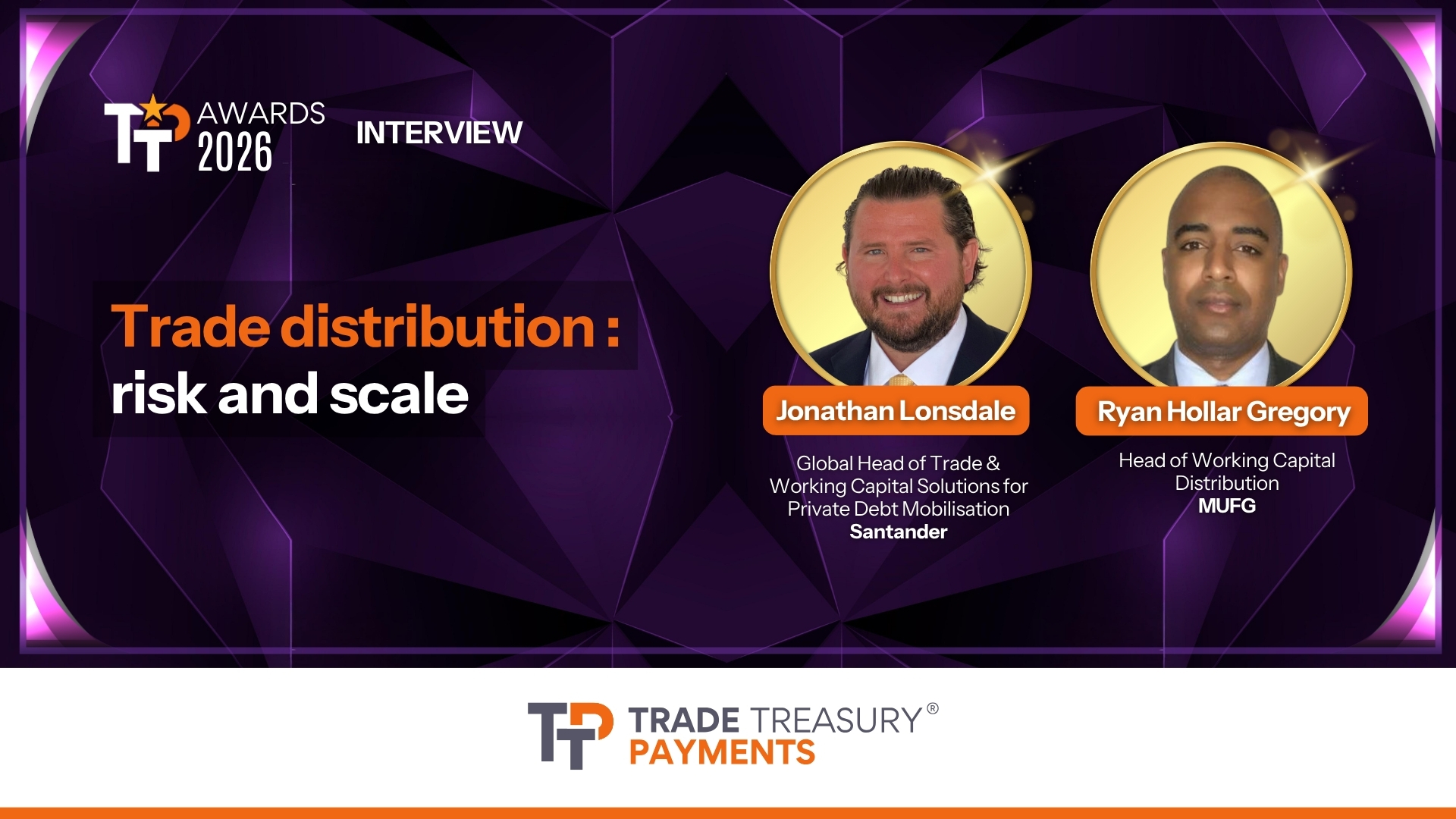
At the 2026 BAFT International Trade and Payments Conference in Jersey City, USA, Trade Treasury Payments (TTP) spoke with Jonathan Lonsdale, Global Head of Trade and Working Capital Solutions for Private Debt Mobilisation at Santander and TTP Global Advisory Panel Member, and Ryan Hollar-Gregory, Head of Working Capital Distribution at MUFG, about how banks distribute trade assets and why the secondary market is becoming an increasingly important part of trade finance.
What is trade distribution?
Trade distribution is the process by which a bank sells or transfers part of a trade finance exposure to other financial institutions or investors, allowing risk and capital to be shared across the market.
Lonsdale explained that distribution often starts with simple balance sheet limits. A bank may want to support a large client transaction but cannot hold the full exposure on its own. “If you want to put a large ticket on the table for your clients, say a billion dollars, and you only have appetite for two hundred million, then distribution becomes essential,” he said.
Distribution is also used to free up capital, improve returns, and meet client requests to involve multiple relationship banks in a financing programme.
How trade assets are distributed
Hollar-Gregory outlined the main ways banks distribute assets. These are:
- Master participation agreements: Often based on industry-standard frameworks such as the BAFT Master Risk Participation Agreement, allowing banks to sell participations in trade assets while retaining the original client relationship.
- Assignments: Typically used for longer-dated assets or loans that pay interest periodically, where the ownership of the asset (or a portion of it) is legally transferred to another investor.
- Fund structures: Some banks place trade assets into internal investment funds managed by their private wealth or asset management divisions, allowing investors to gain exposure to a portfolio of trade assets.
Some banks also use securitisation, though this is less common because of structural constraints. “The vast majority of investors are still banks,” Hollar-Gregory said, “but in the last five to six years we’ve seen non-bank investors becoming increasingly active.” Funds, asset managers, and speciality finance firms are becoming more visible participants, especially where they can take higher-yielding risk.
As more banks look to build distribution desks, Lonsdale called out the importance of getting the foundations, like clear legal and regulatory requirements, right. “Trade is already an operationally heavy asset class, and distribution adds another layer on top,” he said, suggesting that aspiring banks start with pilot transactions to test structures and build investor relationships before they scale.
Regional dynamics and a changing investor base
Part of the reason for testing the market is that there are still considerable regional variations in how trade assets are distributed. The Americas, for example, tends to see higher pricing and a stronger focus on open-account funded structures, while Europe has a more developed distribution ecosystem, with “more than a dozen” distributing banks, compared to the Americas where “you may have six, seven, eight banks that really distribute consistently,” Hollar-Gregory explained. Asia is more complex, shaped by differing legal and regulatory frameworks across jurisdictions. Hollar-Gregory said, “In Asia, understanding the legal and regulatory framework is probably more important than in any other region.”
These differences are becoming more pronounced as the investor base evolves. Trade finance assets are typically short-dated, often with maturities in the 90–180 day range, and have historically very low default rates, according to data from the International Chamber of Commerce. That profile has attracted increasing interest from non-bank investors. Over the past three years, the asset class has moved from a relatively niche allocation to a more mainstream part of private credit markets, with a growing number of institutional funds entering the space. As a result, distribution is no longer confined to bank-to-bank activity, but is developing into a broader, more global market.
Looking ahead, the outlook appears strong for the distribution market. “I think there will be more exchange, and it will become an increasingly liquid market as the year goes on,” Lonsdale said, adding that financing needs in areas such as defence could also contribute to increased activity. Hollar-Gregory added, “Having that distribution capability will be critical to winning large deals going forward.”
Trade distribution is no longer just a back-end balance sheet tool, but is becoming a core part of how banks structure and deliver trade finance.
Key Topics
- Trade distribution strategies
- Capital and balance sheet management
- Investor participation in trade finance
- Regional market differences
- Building distribution capabilities
Key Insights
Expert Analysis
Deepesh Patel sits down with Jonathan Lonsdale of Santander and Ryan Hollar Gregory of MUFG to explore how trade distribution is evolving and why it is becoming increasingly important for banks and their clients. At its core, trade distribution is about managing constraints. As Lonsdale explains, banks often face limits on how much exposure they can take on a single deal. By distributing part of that exposure, they can support larger transactions while keeping their balance sheets under control. It also allows them to recycle capital more efficiently and improve the overall return on their deals. There is also a strong client dimension. Corporates are no longer comfortable relying on a single bank. They want to diversify their funding sources and involve multiple relationship banks in their programmes. Distribution makes that possible and, in many cases, is now expected by clients from the outset. Hollar Gregory highlights the practical side of how this works. Banks typically rely on participation agreements, assignments, and fund structures to distribute trade assets, with securitisation used more selectively. While banks remain the dominant buyers, there has been a noticeable increase in interest from non-bank investors such as asset managers and private funds, particularly in higher-yield opportunities. Setting up a distribution capability is not straightforward. It requires the right legal framework, a clear understanding of regulatory requirements, and strong operational support. Just as importantly, banks need to build relationships with investors, which effectively become a new client base. Regional differences also play a significant role. The US market tends to offer higher pricing and favours funded structures. Europe is more competitive, with a wider range of banks and structures. Asia, meanwhile, is more complex, with varying regulations across jurisdictions, meaning strategies often need to be tailored country by country. Looking ahead, both speakers expect trade distribution to become more embedded in how banks originate and manage deals. As capital pressures persist and clients demand greater flexibility, distribution is likely to play an even bigger role. At the same time, a gradual increase in institutional investor participation should help deepen the market over time.
Key Findings
- Distribution enables banks to take part in larger deals without overextending their balance sheets
- Capital constraints remain a key driver behind distribution activity
- Structured approaches improve efficiency and make scaling easier
- Each region presents its own pricing, regulatory and structural characteristics
- The investor landscape is slowly diversifying beyond traditional banks
Implications
- Banks will need to invest in expertise and infrastructure to build effective distribution platforms
- Distribution is likely to become part of the deal from the very beginning, not an afterthought
- Collaboration between banks will increase as clients seek broader participation
- The rise of non-bank investors will expand capacity but add new considerations
- Regional regulatory differences will require careful, localised approaches
Key Takeaways
- Distribution is becoming a central part of how banks manage capital and risk
- Clients increasingly expect access to multiple funding partners
- Strong operational and legal foundations are essential for success
- The market is gradually becoming more liquid and interconnected
- A broader investor base will continue to shape the market