


Stablecoins and the future of corporate treasury
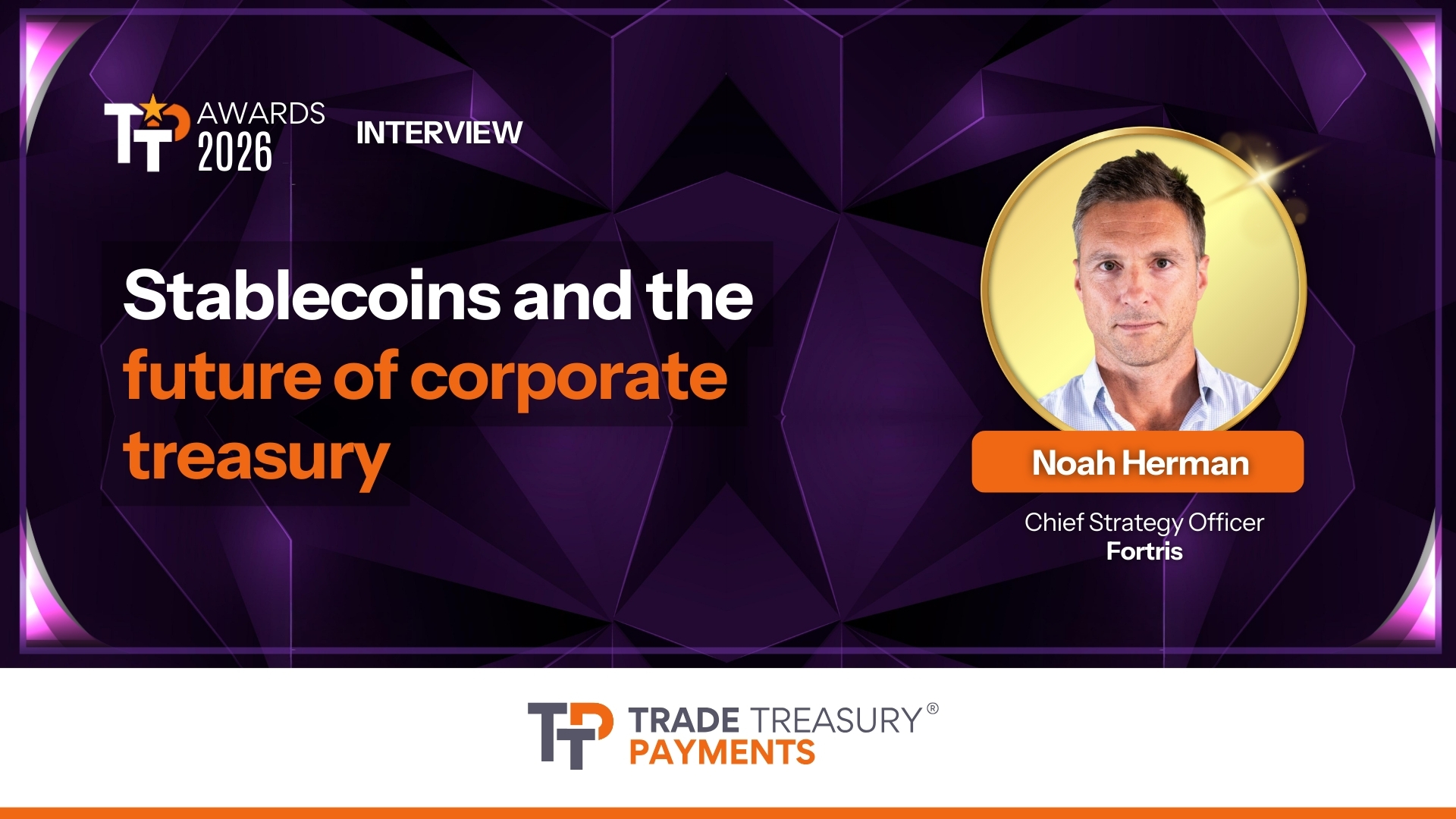
At the BAFT International Trade and Payments Conference in Jersey City, USA, Trade Treasury Payments (TTP) spoke with Noah Herman, Chief Strategy Officer at Fortris, about the growing role of stablecoins in corporate treasury and why treasurers are beginning to reassess their place within the financial toolkit.
Herman, whose career spans traditional banking, payments, fintech, and digital assets, argued that stablecoins are often misunderstood when grouped together with speculative crypto assets. Herman said, “If you’re focusing on stablecoins, this is truly just a digitising or tokenising of a dollar… which makes it distinctly different from any of the other crypto broadly discussed in the market.”
Although adoption remains early, Herman said a growing number of multinationals and global non-profits are already using stablecoins in practical ways to hold, move, and protect funds across borders. The appeal, he noted, is that blockchain-based stablecoins offer another infrastructure layer for global liquidity management, rather than requiring organisations to rebuild their entire treasury operations.
One of the areas where this has become visible is in jurisdictions where capital controls or local market constraints create friction. Critics sometimes argue that stablecoins merely shift trapped liquidity from one place to another, but Herman pushed back on that view. He pointed to in-country currency swaps into stablecoins as an example of how treasury teams can move value out of restrictive environments and make it accessible at the global level. In those cases, he said, what was previously local currency tied to a domestic system becomes part of a global treasury pool
Beyond individual use cases, Herman described the role of stablecoins as part of a shift in financial architecture. Compared with traditional rails such as wires or batch settlement systems, blockchain-based transfers operate continuously and allow corporate users to hold and move funds on their own schedules.
Herman said, “It’s much more efficient than a wire… but if you look at it in its purest sense… allowing the corporate to custody those assets where and when they want and 24/7/365 at the speed of the internet effectively – that to me is not a step change. It’s actually an order of magnitude change.”
The result, Herman suggested, is that stablecoins may move from being viewed as a niche innovation to becoming a practical extension of modern treasury infrastructure.
Key Topics
- Stablecoins and corporate treasury management
- The difference between stablecoins and other cryptocurrencies
- Cross border payments and global liquidity
- Blockchain infrastructure in financial operations
- Managing liquidity in restricted or emerging markets
Key Insights
Expert Analysis
Noah Herman brings more than two decades of experience across banking, payments and digital assets. He began his career in traditional banking, working across corporate, private and commercial banking as well as trade finance. He then spent several years in the payments fintech sector before moving into the crypto industry, where he has focused primarily on stablecoins and digital asset infrastructure for the past seven years. Through his work with institutions, governments and international non-profits, Herman has seen first-hand how organisations manage and move funds across borders. In his view, stablecoins are often misunderstood, particularly among corporate treasury teams that tend to group them together with speculative cryptocurrencies. He argues that this perception overlooks a key distinction. Stablecoins are essentially digital representations of fiat currency, most commonly the US dollar, issued on blockchain networks. Unlike other cryptocurrencies, their value is designed to remain stable because they are backed by reserves. For treasury professionals, this makes them less about speculation and more about practical financial infrastructure. While adoption among multinational companies remains limited, the organisations that are using stablecoins are beginning to see operational benefits. Blockchain networks allow funds to be transferred at any time, without relying on traditional banking hours or settlement processes. This can make global treasury management more responsive, particularly for companies operating across multiple jurisdictions. Herman also challenges the criticism that stablecoins simply move liquidity rather than create it. In certain markets where capital controls or currency restrictions exist, companies can exchange local currency for stablecoins and transfer the value to their global treasury. In practice, this can allow funds that were previously difficult to move to become available for international operations. For Herman, the significance of stablecoins lies not just in faster payments, but in the wider implications for financial infrastructure. Used effectively, they could reshape how companies hold, move and manage liquidity across the world.— Noah Herman
Key Findings
- Stablecoins are best understood as digital versions of fiat currency rather than speculative crypto assets.
- Corporate treasury teams are beginning to explore how they can support international liquidity management.
- Blockchain networks enable faster and more flexible movement of funds across borders.
- Stablecoins may help companies access capital that would otherwise remain trapped in local markets.
- The technology could gradually reshape global treasury operations and payment infrastructure.
Implications
- Treasury teams may increasingly explore blockchain based tools for managing global liquidity.
- Stablecoins could reduce reliance on traditional cross border payment systems.
- Organisations operating in markets with currency restrictions may gain greater flexibility in managing funds.
- Financial institutions will need to adapt services and frameworks as tokenised currencies grow in use.
- The long term impact could extend beyond payments to the broader architecture of global finance.
Key Takeaways
- Stablecoins are best understood as digital versions of fiat currency rather than speculative crypto assets.
- Corporate treasury teams are beginning to explore how they can support international liquidity management.
- Blockchain networks enable faster and more flexible movement of funds across borders.
- Stablecoins may help companies access capital that would otherwise remain trapped in local markets.
- The technology could gradually reshape global treasury operations and payment infrastructure.