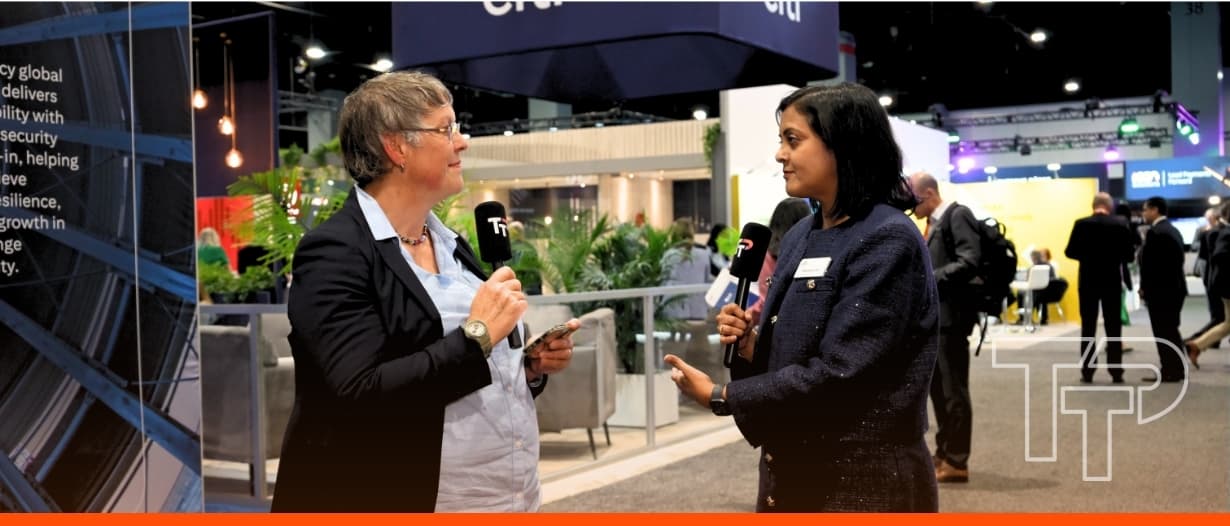
Solving trade’s data problem with AI: In conversation with Mariya George
Trade Treasury Payments (TTP) Editor Deepesh Patel caught up with Mariya George, CEO and co-founder of Cleareye.ai, to discuss how artificial intelligence is reshaping trade finance and why solving the sector’s underlying data challenges remains the true prerequisite for meaningful digital transformation.
Banks across markets often describe themselves as drowning in paper, red flags, and manual checks. George argued that the greatest misconception is assuming that AI alone can instantly resolve this. She said, “Some banks make the assumption that AI is the magic sauce and things just happen. It takes time, training, and change management. Trade finance is extremely paper-driven, and people have been doing it the same way for decades. You need patience to introduce that change.”
Rather than focusing on product features, George sees Cleareye’s mission as addressing the fundamental issue preventing automation from scaling: unstructured, inconsistent, and incomplete data. She said, “Trade finance is still operating in yesterday’s rules in tomorrow’s world. We start by converting unstructured data into structured data. If we solve the data problem, then compliance checks, TBML checks, sanctions screening, and everything else becomes possible.”
The company’s collaboration with UAE-headquartered Rakbank demonstrates how this plays out in practice. In 2024, the Central Bank of the UAE issued new guidance requiring financial institutions to show proof of compliance in trade-based money laundering. Cleareye worked with the bank to enhance its capabilities across an array of activitie including vessel tracking, sanctions-related routing, ship-to-ship transfers, adverse media screening, fair-price checks, duplicate invoice detection, and exposure monitoring.
But even as the technology becomes more sophisticated, George stressed that humans remain at the centre of the decision-making process. She said, “It’s not end-to-end. The tool makes recommendations, but the decisions are made by humans. No bank wants a tool to say, ‘I made this decision for you.’”
Large language models are now augmenting these workflows, and in the process they are transforming letter of credit (LC) conditions into human-readable instructions, auto-checking documents against those rules, and reviewing guarantee and standby LC clauses that typically require paralegal expertise. “We want to make the job easier,” George added.
As with many digital transformation projects, it is change management, not technology, that continues to be the barrier to adoption. Banks must map their current processes, redesign workflows, and ensure the technology reduces workload rather than adding new layers. George noted that Cleareye spends the first months post-implementation working closely with clients to embed new operating models and ensure that they actually experience efficiency gains.
Interoperability was another central theme in the conversation and indeed over the course of 2025 as well. With new global standards coming to the fore (from MLETR-aligned digital documents to ICC DSI datasets and broader identity frameworks) Cleareye is preparing its systems for a more standardised future, even as reality remains fragmented. George said, “It would be amazing if all banks agreed on the same 200 data elements. The reality is different. Every bank has different needs, so we map to the standards but fine-tune for customers. Our common data model has become a superset.”
Looking ahead to 2026, Cleareye is expanding deeper into the MENA region where regulatory momentum is accelerating digital adoption. The firm is also targeting growth in South America and Africa and investing heavily in AI-enabled automation for guarantees, standbys, and more complex workflows using autonomous AI agents.
When asked what conviction carried her from global IT leadership into founding an AI-driven trade finance company, George pointed to the very messiness that discourages others from entering the space. She said, “Trade finance is messy because the data is messy. If we can solve that underlying problem, we can solve the trade finance problem. And I don’t think there’s a better technology than what we have today.”
In a world grappling with volatility, trade has shown itself to be remarkably resilient. As digitalisation accelerates, solving the data challenge may ultimately determine who is positioned to lead the next chapter of transformation.
Key Topics
- Trade finance digitisation
- Artificial intelligence in trade finance
- Unstructured trade data and data standardisation
- Trade based money laundering controls
- Sanctions and compliance screening
- Document examination and automation
- Guarantees and standby letters of credit
- Interoperability and digital trade standards
Key Insights
Expert Analysis
Mariya George highlights that many banks underestimate the change management required to deploy AI in trade finance. In a sector that remains heavily paper driven and dependent on human expertise, AI must be introduced gradually, with training and operational alignment. She identifies data quality as the foundational issue. Without structured data, trade based money laundering checks, sanctions screening and compliance controls cannot function effectively. Cleareye.ai focuses first on converting unstructured trade documents into structured data, enabling AI systems to support, rather than replace, human judgement. George also points to increasing regulatory pressure, particularly in the Middle East, where banks are now required to demonstrate proof of compliance. In this environment, AI becomes a tool for enhancing transparency, consistency and decision support, not for autonomous decision making.— Mariya George
Key Findings
- Trade finance remains dominated by paper based processes.
- AI adoption fails when banks assume it is a plug and play solution.
- Structured data is essential for effective compliance and risk controls.
- Regulators increasingly demand demonstrable proof of compliance.
- AI delivers the greatest value when augmenting human expertise.
- Guarantees and standby letters of credit are emerging as key AI use cases.
Implications
- Banks must approach AI as an operational transformation, not a technology add on.
- Data architecture will shape future competitiveness in trade finance.
- Regulatory pressure will accelerate demand for AI driven compliance tools.
- Standards and interoperability will become increasingly important.
- Human oversight will remain critical as AI capabilities expand.
Key Takeaways
- Mariya George argues that artificial intelligence is not a magic solution for trade finance. The real constraint lies in unstructured data and fragmented processes. By converting trade data into structured, standard aligned formats and applying AI responsibly, banks can strengthen compliance, manage risk more effectively and modernise operations while keeping human decision making at the centre.