Scaling sustainable trade finance through common standards
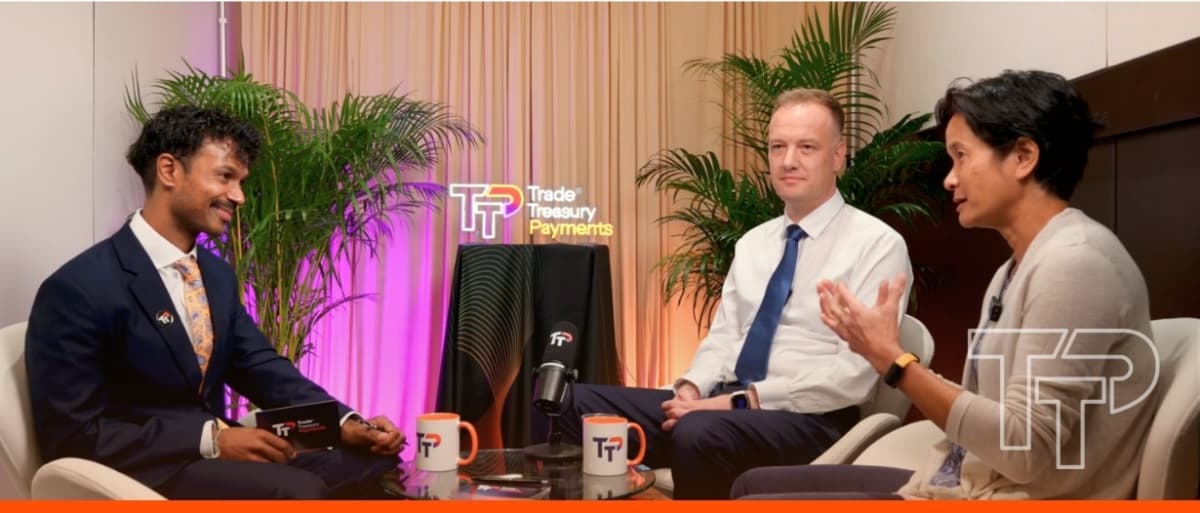
At Societe Generale’s headquarters in Paris during the International Chamber of Commerce’s (ICC) Global Banking Commission’s Annual Meeting, Trade Treasury Payments (TTP) spoke with Marie-Laure Gastellu, Global Head of Trade Services at Societe Generale, to explore the current state of sustainable trade finance and what it will take to scale it across the industry.
One of the biggest milestones along this journey over the past two years came with the release in 2025 of the ICC Principles for Sustainable Trade Finance, which have been developed in an effort to bring consistency to a long-fragmented space.
By aligning approaches across banks, the principles are beginning to create a shared foundation for how sustainability is assessed and applied in trade transactions. “There is increased standardisation, and it brings harmonisation,” Gastellu said. “This is very key in terms of market practice because so far every institution had its own practices.”
The fact that this alignment initiative comes from a globally recognised institution that has (quite literally) written the rulebook for International Commerce for more than 100 years, speaks volumes. “It brings credibility for clients,” Gastellu noted.
For banks, adopting the Principles changes how they engage with one another as much as how they serve clients. Historically, different banks have used their own methodologies and interpretations when it came to sustainability. Establishing common definitions streamlines implementation and supports interoperability across markets, particularly for smaller banks that may not have dedicated ESG teams or be less mature. “It brought the capacity to engage with other banks using a common language and also sharing best practices,” Gastellu explained, adding that now transparency also enhances credibility.”
At the same time, it is important to have momentum from corporates. “Banks have a strong voice, but banks are serving clients,” Gastellu noted. “It’s very important that all corporates are really embarking as much as banks on the journey.”
Despite this progress, however, effective implementation has been far from straightforward, and one of the most pressing challenges lies in the data. Trade finance is already known to be quite documentation-heavy, and “if you add the ESG factor, you’re increasing the number of data that you need to collect and analyse,” Gastellu said, noting scalable digital solutions would significantly ease adoption and reduce operational friction.
“Digitalisation is a key enabler to facilitate the gathering, the analysis, and the processing of this data” and is a key driver to attract and onboard clients on this journey. At the same time, fragmented systems still limit efficiency for the ecosystem as a whole. Platforms may be effective in isolation, but their ability to communicate with one another remains constrained. Gastellu described this as the “interoperability Everest” and this is true beyond ESG for the overall trade digitalization challenge.
What becomes clear at this stage is that defining sustainable trade finance is only part of the battle. The more difficult task now lies in embedding it into the actual processes themselves across the entire ecosystem.
And while sustainable finance frameworks in other asset classes, like loans or capital markets, have provided a useful starting point, they cannot simply be applied as-is. “Trade finance is a different animal,” Gastellu said. “It is off-balance sheet, high volume, small tickets… there is an operational dimension which is very different and that must be taken into account to fit the speed, scale, and complexity of trade transactions”.
Over time, what may initially appear complex will become embedded as common practice. “We are just at the start of the journey,” she said. “But progressively, it will become a common language that everybody will understand and use.”
For an industry that underpins global trade, the stakes are high. As geopolitical tensions rise and supply chains continue to shift, trade finance will be as critical of an enabler of global trade and economic development as it has always been. Trade has proven to be resilient over the years, whatever the economic and geopolitical conditions, and trade finance provides a whole set of rules and instruments to allow for it. The challenge now is to ensure that sustainability frameworks, supported by common standards and a coordinated effort across the ecosystem, will scale up alongside it.
“We are not at the end of the journey,” Gastellu concluded. “There is still a lot to do to bring trade finance to be more efficient, more standardized, more digitalized, including on ESG aspects.”
Key Topics
- A common framework is taking hold
- Trust has improved
- Focus has moved to delivery
- Trade finance needs its own approach
- Digital progress is essential
Expert Analysis
Sustainable trade finance has reached an important point. The foundations are in place, and the industry has a clearer sense of direction. What stands out now is the gap between intention and execution. Trade finance is already complex, and adding sustainability into the mix brings additional layers of data, judgement, and coordination. Progress will depend on how quickly the industry can simplify processes without losing rigour. Digital infrastructure will play a central role, but it is only part of the answer. Real momentum will come from collective effort, where banks, corporates, and industry bodies move forward together and turn shared principles into everyday practice.— Marie-Laure Gastellu
Key Findings
- Greater alignment is improving how sustainable trade finance is delivered in practice.
- Complexity remains a barrier, particularly for smaller institutions.
- ESG requirements are increasing the volume and depth of data needed for each transaction.
- Systems are not yet fully connected, limiting efficiency across the trade lifecycle.
- Corporate demand is growing, but not yet strong enough to drive full scale adoption.
Implications
- The direction is clear, but the work is far from done.
- Standardisation has laid the groundwork, yet implementation brings new pressures.
- Banks need to adapt processes and invest in digital capabilities, while corporates must play a more active role in driving demand.
- Without wider engagement and better infrastructure, progress will remain uneven.
- Regions that are further ahead will continue to shape expectations in global trade, influencing how quickly others move.