
Cooperation in a fragmented world
Geopolitical fragmentation intensifies, and global trade flows face uncertainty. Trade, treasury, and payments systems are becoming increasingly important. In this uncertain economic environment, industry coordination and international collaboration are becoming crucial to navigating global economic challenges.
Despite economic fragmentation, government bodies such as the International Chamber of Commerce (ICC) play an important role in fostering a shift toward new collaborative policies across countries and expanding trade partnerships to enhance healthy trade beyond geopolitical tensions.
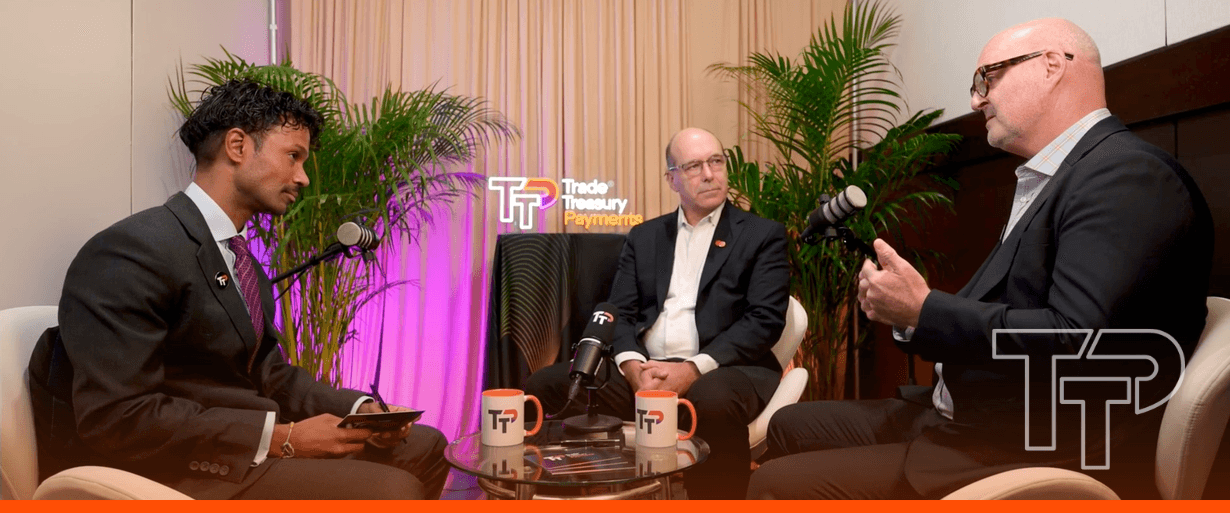
To help us learn more about this, Deepesh Patel, Editor-in-Chief at Trade Treasury Payments (TTP), spoke with Marilyn Blattner-Hoyle, Vice Chair of the International Chamber of Commerce Banking Commission and Head of Public Sector Solutions at Swiss Re, on the sidelines of the ICC Banking Commission meeting in Paris to explore how cross-border collaboration is essential for sustaining international trade and financial stability.
A dual reality
“Fragmentation is on the rise — that’s a reality. At the same time, cooperation is in many ways on the rise,” Blattner-Hoyle said, emphasising the increasing fragmentation of the global economy.
During the ICC’s meeting in Paris, the discussion mainly focused on policy standards and interoperability among nations while ensuring national priorities. Institutions such as the ICC play a vital role in connecting stakeholders across borders within this economic environment. The dual dynamic between fragmentation and cooperation requires a pragmatic approach.
Blattner-Hoyle also pointed out that the European Union is a strong example of how multilateral, rule-based systems can support global trade and promote peace among trade partners. Its regulatory framework demonstrates the optimal outlook for regionalised systems that foster trade finance mobility and avoid trade barriers, and could serve as a role model for expanding this model to other parts of the world.
Why the shared standard remains essential in the increasingly regionalised market.
In global trade, fragmentation creates “walls” across markets, but standards, if developed intentionally, can act as a common language between trade partners.
With an increasingly regionalised trade system, the need for common standards becomes even more essential. “Walls create friction, which increases costs,” Blattner-Hoyle said. “In the perfect world, one would see open trade connections. It drives GDP. It drives growth,” she further explained. The importance of common standards has not diminished. Organisations such as the ICC and other banking commissions worldwide are responsible for establishing a “playbook” for global trade and finance. The role of an organisation like the ICC is to communicate messages from the private to the public sectors to reduce the difficulties arising from these frictions.
Data initiatives, such as the ICC Trade Register, are one of the key areas that promote international trade. Enabling transparency and access to information will improve risk assessment, which is relevant to solving these structural challenges and ultimately closing the $2.5 trillion gap in global trade finance.
Similarly, in the insurance sector, the “protection gap” represents a challenge; closing the gap requires weather and other data for risk prevention and pre-arranged disaster risk financing to prepare for natural catastrophes and other insurable shocks. These challenges demonstrate how data and collaborative frameworks are essential for the efficient mobilisation of capital.
Future-proofing trade and treasury systems
Throughout the discussion, Blattner-Hoyle highlighted some key initiatives that drive sustainable global collaboration. One of which is public-private cooperation. “Public-private partnership is all about governments, multilaterals and humanitarian organisations bringing their capacity… but then the private sector is here to create exponential benefit,” Blattner-Hoyle said.
Governments and multilateral institutions are responsible for bridging policy frameworks. In parallel, the private sector is responsible for contributing capital and innovation. To remain at the heart of global trade, Blattner-Hoyle explained how a government body like the ICC must become a key enabler of this collaboration through the 2 P’s: Prioritisation and Pragmatism.
“There are many challenges around the world, and we need to pick the challenges where we can have an impact,” Blattner-Hoyle said. At the international scale, by aligning incentives with national priorities and government bodies, entities such as the Banking Commission can continue to reduce friction and enhance economic stability in global trade and payments systems. Ensuring alignment of regional trade standards and finding common ground among diverse economic priorities can ultimately enhance global economic welfare.
Key Topics
- Global economic fragmentation and rising friction in trade and capital flows.
- The role of the ICC Banking Commission in setting standards and enabling cooperation.
- Public private collaboration as a driver of trade finance solutions.
- The importance of data, interoperability and shared frameworks such as the trade register.
- European Union influence in supporting stability, regulation and cross border capital mobility.
Expert Analysis
The discussion reinforces a consistent theme across global trade and treasury systems. While fragmentation is increasing, structured cooperation remains the stabilising force that enables markets to function efficiently. As highlighted in the dialogue, “walls obviously create friction, which increase costs” and this friction ultimately limits the efficiency of trade, capital movement and risk distribution. The emphasis on interoperability, shared data frameworks and public private collaboration signals a practical direction of travel rather than a purely theoretical one. In this context, institutions such as the ICC Banking Commission act as essential connectors, aligning policy intent with market execution while ensuring that global trade remains operationally viable.
Key Findings
- Friction created by economic and regulatory barriers directly increases costs in trade and payment systems
- The trade finance gap remains significant at around two trillion, indicating persistent unmet demand in global trade support
- The protection gap in risk coverage continues to grow, particularly in relation to natural disasters and sovereign funding pressures
- Standardisation and shared rulebooks are essential to sustaining global trade connectivity in a regionalising world
- Prevention, data clarity and risk understanding are foundational to improving capital allocation outcomes
Implications
- Increased fragmentation reinforces the need for stronger standards to reduce friction in cross border payments and trade finance flows.
- Institutions like the ICC become more critical as convening platforms for aligning regulatory and market practices.
- Trade treasury systems will need to prioritise interoperability to support seamless capital movement across jurisdictions.
- The scale of the trade finance gap highlights ongoing structural inefficiencies that require coordinated financial and policy intervention.
- Capital mobilisation will increasingly depend on collaboration between governments, multilaterals and private financial institutions.