




ICC DSI 2.0: Progress update and future strategy for data, standards, and legal
By: Scott Sanchon, Trade Treasury Payments
Five years ago, the International Chamber of Commerce (ICC) launched its Digital Standards initiative (DSI) with an ambition to make digital trade documents legally valid and interoperable with the world’s financial infrastructure. The global supply chain in the modern world is now more open to digital systems, but there is still a trust gap in these transactions.
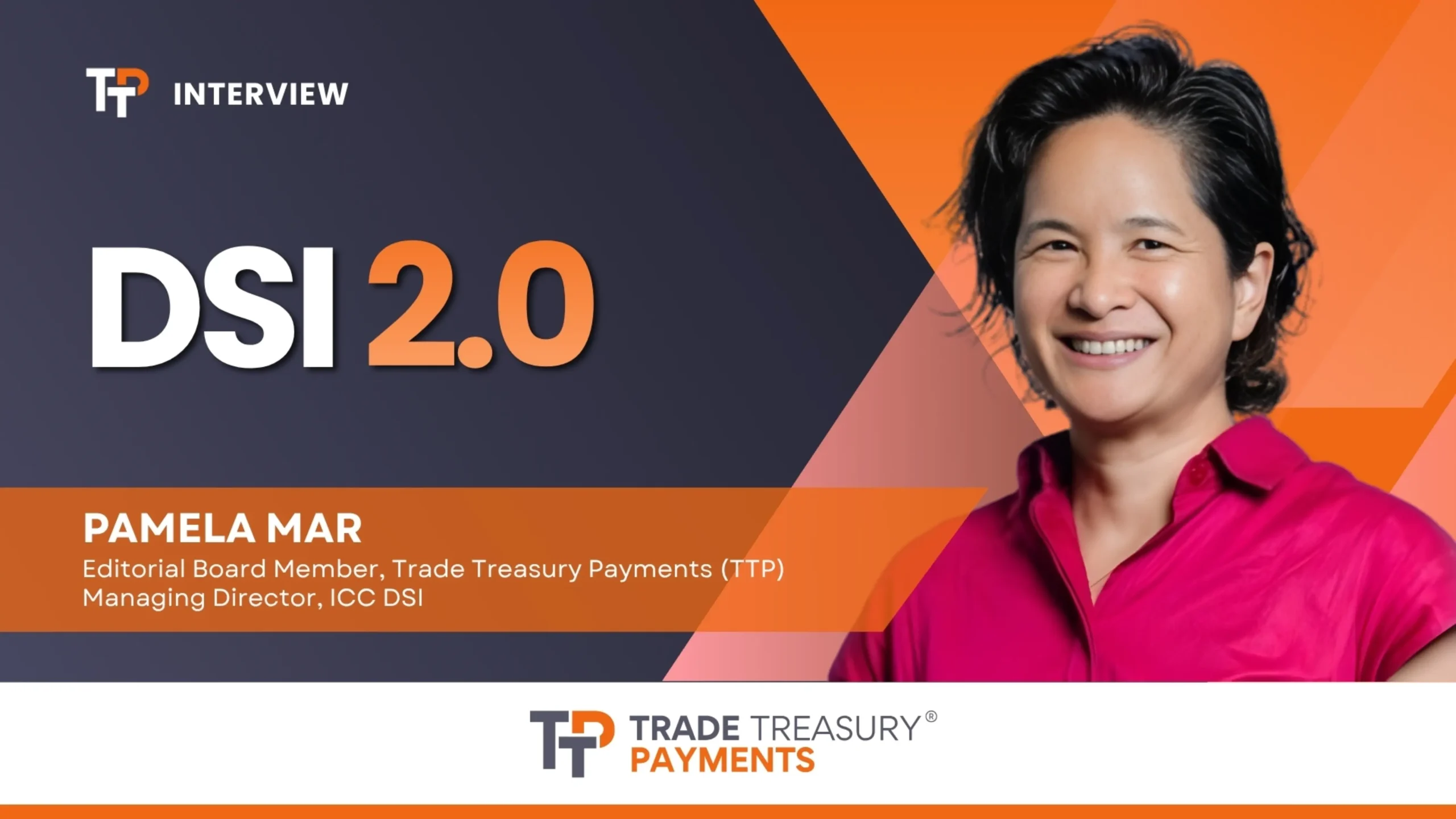
To help us learn more about this, Deepesh Patel, Editor in Chief at Trade Treasury Payments (TTP), sat down with Pamela Mar, Managing Director of the ICC DSI at the ICC Banking Commission Conference in Paris.
Digital trade adoption and the legal reform
“Our goal is to make it digital by default, so that any trade transaction along the supply chain can be turned into data, automated, sped up, and simplified,” said Mar.
On the legal front, the initiative had made progress, with more than 60% of global exports now coming from countries that have committed to align with the Model Law on Electronic Transferable Records (MLETR).
The market is also demonstrating strong momentum as common trade practices move towards digital infrastructure. Emerging markets such as Africa, Latin America, and Southeast Asia are adopting new trade policies and infrastructure.
“My ambition and my expectation is that by, say, 2028 to 2029, 80 to 90 per cent of global trade will be conducted under the MELTR-aligned legal framework,” Mar said. “Today I don’t think the industry actually doubts that it’s possible, it’s just a question of going to do it.”
The gap and a massive step forward
One of the key challenges of pulling back the digital system is whether interoperability is even achievable.
In 2026, DSI’s core strategy is to connect individual businesses’ ERP systems, productivity tools and IT infrastructure, which are the backbone of how large companies manage their operations, into the broader trade ecosystems. “We want any company to be able to generate globally interoperable trade documents,” said Mar.
DSI has developed a data-mapping framework that enables information to flow across the supply chain. The next step is getting ERP providers, such as Microsoft and SAP, who have the know-how to generate corporate data, to get on board with the standard. Positively, most of the ERP providers already follow bodies such as ISO and GS1, which align with DSI’s framework.
“It’s not a technological frontier issue,” Mar said. “We just have to connect up the key players and show them the incentives to act.” Once onboard, another key issue is a fragmented market of digital island systems that do not speak to each other, resulting in slowing adoption across ecosystems.
Moving forward, DSI also encourages the supply chain ecosystem to be accessible and inclusive, without relying on a single platform or network. In the DSI’s ideal world, trade providers will be able to use a universal trade document file type that everyone knows how to use and is able to access without any specific software, much like a .pdf or spreadsheet file is for businesses today.
“That’s the choice we want to give to organisations,” Mar said. “You should be in control of your future. Your pace of adoption should be determined by your willingness actually to undergo the transformation required.”
Measuring success
DSI has been working with the FIT Alliance to benchmark how digital infrastructure is implemented through electronic bills of landing. According to DCSA data, adoption is approximately 12% globally, though regional variation exists, with China, at 20%, leading the change. The 85% target by 2030 appears controversial, given that the gap is quite large.
Mar said, “This is one metric. We’re also working on a financial digitalisation metric around the bill of exchange, around the digitalisation of trade finance.”
If the document is submitted into a proprietary, single-use system that does not connect with the supply chain, that is not a DSI priority. DSI, on the other hand, is working toward a trade record flow within the supply chain to enable speed, accuracy, and efficiency in closing the trade finance gap.
Get it right, and it may also help to lower barriers for small businesses to participate in international trade. To generate data to provide transparency and address sustainability challenges across the global supply chain.
“We’re hard at work, but we’re making progress.”
Key Topics
- Global legal reform and alignment with MLETR
- Standards interoperability across the supply chain
- The role of ERP and IT infrastructure providers
- Embedding trust and identity in electronic trade records
- Reducing reliance on platforms and solving digital islands
Key Insights
Expert Analysis
Pamela Mar’s reflections show a maturing digital trade landscape where legal reform and standards alignment have moved from aspiration to implementation. The remaining challenge is structural: connecting the systems that businesses already use to the wider digital trade ecosystem. Her emphasis on trust, identity and system agnosticism signals a shift away from platform dependency towards a more open, interoperable model. As she notes, “We want to solve the digital islands problem because it is not scalable.” The next five years will hinge on whether ERP and IT providers embrace their role in enabling trusted, interoperable trade records at source.
Key Findings
- Legal reform is no longer the bottleneck; global alignment is well underway.
- Standards interoperability is technically feasible and progressing through DSI frameworks.
- ERP and IT providers hold the key to generating trusted, interoperable digital records.
- Verifiable credentials offer a practical route to embedding trust and identity.
- A platform only model is not scalable and limits adoption across supply chains.
Implications
- Trade digitalisation will accelerate as legal certainty increases.
- Interoperability will reduce fragmentation.
- ERP engagement will determine the pace of adoption.
- Trusted records will reduce reliance on platforms.
- Solving digital islands unlocks inclusivity and SME participation.
Key Takeaways
- Digital trade is moving from theory to practice, driven by legal reform and standards alignment.
- The next breakthrough depends on integrating ERP and IT infrastructure providers.
- Embedding trust in the record itself enables system agnostic exchange.
- Reducing platform dependency will unlock scale and inclusivity.
- The industry now has a clear path to a harmonised, interoperable digital trade ecosystem.