








Afreximbank has argued for a decade that factoring in Africa needs stronger laws to grow, a case it has been making publicly since 2017. The bank is headquartered in Cairo, and Egypt is the market it points to.
Background
In April 2024 the bank said seven countries had adopted the model law. It set out rules for transferring receivables, deciding priority between competing claims, addressing contractual restrictions on assignment and requiring the debtor, once notified, to pay the factor. In April 2024, Awani, by then an executive vice president, said seven countries had adopted it.
Afreximbank has cited Egypt as an example since 2020. It says Egypt’s 2018 factoring law used the Afreximbank model law as a guide, and that this contributed to the growth that followed. Doaa Hafez, who runs Egypt Factors and sits on FCI’s executive committee, describes the relationship differently, saying Egypt built its framework in dialogue with the push for model factoring laws led by Afreximbank and FCI.
The market the law arrived in was small. Figures from Egypt’s Financial Regulatory Authority (FRA) put 2017 discounted paper at EGP 8.9bn, handled by eight companies for 304 clients.
One law was only the beginning
Law 176 of 2018 gave factoring and financial leasing a single statutory home. Hafez said it gave sellers, debtors, financiers and investors confidence that a receivable could be transferred and enforced. She said bringing the two products under one law also drew leasing companies into factoring. By 2025 the FRA counted 41 licences.
More rules followed. The FRA addressed eligible receivables, notification and credit insurance in 2018, recognised Shariah-compliant factoring in 2019 and revised insurance requirements in 2021.
From 2022, the rules went digital. A fintech law and subsequent regulations allowed electronic contracts, digital identity checks, and technology-based factoring companies. In 2025 the FRA allowed factors to lend in foreign currency and licensed Egypt’s first digital factor, Oliv Finance.
Decision 51 of 2026 tackled double financing: the same invoice being financed twice. A factor must now check an invoice against previous financing records through an FRA electronic system linked to the Ministry of Finance and the Egyptian Tax Authority. Once financed, the invoice is frozen in the factor’s favour and the security interest registered in the Movable Collateral Registry. A second phase, covering the cycle through to settlement, is not yet live.
“For years, double financing was the risk everyone quietly priced in,” Hafez said. “This is the FRA taking that risk off the table structurally rather than asking us to manage it contractually.”
The growth figures need deflating before they mean anything
The FRA reported factored receivables of EGP 132.2bn in 2025, against EGP 74.6bn in 2024, an increase of 77.3 per cent. Adjusted for inflation, the increase is still more than 50 per cent. Hafez said the currency effect had mostly played out in 2023 and 2024, when the pound was floated. In euros, FCI’s figures show an increase of 71 per cent.
Why it grew is harder to establish. Afreximbank attributes the expansion to the regulatory programme. But the central bank also cut rates five times during 2025, while annual urban inflation fell from 24 per cent in January to 12.3 per cent in December. The available data does not show how much each contributed.
The market remains narrow. Hafez counts 730 factoring clients in 2024 and 943 in 2025. FCI put Egypt’s 2024 turnover at €1.41bn, against €5.0bn in Morocco and €42.6bn in South Africa.
Knowledge transfer works
“I would advocate knowledge transfer rather than replication,” Hafez said of what Egypt can offer other regulators. She sees more cross-border business as the next step. A two-factor transaction needs a factor at each end, and the factor at the far end needs a legal framework that makes the assignment certain and enforceable.
By June 2026, both chambers of Nigeria’s National Assembly had passed the Factoring, Assignments and Receivables Financing Bill, which Afreximbank says it supported alongside the Nigerian Export-Import Bank. No assent had been reported by 28 September. Egypt passed its law in 2018.
Egypt: factoring since the 2018 law
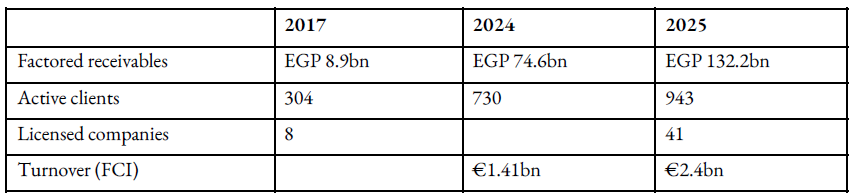
Sources: Financial Regulatory Authority; FCI. The 2017 fi gures are FRA data reported by Daily News Egypt in April 2018. The FCI turnover fi gures are euro equivalents, the 2025 one published in May 2026, and both are rounded, so a percentage worked from this table will diff er slightly from one worked from FCI’s own data. Receivables rose 77.3 per cent in 2025, and by more than 50 per cent once infl ation is taken out.