








Mexico was IDB Invest‘s pilot market, chosen in 2017 because it already had electronic invoicing and collateral rules. In May 2026 it published fi rm-level evidence on what reverse factoring did to 11,400 small Mexican companies. No other institution in these pages has published anything comparable.
Mexico had much of the infrastructure in place
Nacional Financiera, the state development bank, launched its Cadenas Productivas reverse factoring programme in September 2001. By mid-2004 it had signed up 190 large buyers and more than 70,000 small and medium-sized suppliers, according to a World Bank paper by Leora Klapper.
A national registry for security interests in movable assets, the Registro Único de Garantías Mobiliarias, opened in October 2010. The tax authority has required every business to issue electronic invoices since 2014.
IDB Invest’s submission says Mexico had electronic invoicing, factoring rules, collateral registries and a mix of banks, fintechs and specialist lenders when it chose the country as its pilot market. Romario Alves Pinto, of IDB Invest’s trade, supply chain and commodity finance team, said only six or seven of the region’s 26 countries have the basics in place: electronic invoicing, a legal base, the technology and enough scale.
Bank lending to trading firms remains thin. A 2025 study by IFC and the WTO found that Mexican banks financed 8 per cent of the country’s merchandise trade in 2023, against 21 per cent in Viet Nam and 25 per cent in West Africa. Only about a quarter of Mexico’s formal trading firms received any kind of bank loan that year. Among micro-sized traders the figure was 7.7 per cent.
IDB Invest started with large buyers
In October 2017 the Inter-American Investment Corporation, as IDB Invest was then called, opened a US$30m discount line for suppliers to car parts maker Nemak, working with E Factor Diez on the Mexican eFactor Network platform. The corporation described it as its first value chain finance transaction.
CEMEX followed in November 2018 with a 975 million peso electronic factoring line, about US$50m, which IDB Invest expected to reach around 330 small and medium-sized suppliers. In June 2019 appliance maker Mabe signed a US$50m payment service line on the same platform; IDB Invest said it would cut the average wait for payment from 120 days to 30. The submission says IDB Invest also gave eFactor technical assistance.
In August 2020, during the Covid-19 pandemic, IDB Invest approved a US$28m revolving line for suppliers to Rassini, a Mexican maker of suspension and brake components.
Mexico was IDB Invest’s pilot market for the model, according to the submission. It now runs 21 reverse factoring programmes across Latin America and the Caribbean and says it has disbursed more than US$5.8bn to suppliers since 2018, US$2.4bn of it since 2024. More than 2,300 suppliers have received financing, about 90 per cent of them MSMEs. MSMEs account for about 70 per cent of the volume. Those figures cover the whole region.
eFactor brings several banks into the same programme
eFactor Network, whose platform carried the Nemak and Mabe lines, was founded in 2009 and is based in Monterrey, two hours from the United States border. It operates PrimeRevenue’s technology under an exclusivity agreement covering Mexico, Latin America and Spain.
It has about 200 corporate buyers and more than 20,000 suppliers, 96 per cent of them SMEs, and trades about US$7bn a year, half in dollars and half in pesos. It pays suppliers in more than 35 countries. Whirlpool and Kellogg’s were among its other early anchors.
Forty banks fund the platform. A Mexican bank will lend a single company perhaps US$200m to US$250m, said Victor Manuel de la Cruz de los Santos, who runs eFactor’s relationships with financial institutions, while the largest supply chain finance programmes need a billion.
“Only one bank cannot provide the amount necessary for the full programme,” he said.
eFactor assembles the limit from several banks. It earns a fee and carries none of the risk. De la Cruz puts its share of the Mexican market at about 24 per cent, against 22 to 23 per cent for Nacional Financiera, which can only serve Mexican companies.
IFC has a stake here too. Its board approved US$5m of equity in eFactor on 11 September 2017, the month before IDB Invest opened the Nemak line, and seven years before it took a position in C2FO, the company now building the platform in Nigeria described later in these pages.
Sales rose, and mostly from new customers
On 22 May 2026 IDB Invest published The Impact of Reverse Factoring on MSMEs: Firm-level Evidence from Mexico, by Lucas Figal Garone, Victoria Luca, Rodolfo Stucchi and José Tessada.
The authors used eFactor data on 11,400 micro, small and medium-sized firms between 2021 and 2024. Because the invoices were on the same platform, they could follow firms customer by customer. They combined this with fiscal records tracking each firm’s sales and clients over time, then compared firms before and after they started using reverse factoring with similar firms that had not yet started.
They estimated that adopting reverse factoring was associated with sales about 27 per cent higher, an average of around US$191,000 a firm. The number of clients served rose by about 43 per cent, or 3.9 clients on average.
The study also separated regular users from occasional ones. Firms that used reverse factoring only now and then showed no measurable gain in sales. The authors’ June blog said the gains were stronger and more persistent among firms using it for three or more quarters.
One criticism of supply chain finance is that large buyers can use it to extend payment terms for small suppliers. The authors surveyed 700 MSMEs. In their blog, they said 84 per cent reported no change in payment terms after adopting reverse factoring, while more than 60 per cent reported lower financing costs. These were the firms’ own answers.
IDB Invest wants better data on supplier size
IDB Invest says limited information on supplier size makes it difficult to identify MSMEs within a programme and measure what happens to them. It is working with anchor buyers, fintechs and banks to improve the data they collect.
Alves Pinto said the IDB’s public-sector arm works with governments on the laws, while IDB Invest builds the market.
The authors said further research should look at what firms do with the earlier payment, including whether they use it for working capital or longer-term investment.
Mexico: reverse factoring in context
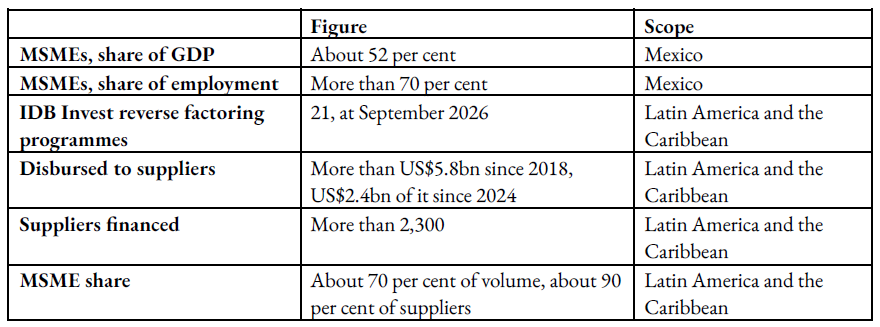
Source: IDB Invest submission, September 2026. Factoring turnover: FCI. The MSME shares of GDP and employment are IDB Invest’s own fi gures.