






ADB supported close to two years of technical assistance to build the programme. Three years in, 85 anchor buyers were on it as at 30 June 2026, and herders who once waited a season for payment are paid in hours.
Mongolian rules treat the financing as a loan
In many payables finance programmes the bank buys the supplier’s claim on the buyer. Mongolian regulation does not allow that: a receivable can be recognised as security, but it cannot be assigned, so the financing is treated as a loan. What carries the structure instead is the buyer’s confirmation, which is given before anything is advanced. Khan Bank is Mongolia’s largest bank and puts its market coverage at about 80 per cent. It began as an agricultural lender, so the herders a programme like this has to reach were already its customers and it held its own data on them. There is no central registry of financed invoices in Mongolia, and anchor-led programmes of this kind do not generally need one.
Digital reach mattered too. Khan Bank put mobile banking use at 85 to 90 per cent of Mongolians when the product was being designed, which is what made it practical to bring herders on, confirm invoices and pay them without a visit to a branch. Mongolian supply chains also have fewer intermediaries than larger markets such as India, which made a direct link between herder, buyer and bank easier to build.
ADB’s experts worked with Khan Bank for close to two years
The idea reached Khan Bank at the start of the pandemic, when Enkh-Ireedui S., the bank’s executive vice president for business development, was running its SME business. Khan Bank then went to its own corporate clients. It studied the payment cycles of a handful of anchors it had banked for years, interviewed their suppliers about how long they waited to be paid, and found the answer clustered around 45 days.
ADB’s contribution was technical assistance, covering market assessment and regulatory engagement as well as the product itself. It hired supply chain finance experts who worked with Khan Bank intensively for close to two years on strategy, policies, transaction structure and system design. With the risk team they set up onboarding criteria, risk review, limit management and disbursement, trained the sales, risk and processing teams in their separate roles, and joined client origination calls. The assistance ended with a train-the-trainer programme. The bank’s own IT team built the system from that advice.
Scoping the market also meant scoping its regulation. ADB held policy discussions with the Bank of Mongolia and the Financial Regulatory Commission, and on 7 June 2023 it ran a workshop on supply chain finance with the Bank of Mongolia, supported by Khan Bank.
The price is set at the collection centre
A herder’s income follows the seasons. There is a season for meat, one for cashmere and one for milk, and a herder who sells cashmere can go without income for the rest of the year. The programme is meant to get herders paid sooner, so it is built around the point at which their goods are valued: the collection centre.
In the cashmere season the fibre goes to a centre owned by the buyer, where it is sorted, weighed and checked for quality, and its grade sets its value. The centre’s system is connected to Khan Bank’s, so when the invoice is finalised it goes to both the buyer and the bank.
The buyer’s staff then confirm what has been received and the amount due. Khan Bank advances up to 90 per cent of the invoice while the herder is still standing at the collection centre, and pays the balance when the buyer settles on the due date. Financing at the centre puts the money where the goods are priced, which takes out both the journey to a branch and the wait that used to follow it.
Suppliers see it through an app the bank built itself, using the same credentials as their online banking. Payment arrives within two to three business hours of the buyer accepting, and often faster. The process was manual at first and ran through one specialist. It is now automated end to end.
Khan Bank holds the relationship with both the herder and the buyer, which is what lets it finance the invoice at the moment the buyer confirms it. Reaching suppliers this directly, in a country where many of them are a long way from a branch, is the part that is usually hardest to put in place.
The anchors are mostly agricultural, and one invoice has gone bad
The anchors were chosen with the countryside in mind. Most are in agriculture, and meat processors are the largest group, followed by firms handling wool and cashmere. It began as a pilot, with two transactions in its first year, and has grown every year since. Eighty-five anchor buyers are now on it. One invoice in the programme’s life has become non-performing.
The telling figure is how often anchors come back. Anchors that started with limits of around US$560,000 now draw on them repeatedly. The bank’s largest user by value ran 124 transactions across 11 suppliers in two years, turning its limit over more than seven times. One retail anchor with a limit of US$84,000 has drawn almost twenty-eight times. Khan Bank’s own summary notes that the average invoice has got smaller while the number of small invoices has grown.
Enkh-Ireedui also credits it with changing the shape of the bank. Khan Bank’s lending was 60 per cent consumer before the programme. It is now 57 per cent business.
Risk sharing is the step ADB is exploring next
ADB’s work was mostly design, with Khan Bank carrying out the implementation, and ADB then gave the bank a year or two to build volume. ADB is now exploring a risk sharing facility, which would spread some of the exposure beyond Khan Bank’s balance sheet and let the programme grow without the bank’s own capital setting the ceiling.
The law may catch up. He said the Financial Regulatory Commission is working aspects of factoring into a new banking law, and that Khan Bank has been feeding back to it and to the Bank of Mongolia on what needs changing. “We were the first one to test it on the market,” he said.
Mongolia: Khan Bank’s supply chain finance

Source: Khan Bank, September 2026. Financing is denominated in dollars. The last column is the year to 9 September 2026 and is not a full year. One invoice in the programme’s life has become non-performing.
Mongolia: the programme
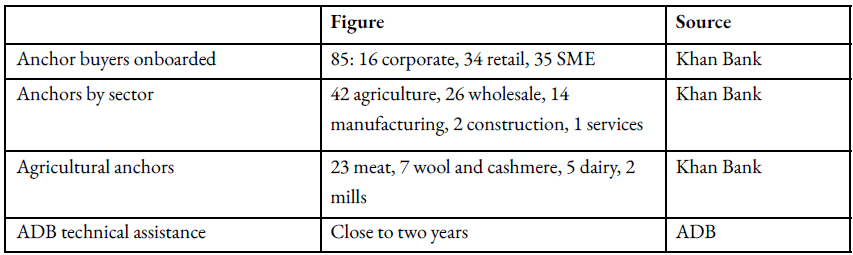
Source: Khan Bank’s case study presentation, supplied September 2026, and ADB. Suppliers fi nanced is not reported: the deck gives supplier counts only within its largest anchors, so there is no total to publish.