







The Bank’s Legal Transition Team worked with the National Bank of Ukraine for six months before producing the text. The law took effect on 30 July 2026, although the required register has yet to be established.
Background
Before the reform, a factor in Ukraine had no reliable way to check whether a receivable had already been assigned, said Serhiy Savchuk, director of the department of methodology for non-banking financial institutions at the National Bank of Ukraine. Where two financiers claimed the same receivable, the priority rules were not clear enough to say whose claim came first.
Anti-assignment clauses in commercial contracts could stop an otherwise valid receivable from being financed. Ukraine had no single legal framework for receivables finance, with provisions spread across the civil code and general financial services legislation.
There was a problem with the word factoring, too. For years, banks sold overdue consumer loan books to collection companies and called it factoring.
“It had some bad influence on the reputation of these products,” said Andrii Babchinsky, head of structured and trade finance at the State Savings Bank of Ukraine (Oschadbank).
As a result, Savchuk said, factoring became associated with debt collection, and classical trade factoring stayed underdeveloped.
Until 2024, the National Bank’s statistics did not separate the two, so nobody could tell how much of the market was trade finance.
Five years before the law
The market drove the push for reform. Babchinsky, who has spent more than twenty years in trade finance, recalls five or six years of meetings with the National Bank and the finance and economy ministries, with the Ukrainian Alliance of Trade Finance and Factoring leading the effort.
“It was a long journey,” he said.
Babchinsky said EBRD‘s Legal Transition Team wrote the first draft with a Ukrainian law firm. Savchuk said the National Bank then significantly revised and improved it. He described the UNIDROIT Model Law on Factoring as an important reference point, and Milot Ahma, who leads the EBRD team, reviewed the draft alongside local and international consultants.
The team worked with the National Bank for about six months before a first draft circulated in April 2024. Industry consultation and parliamentary scrutiny took another fourteen months, and Babchinsky described the final law as a compromise. It was adopted on 3 June 2025 and took effect on 30 July 2026.
The law does four things. It sets out the rights and obligations of factor, client and debtor. It covers future and existing claims, opening the way for revolving and portfolio financing. It makes contract terms that ban or restrict assignment ineffective. And it creates a register that settles priority: first registered, first in line.
It leaves the capital treatment of receivables unchanged, Savchuk said.
There will also be an electronic system for exchanging documents and a national platform where financiers compete for receivables. Receivables from public procurement contracts must go through it.
Providers more than halved while volumes rose
The number of non-bank companies licensed to provide factoring fell from 522 in the first quarter of 2023 to 211 in the second quarter of 2026, a drop of almost 60 per cent. Volumes dipped and then recovered: factoring contracts were worth about US$1.84bn in 2023, US$1.45bn in 2024 and roughly US$2bn in 2025.
Savchuk reads it as consolidation: the more prudent companies stayed, and business from insolvent firms moved to other providers.
Since 2024, the National Bank has reported classical factoring, the financing of accounts receivable, separately from other factoring, mostly claims on bad loans.
Classical factoring rose from US$469m in 2024 to US$681m in 2025, an increase of 45 per cent against 37 per cent for the market as a whole. Other factoring reached US$1.31bn. Savchuk said classical factoring is becoming a more significant part of the market, although other factoring still accounts for the largest share.
Factoring by banks, reported separately, lost about half its volume in 2022, Babchinsky said, and has grown steadily since: the banking sector’s portfolio rose from about US$97m at the end of 2023 to roughly US$144m by March 2026.
Implementation is the harder part
The law is in place. Making it work will be harder, Savchuk said.
The National Bank has adopted the secondary regulation, but it still needs technical rules for the new systems. Banks and non-bank lenders must adapt their products, connect to the new infrastructure, and train staff and clients.
EBRD says it is overseeing implementation. Its Trade Facilitation Programme ran factoring training in Ukraine in 2024, and Babchinsky said seminars supported by EBRD and FCI now focus mainly on international factoring.
The register is not yet in place. Babchinsky expects it to take up to half a year, and says the law’s effect so far has mostly been on the product’s reputation. EBRD’s submission says IFC is building the registry the law depends on, along with a digital marketplace, and IFC is contributing on Ukrainian factoring reform and a receivables platform.
Savchuk said it was too early to draw conclusions from the statistics. Babchinsky said a month’s figures would not show much, “especially if you will recall the situation in Ukraine right now, when a lot of goods are damaged every day and every hour”.
Savchuk measures success by whether Ukrainian companies can turn their receivables into an accessible and competitively priced source of working capital.
The law leaves export factoring largely untouched. Babchinsky said it was at zero before the reform and remains there, because currency rules make cross-border factoring difficult. Changing them is next on the industry’s list.
It is that reform, he said, that he is now waiting for more keenly than he waited for this one.
Ukraine: factoring around the 2025 law
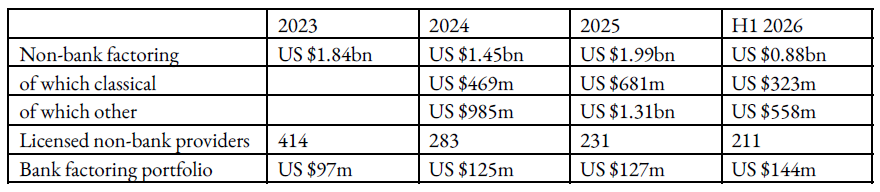
Source: National Bank of Ukraine, series supplied by EBRD. Converted from hryvnia at the offi cial rate on the last day of each period. Classical factoring fi nances accounts receivable; other factoring assigns claims, mostly on bad debt. The two were reported together before 2024. Provider numbers and the bank portfolio are end-of-period, and the bank fi gure in the last column is March 2026. The provider count peaked at 522 in the fi rst quarter of 2023. The law was adopted on 3 June 2025 and took eff ect on 30 July 2026.