






The African Development Bank (AfDB) is not a signatory to the 2024 Joint Statement because at that time it did not have and has no factoring or supply chain finance product of its own. It funded factoring training across Africa through Afreximbank, while its much larger trade finance business provides liquidity and risk cover to banks and commodity aggregators. It is now considering a supply chain finance instrument, which it says would bring it into line with its peers.
Background
AfDB’s involvement began in 2018, when it gave Afreximbank a grant of US$500,000 from its Fund for African Private Sector Assistance to promote factoring in Africa. Afreximbank added US$450,000 of its own. Implementation began in January 2021, with FCI delivering the training and technical assistance alongside the two banks.
The grant bought training, not finance
The combined grant supported 16 banks and factoring companies and four regulators and industry bodies. Sixty-eight professionals received technical assistance covering product development, risk management, operations and market readiness.
The grant also paid for an e-learning platform on factoring, used by 352 participants across Africa, and FCI certificate courses for 60 professionals. Six regional conferences and four webinars drew more than 820 conference participants and 1,440 webinar attendees.
AfDB counts seven factoring laws among the results
The grant completion report states that advocacy and capacity building under the grant contributed to seven countries adopting dedicated factoring laws between 2022 and 2023: Benin, Burkina Faso, Côte d’Ivoire, Mali, Niger, Togo and the Republic of Congo.
Six of the seven are members of the West African monetary union and legislated by adopting the uniform factoring law of the Central Bank of West African States (BCEAO).
“By strengthening institutional capacity, promoting regulatory reforms, and raising awareness about factoring, the AfDB grant has contributed to laying the foundations for a stronger supply chain finance ecosystem in Africa. Hopefully, this will serve as an impetus for AfDB to introduce its own supply chain finance instrument in the near future,” said Lamin Drammeh, head of trade finance at the African Development Bank.
AfDB’s trade finance business is much larger
As of August 2026, AfDB had supported more than US$15.3bn of trade through its trade finance programme. That included US$4.2bn of credit lines to local banks and US$920m of soft commodity finance.
Its risk participation agreements had also supported 3,300 transactions worth US$10.2bn, 55 per cent of them for SMEs. In 2021 AfDB added a Transaction Guarantee instrument, which can cover up to the full non-payment risk for confirming banks dealing with issuing banks in Africa.
Its own research measures what is left
AfDB has published research on Africa’s trade finance shortfall since 2014. The fifth report in the series, Trade Finance Supply in Africa, came out in May 2026 and put unmet demand in Africa at between US$74bn and US$92bn in 2024. The lower figure is 5.4 per cent of the continent’s merchandise trade for the year.
Unmet demand peaked at US$120bn in 2011 and was US$81bn by 2019. AfDB says its own work alongside that of other institutions may have contributed to the decline.
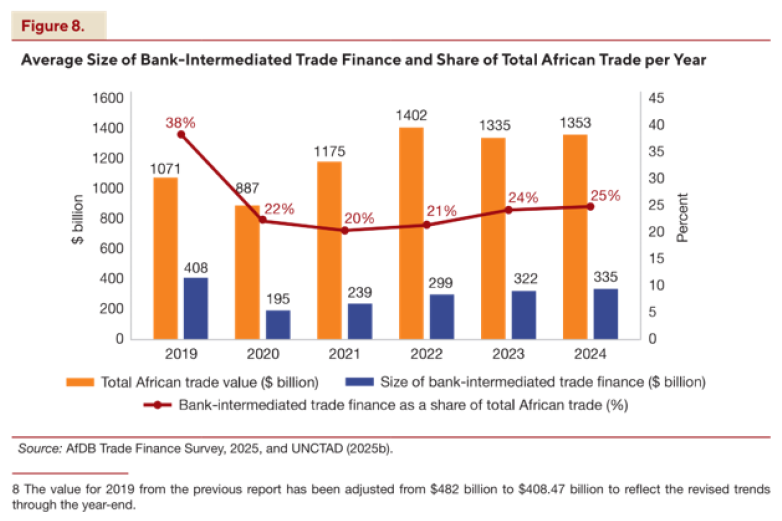
Source: African Development Bank, Trade Finance Supply in Africa, May 2026, Figure 8. Reproduced with permission.
The same report says only about a quarter of African trade is now financed by banks, down from 38 per cent in 2019, and that banks rejected 37 per cent of SME applications during the survey period. It warns that unmet demand could rise again to between US$86.6bn and US$102.6bn by 2027.
A supply chain finance product of its own may follow
In its May 2026 report, AfDB says it is “considering the introduction of a complementary supply-chain finance facility aimed at increasing access to finance for SMEs”.
If introduced, it would be AfDB’s first supply chain finance product, in a market it has spent eight years measuring and five years funding others to serve.