







In 2022, IFC and the World Trade Organization found that supply chain finance (SCF) was still in its early stages in Nigeria. Four years later, IFC is backing an SCF marketplace with C2FO, owns a stake in the company behind it, and is sharing risk on a facility taking supply chain finance into eight African markets.
Background
In October 2022, IFC and the World Trade Organization published a survey of banks in the four largest economies of the Economic Community of West African States. Trade finance supported a quarter of the four countries’ goods trade, against about 40 per cent across Africa. Unmet demand ran to about US$14bn a year, US$7bn of it in Nigeria, the largest shortfall of the four.
Supply chain finance barely registered. Fewer than half the lenders surveyed offered it, and several said they were not familiar with the product.
C2FO gives suppliers a choice
IFC is now backing an SCF platform with C2FO. Unlike a conventional programme built around one buyer and its suppliers, C2FO operates a marketplace available for the whole country. A supplier can select early payment by engaging with the buyer and accessing SCF.
“We want to be dial tone for working capital,” said Sandy Kemper, who founded the company. About US$3tn of approved payables sits on the platform, matched against the receivables they will settle.
Once a supplier joins the network, it can see what it is owed by every customer it has on the platform, not only the buyer that brought it there, and choose which invoices to accelerate. “That doesn’t exist in supply chain land,” Kemper said.
His argument for development bank involvement is that the model can reach companies in markets where bank finance is harder to come by without requiring each supplier to be underwritten.
CycleFlow is bringing in Nigerian buyers
C2FO already had multinational companies on its network. What it lacked in Nigeria was domestic buyers.
That job falls to CycleFlow, which was set up to run C2FO’s platform in Africa under licence and works exclusively with it. Its anchor buyers, at various stages of integration, include MTN, IHS Towers, Flour Mills, Airtel, Unilever, Dufil and Guinness Nigeria.
“We are transferring the profile of a large company,” said Segun Ogunsanya of CycleFlow. “With that credit profile we are assigning that same profile to a smaller business, and we are able to make funding available to that smaller business at more or less the same risk profile of a large business. There are no collaterals.”
CycleFlow says Stanbic IBTC has made US$250m available for the platform. Little of it has been drawn while the buyers are being integrated. The company wants several banks bidding for receivables rather than relying on one.
It cites IFC research that every US$1m advanced early to an MSME supports about 14 or 15 jobs.
Beyond Nigeria, it is looking at Ghana, Kenya and Cameroon.
IFC supports C2FO’s expansion in emerging markets
IFC’s involvement is not limited to the Nigerian project. In April 2025, it invested in a US$30m funding round alongside C2FO’s existing shareholders. C2FO said IFC’s funding would support expansion into emerging markets and a nationwide working capital platform in Africa, starting in Nigeria. Kemper describes IFC’s holding as a small equity position.
IFC also provides financing and guarantees intended to reduce the cost of capital in Africa. IFC says the Nigerian platform could eventually carry US$25bn to US$30bn of financing a year. IFC put the entire bank-intermediated trade finance market in Nigeria at US$21bn in 2021.
The US$25bn to US$30bn figure is a projection. Kemper goes further, estimating that 20 to 30 per cent of Nigeria’s economy could eventually be represented on the platform.
In June 2026, IFC co-hosted a supply chain finance workshop in Nigeria with IBRD and the Development Bank of Nigeria. Fifty-five people attended, including Nigerian banks and corporates, the Central Bank of Nigeria, and two platform operators, C2FO and Fiducia.
IFC supports private-sector banks investing in supply chains across Africa
Nigeria is also one of eight African markets covered by a risk-sharing facility between IFC and Standard Chartered. The others are Côte d’Ivoire, Egypt, Ghana, Kenya, South Africa, Tanzania and Zambia.
The facility covers up to US$300m of supply chain finance assets across payables finance, receivables discounting and pre-shipment finance. IFC takes half the risk on every transaction it underwrites, up to a maximum of US$150m. Five countries make up the first phase, with a second phase to follow.
For Standard Chartered, the attraction is partly what happens before a transaction reaches the bank.
Underwriting transactions for a single corporate in an emerging market takes time, while the resulting business may be relatively small. “If you’re doing underwriting for one corporate in Nigeria, you’re going to the market to explore potentially US $5m to US$10m of participation from the investors given the size of the client needs,” said Nicolas Langlois, managing director and global head of trade distribution at Standard Chartered Bank, “because of the requirement size for the majority of clients, every time there is a new corporate to support, you have to go through the time-consuming process.”
Under the facility, IFC underwrites an agreed list of countries and clients in one exercise. Standard Chartered can then originate business against the capacity already in place.
“If the origination team knows that there is capacity, they originate into that capacity,” Langlois said.
Without it, a banker may have to work through the distribution team to test the market before promising a client anything over the available internal credit capacity to the client.
Langlois said distributing bank risk is relatively straightforward, because much of the information is public and in many cases investors have already underwritten the bank. The decision largely comes down to appetite. Assessing an individual corporate in an emerging market requires considerably more extensive underwriting work.
One facility covers three kinds of finance
Standard Chartered also wanted the facility to cover more than one product. Receivables, payables and pre-shipment finance can all be put through it.
That reflects the way the bank approaches trade finance, Langlois said: start with the client’s working capital requirement and use whichever product fits. Putting the facility together took time.
“Those programmes take some time to put in place, because you’ve got regulatory implications, you have documentation, and especially in emerging markets each regulator is a little bit different,” Langlois said. “When it’s in place, it runs almost by itself.”
Countries and corporate names can then be added without setting up a new facility each time.
A model scaled across regions
Standard Chartered and IFC have done this before. The bank has run a programmatic facility with IFC in Pakistan for over three years, including an upsize. It also had a global corporate risk-sharing facility with IFC before the pandemic, while the wider relationship dates back to a Global Trade Liquidity Programme agreement in 2009.
Africa’s SCF facility replicates Pakistan’s existing SCF initiative, which the bank says lets it move faster and add countries later.
IFC expects the arrangement to facilitate about US$1.9bn of supply chain finance transactions over three years and support more than 500 suppliers, with what it says is the potential to reach more than a million farmers indirectly.
The facility will focus on supporting suppliers in what Standard Chartered calls critical industries, including healthcare, agriculture and some manufacturing, with the mix varying by country.
“We would not be able to do it without IFC,” Langlois said.
Nigeria: IFC’s supply chain finance programme
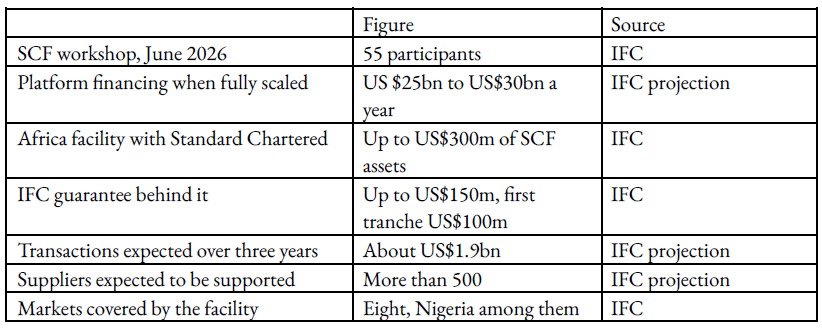
Source: IFC Supply Chain Finance Progress Report 2024 to 2026, fi led 23 September 2026. The platform is being built with C2FO; the June 2026 workshop was held with IBRD and the Development Bank of Nigeria, and the Central Bank of Nigeria attended.
Nigeria: the market IFC is building into
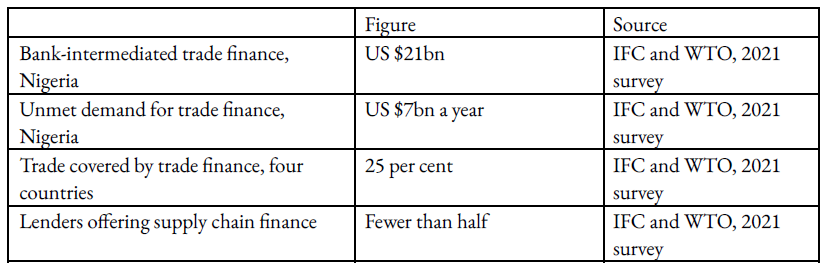
Source: Trade Finance in West Africa: A Study of Côte d’Ivoire, Ghana, Nigeria and Senegal, IFC and WTO, October 2022, from a survey conducted in 2021 and 2022. The four-country coverage fi gure compares with about 40 per cent across Africa and 60 to 80 per cent in advanced economies.