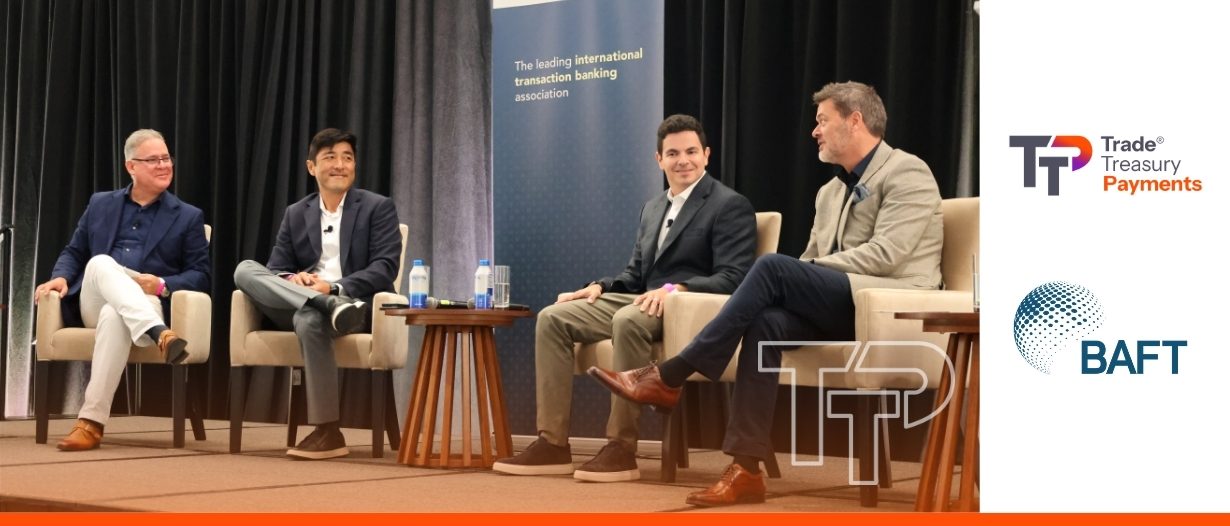

Participants at the BAFT meeting in Miami discussed how correspondent banking and cross-border payments are being remodelled, the impact of AI and resilience in the Middle East.
In the face of geopolitical instability, greater compliance pressures, accelerating digitalisation and more sophisticated cyber-attacks, transaction banks are having to navigate an increasingly complex landscape while growing their business, supporting clients and out-manoeuvring new entrants.
The recent BAFT Global Councils Forum, held on September 27 in Miami ahead of Sibos, brought together more than 150 senior leaders to discuss how the global industry is rising to the challenge, as well as share insights and best practice. Tackling the big issues such as where agentic AI will add value in transaction banking and the remaining gaps in cross-border payments, the half-day event prepared attendees for the hot topic discussions during Swift’s user conference.
With new 24/7 payment rails and emerging value forms, such as tokenised assets, the future of correspondent banking was top of the agenda. In a session about whether the existing network was fit for purpose, panellists discussed the challenges of legacy bank technology and financial market infrastructure, non-standard implementation of ISO 20022 and data requirements, and the lag in regulation compared to the fast pace of change in the market.
A straw poll found that most of the audience believed that interoperability would have the biggest impact on corresponding banking in the next three to five years, more than clearing channels, stablecoins and compliance economics.
Interoperability is often cited as a major challenge to scaling digital asset markets, due to ecosystem fragmentation, trapped liquidity and operational complexity. “Every financial institution can issue a token, but what about interoperability? Creating a solution where a token issued by Citi is accepted by Wells Fargo, for example, is not an easy feat,” said Sebastien Kucharek, Head of Global Clearing, Citi.
The opportunity to move value within the same currency or between currencies with the use of tokenised deposits also requires interoperability between digital assets and fiat, Kucharek added, to avoid burdening the customer with technical complexity. “A customer doesn’t care if we are moving money using a tokenised deposit or fiat. What really matters is whether we can do it fast, cheaply and without friction,” he said.
Visa is looking at enabling stablecoins as a source of liquidity for its clients, as well as enabling stablecoin payouts to stablecoin wallets where this is required, according to Sandeep Gupta, Head of Global Partner Network, Visa Direct. Visa has modernised its multi-country treasury operations by leveraging tokenised deposits and stablecoins. “Our treasury is using tokenised deposits with certain banks, as we pay to around 125 countries and need to position liquidity in different places,” he said.
Earlier this month, Visa announced that Inyo Global, a payments infrastructure provider, has brought Visa Direct’s stablecoin-enabled prefunding into production, making stablecoin-powered transactions available for businesses that run cross-border payments through Visa Direct.
Ainsley Ward, Vice President, Payments Consulting Services, CGI, looked at the problem of cross-border payments through a different lens. He was the technical solution designer of the Bank for International Settlements’ Nexus network, now called Nexus Global Payments, which links together domestic real-time systems and settles domestically on both sides, effectively eliminating foreign exchange risk.
“If you’re not making money move, then you don’t have a problem with moving money,” he explained. “As we go through this change in cross-border payments, which underpins all of our cross-border networks and global trade, Nexus is trying to fix the problem in a way that makes sense.”
State of play in MENA
A separate panel during the BAFT forum explored the reality on the ground for those banks operating in the Middle East and Africa (MENA) and how they are helping clients navigate supply chain challenges.
The panellists rejected overblown international news headlines of a crisis-ridden region, focusing instead on regional response to control the damage and return to business as usual.
“After an initial day of assessment, we continued to go into work almost every day because we wanted to keep all our branches open,” said Barbara Riccardi, Co-head, Wholesale Banking, Commercial Bank of Dubai (CBD). “Plus, there was an immediate response from the central bank to provide liquidity for the most affected local corporates, such as hospitality and real estate.” She added that now real estate development has now rebounded and accelerated.
Faisal Hussain, Regional Head of Financial Institutions Sales, Africa and Middle East, Transaction Services, Standard Chartered Bank, agreed that the response was quick and effective in the UAE and other Gulf Cooperation Council nations. “People have confidence in the infrastructure and security system within the UAE and the way the authorities have responded,” he added.
While the closure of the Strait of Hormuz caused an immediate disruption in supply chains, the region has remained extremely resilient, according to Hussain. “The Middle East is not just a supplier of energy or where capital needs to be invested – it is connected to the global economy,” he said.
Many corporate clients have explored changing suppliers, shipping routes, logistics providers, banking relationships, and sources of capital. Riccardi believes the current situation has accelerated an ongoing process of diversification.
As such, she doesn’t believe that reactions to the current logistical disruption will be temporary. “The changes are here to stay,” she said. “The logistical arms were mostly affected by the lack of insurance. But while costs increased and many faced delays, trade continued. Some of our clients took advantage of their strength in the market and international presence to step up and help others.”
Riccardi pointed to multinational logistics company, DP World, which supported other entities that needed to transport goods in and out of UAE, as well as leveraged its negotiating position in the market to obtain insurance coverage.
“Clients have been developing new corridors and counterparties to be more resilient when supply chain disruption happens. It is important that the financial ecosystem infrastructure is quick enough in response,” said Hussain. He reported a shift from open account to documentary trade, specifically an increase in letter of credit usage.
In a straw poll of the audience, more than half thought that MENA-Asia would be the most important trade corridor over the next five years.
Hussain emphasised the importance of intra-MENA corridors. “We’ve seen trade between Gulf countries evolve, but some countries have better access to logistics and shipments than others. The current situation has fast-tracked the need to make intra-regional trade even stronger. More regions will realise that they need to interconnect more closely to navigate future challenges.”
“South-South trade cannot be ignored,” added Riccardi. “The importance of not relying on one corridor is a lesson learned over the past few months with dramatic effect. The closure of the Strait of Hormuz was a wake-up call to the region.”