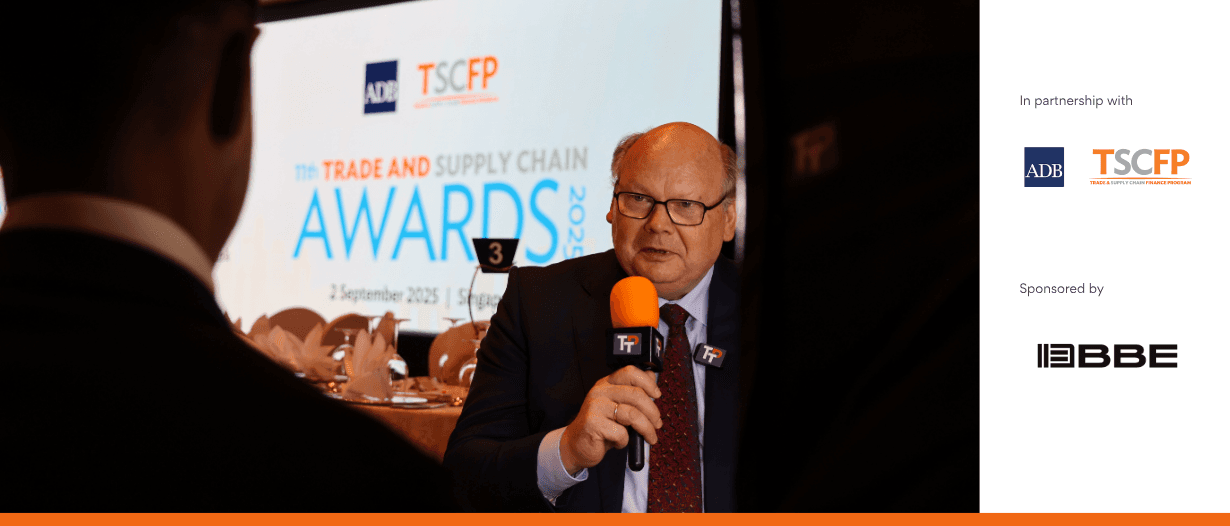


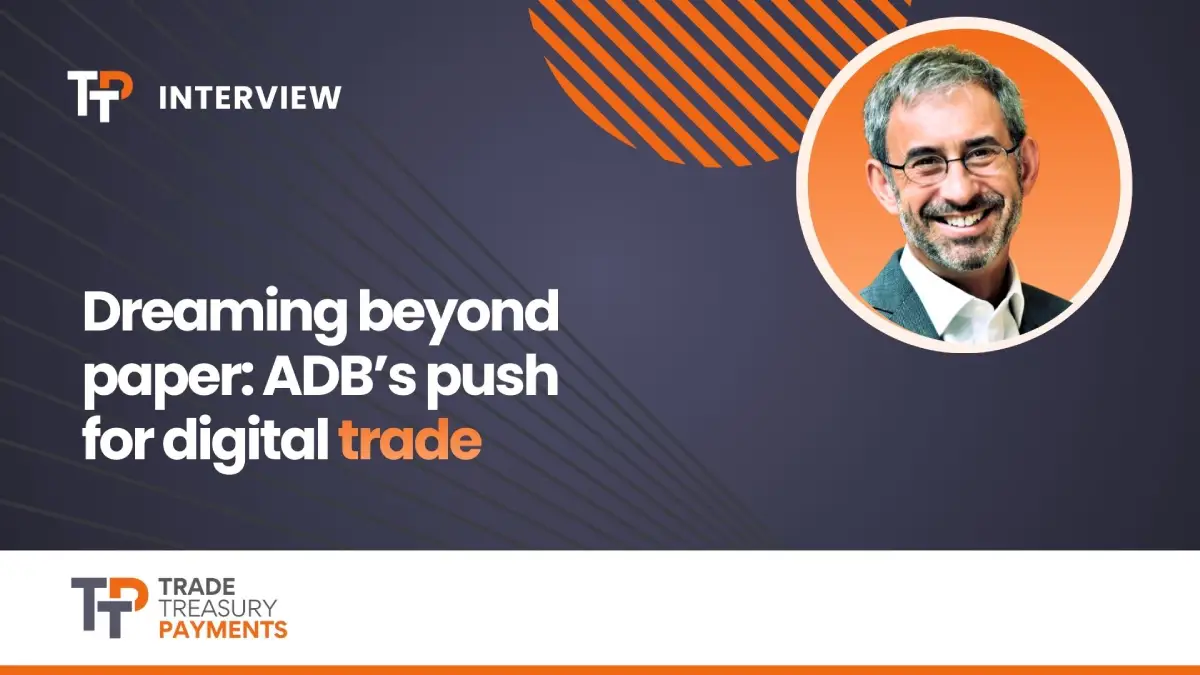
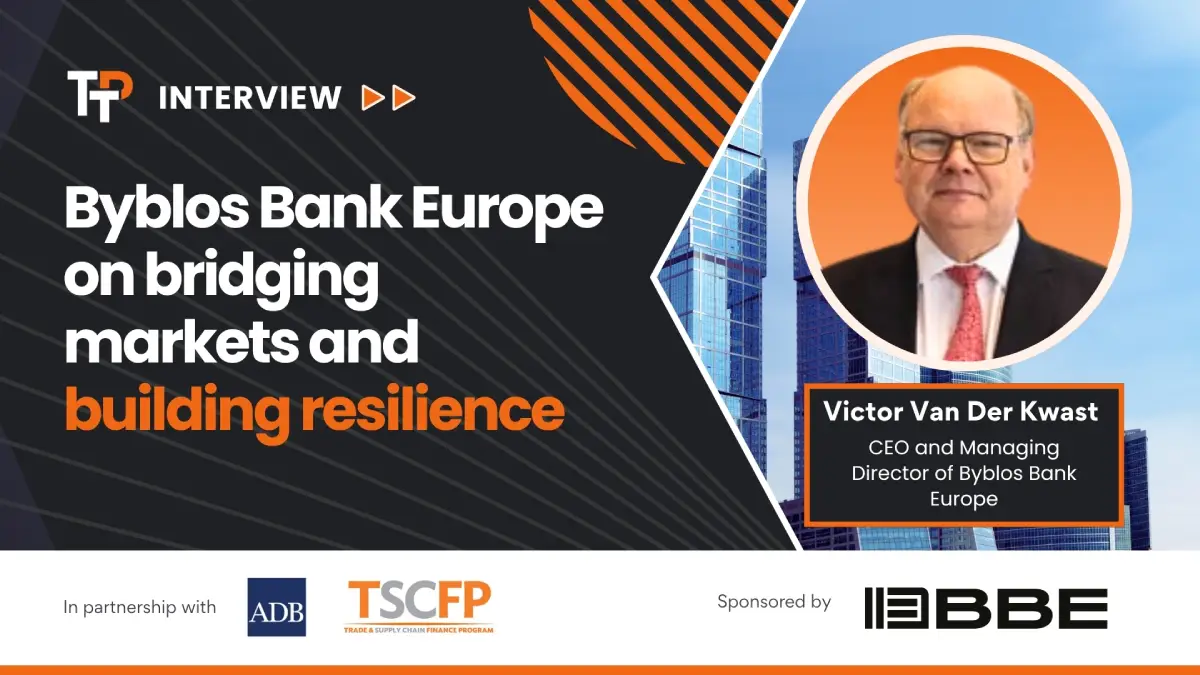
At the Asian Development Bank’s Trade & Supply Chain Finance Program (TSCFP) Awards in Singapore, Trade Treasury Payments spoke with Victor Van Der Kwast, CEO and Managing Director of Byblos Bank Europe, about the bank’s role in mobilising trade finance across both developed and developing markets.
Van Der Kwast reflected on today’s environment. “Markets are really volatile. Building an international franchise is not that easy anymore. In the old days, you could predict two, three, four, five years ahead. Now it is difficult to predict two years ahead. At the same time, the world still needs food, commodities and energy. Our role is to be a bridge between markets, parties, continents, and that is what we have done for many years.”
He stressed that continuity is key, even when volatility makes planning harder. “Today it is less obvious than it was before, but life goes on. You have to adjust to the new reality.” Byblos Bank Europe has built its business on linking Europe with Asia, the Middle East, and Africa, supporting clients in moving goods and finance across borders.
On the partnership with ADB, Van Der Kwast said, “ADB is for us critical. You are a source of information about markets and cultures. You provide support which is enormously valuable for us. We are in Europe, you are in Asia. It allows us to connect. Together we are stronger and together we are bigger. That is the whole game of trade finance on a global scale.”
For Byblos Bank Europe, building resilience is about staying relevant to clients across regions while contributing to development outcomes. Connectivity and partnership remain at the heart of its international franchise, even in volatile times.
Key Topics
- Market volatility has made long‑term planning far more challenging for global financial institutions.
- Despite uncertainty, global demand for essential goods continues to drive trade flows.
- Partnerships between banks and development institutions are crucial for navigating unfamiliar markets and maintaining confidence across regions.
Key Insights
Expert Analysis
Institutions that operate as bridges between regions are proving indispensable, especially when supported by development banks that offer both market intelligence and operational backing. The message is clear: in a world where certainty is scarce, collaboration and connectivity are the real stabilisers.— Victor Van Der Kwast
Key Findings
- Market predictability has significantly decreased, compressing planning horizons
- Trade flows remain robust because essential goods continue to move regardless of global uncertainty.
- Institutions with strong regional networks, particularly across Europe, Asia, the Middle East and Africa, are better positioned to support clients.
- Collaboration with organisations such as ADB enhances market understanding and operational reach.
Implications
- Banks will need to strengthen cross‑border partnerships to remain competitive in volatile conditions.
- Development institutions will continue to play a central role in providing market insight and operational support.
- The ability to adapt quickly to shifting geopolitical and economic realities will determine long‑term resilience.
Key Takeaways
- Trade finance is no longer just about capital, it is about connection. In a volatile world, institutions that share information, support one another and build cross‑border partnerships will shape the future of global commerce.