Sustainability as the new licence to operate in global trade


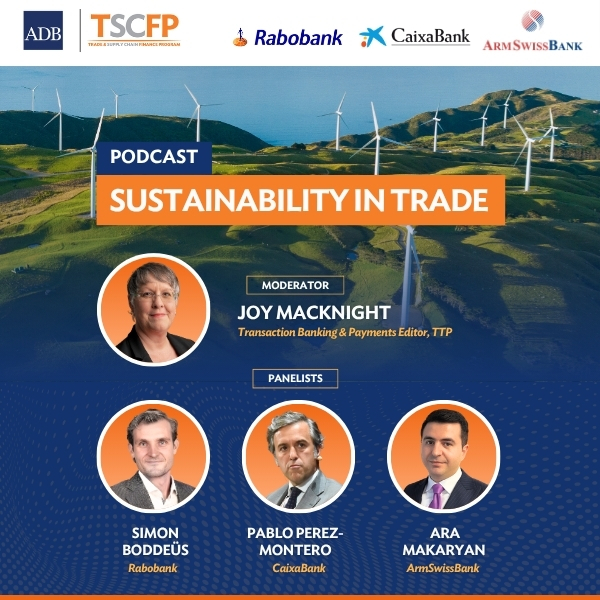

When banks talk about sustainability today, they are no longer discussing a side theme. That much is clear from the Asian Development Bank (ADB) Trade and Supply Chain Finance Programme’s (TSCFP) latest podcast episode, when Joy Macknight, Transaction Banking Editor at Trade Treasury Payments (TTP), spoke with Simon Boddeüs, Director of Sustainable Business Development Europe, Africa and Asia for trade and commodity finance at Rabobank; Ara Makaryan, Deputy CEO and Director of Business Development Department at ArmSwissBank; and Pablo Pérez-Montero, Global Head of Sustainable Finance and ESG Advisory in Corporate and Investment Banking at CaixaBank.
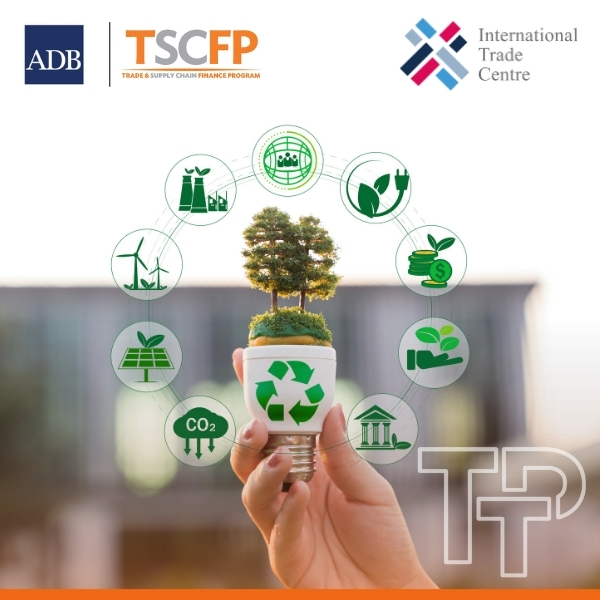
The intersection of trade and climate change is becoming increasingly prevalent, particularly given that international trade is estimated to represent up to 30% of global greenhouse gas (GHG) emissions. To that end, the concept of sustainable trade now covers more than climate change and includes wider environmental, social, and governance (ESG) areas and is seen as essential to delivering both the Paris Agreement and the UN Sustainable Development Goals.
Sustainability is becoming a determinant of who trades, on what terms, and with whose capital – effectively a new licence to operate in global trade.
From parallel agenda to core determinant of competitiveness
For much of the past decade, sustainability in trade has sat uncomfortably between voluntary aspiration and regulatory expectation. This, however, is changing.
“Climate and sustainability will be the key factor for future trade deals,” Makaryan said. “Not as a parallel agenda, but as a core determinant of competitiveness, market access and financial conditions. In particular, global supply chains are moving toward strict climate alignment requirements and exporters who cannot demonstrate low carbon production, traceability or compliance with ESG standards will increasingly lose access to key markets.”
That shift is already visible in practice – especially in advanced economies – through areas such as procurement rules, corporate due diligence practices, and buyer expectations. For countries like Armenia, Makaryan warned that “SMEs [small and medium-sized enterprises] must adapt quickly to continue participating in international trade.” The risk is that firms without the systems, data and investment to demonstrate climate alignment will find themselves excluded from the very value chains that once enabled their growth.
Boddeüs shared this sense of both pressure and opportunity. “From my point of view, there are several opportunities,” he said. “For Rabobank as a food and agricultural-focused bank, the food system transition provides opportunities for sustainable trade and supply chain finance.”
He went on to discuss circular economy activity and low-carbon transportation technologies as further areas where trade flows and sustainability are now tightly linked. The implication then is that as value chains reorient around low-carbon, certified and circular goods, sustainability performance is intertwined with trade opportunity.
Financing around sustainable trade and supply chains
If sustainability now influences who can sell into global markets, it also shapes who can access capital, and many banks have been seen to be redesigning trade and supply chain finance products to reward better ESG performance and steer capital toward climate-aligned activities.
For Rabobank, that starts with what Boddeüs calls “sustainable goods”. The bank is already financing flows such as certified coffee, palm oil and soy from a sustainable angle and is looking at how to recognise low-carbon production more explicitly. He explained that while the International Chamber of Commerce’s Principles for Green Trade Finance are helpful, there is still a need for greater recognition of already low-carbon upstream production and for certification that would allow banks to treat certain goods as sustainable without re-assessing every transaction.
On the supply chain side, CaixaBank has embedded sustainability criteria into its trade finance and supply chain finance activities. Pérez-Montero noted that the bank launched an initiative in 2023 to boost the sustainable trade financing activity that now amounts to roughly €1 billion of sustainable trade financing. In 2025, this has been expanded with an initiative with 3 specific trade lines action and a strong focus on supply chains with an innovative product (Sustainable Supply Chain Finance).The innovation here is the decision to generate a new product which is linked to the evolution of the ESG behavior of the suppliers based on an independent source, grants better financing conditions according to their ESG performance, many of whom sit in emerging markets and mid- market segments.
ArmSwissBank is working on a different scale but with a similar intent. Makaryan described how the bank has integrated annual GHG emissions into its portfolio reporting and hired a specialist in green and sustainable finance, among other activities.
“We have integrated annual reports of the GHG emissions of our portfolio and activities, which supports us in targeting how we develop our green agenda and increase it,” Makaryan said.
Taken together, these examples show how financing structures are being used to reward climate-aligned behaviour and to embed sustainability factors into everyday trade and supply chain transactions.
Standards, partnerships and the role of multilaterals
If sustainability is becoming a condition for market access and financing, it is standards and partnerships that determine how that condition is defined and applied, which is somewhere that multilateral development banks (MDBs) have an outsized role to play.
Makaryan explained that perceived risk is one of the biggest barriers to sustainable trade and that MDBs help close this gap.
“One of the biggest barriers to sustainable trade is the perceived risk, whether it’s new technologies, new markets or climate-aligned business models,” Makaryan said. “MDBs can help close this gap by providing partial guarantees, blended finance structures and longer tenor concessional lines that banks cannot offer on their own. This is a huge support, and it unlocks transactions that would not happen otherwise.”
As an example, ArmSwissBank financed one of Armenia’s largest solar power plant projects by importing the necessary equipment from China using letters of credit. The transaction was supported by instruments from MDBs, which helped make the deal bankable. Alongside this, the ADB provided technical assistance that enabled ArmSwissBank to upgrade its environmental and social risk management system, strengthening the bank’s ability to assess and monitor sustainable transactions.
For its part, CaixaBank works closely with institutions such as the International Finance Corporation, the European Bank for Reconstruction and Development, ADB, and the Inter-American Development Bank to expand its sustainable trade activities, using trade finance guarantee programmes to support transactions across different regions.
These examples help demonstrate that standards and MDB partnerships are shaping how sustainability is defined, measured and financed in trade. They are the mechanisms through which the licence to operate comes to bear, especially in markets where local frameworks are still maturing.
Sustainability as the organising principle of future trade
Sustainability is moving into the centre of how trade operates, shaping the cost of capital, the structure of supply chains and the ability of firms to compete. Likewise, sustainable financing is extending beyond large corporates to SMEs and mid-market companies, and banks are redesigning products to carry ESG performance through entire value chains.
Boddeüs said that there is “more pressure on improved performance from a sustainability perspective” and that “sustainability will get increasingly to the core of trade. It will become more and more a licence to operate rather than a separate theme to address.”
Trade and supply chain finance are no longer simply about moving goods and cash efficiently, but now they also dip into the realm of enabling transition toward more inclusive, responsible and resilient value chains.
For banks, corporates and policymakers, the challenge now is to align products, standards and partnerships with that reality. Those who do so early will help define the future terms of trade.