Transparency in trade finance and the fight against TBML
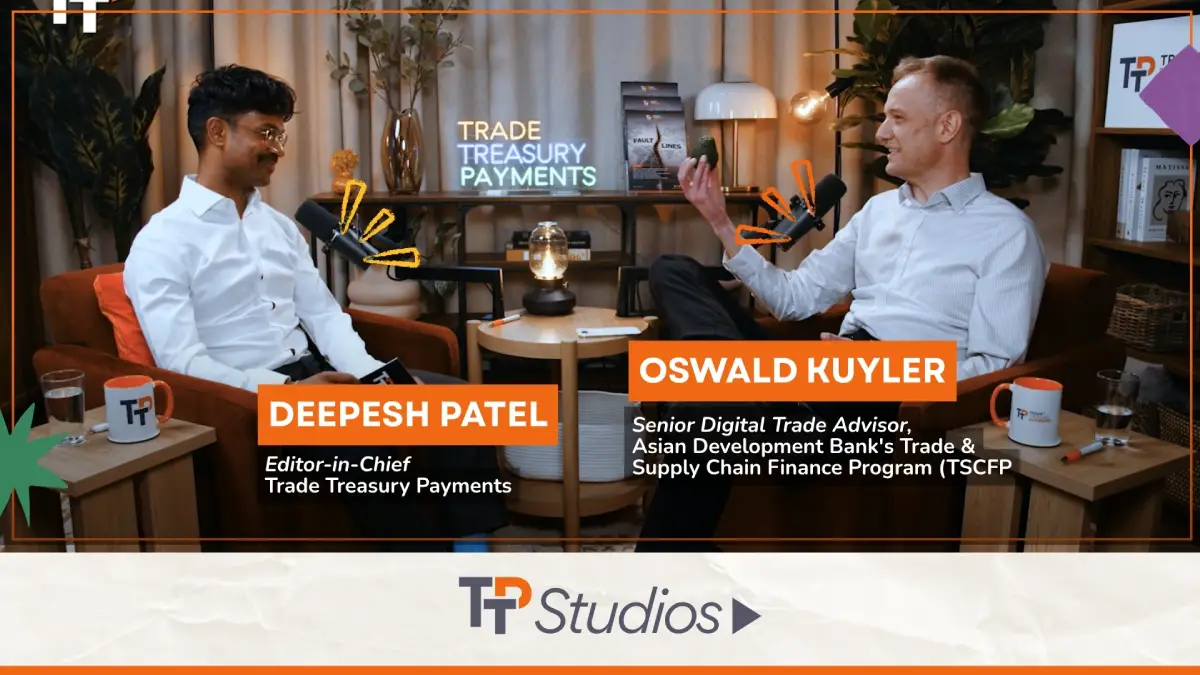

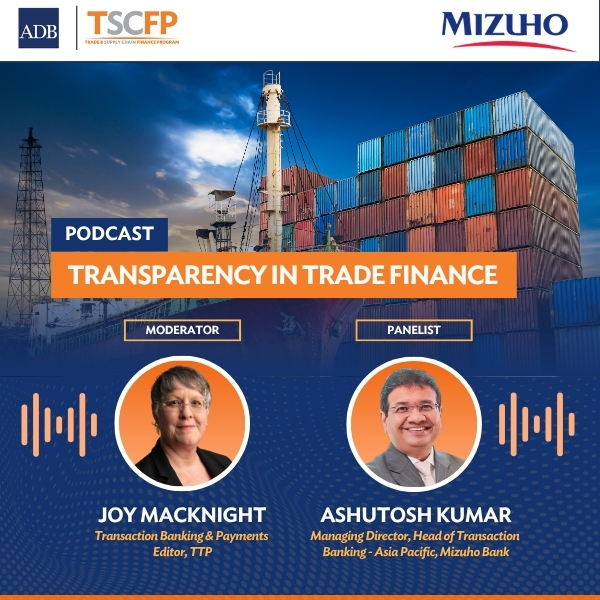
In this episode of our podcast series with the Asian Development Bank’s Trade and Supply Chain Finance Program (TSCFP), we take a closer look at the idea of transparency in trade.
Joy Macknight, Transaction Banking Editor at Trade Treasury Payments (TTP) spoke with Ashutosh Kumar, Managing Director and Head of Global Transaction Banking Department, Asia Pacific at Mizuho Bank, about what transparency looks like in day-to-day trade finance operations, and why the fight against trade-based money laundering (TBML) increasingly depends on collaboration, better data, and smarter workflows.
For Kumar, transparency starts well before a transaction arrives on an operations desk. “The first principle is to know your customers,” he said, emphasising the importance of understanding not just the exporter or importer, but also how well counterparties know each other and whether a transaction aligns with a customer’s normal business activity. “You need a very holistic approach towards trade-based money laundering and about transparency and due diligence, rather than just looking at the transaction in isolation,” Kumar said.
That holistic approach matters because TBML risk often hides in complexity. Trade involves multiple parties, varied documentation, and cross-border movement that can make patterns difficult to spot quickly. Kumar pointed to the foundational value of KYC and what the industry increasingly calls “knowing your customer’s customer”.
The challenge compounds when banks are dealing with a broad network of correspondent institutions. Maintaining the right permissions and due diligence standards at scale is difficult, and costly. Kumar described how Mizuho addresses this by working with like-minded banks and leveraging each other’s networks, rather than trying to replicate the same due diligence effort across thousands of institutions. “If you look at the SWIFT network, there are roughly 11,000 banks. For any large bank to carry out full due diligence across all of them is a truly Herculean task.” he said.
Where the industry is beginning to see a step change is in how data is shared and used. Kumar pointed to Singapore’s Trade Risk Registry initiative as a practical example of banks contributing information into a common database to identify anomalies, such as duplicate presentation of the same invoice or bill of lading. “This kind of sharing of information… is very very helpful,” he said, particularly for detecting behaviours associated with double financing and other related financial crime risks.
In Kumar’s view, “Technology, data sharing, collaboration are the three pillars on which the whole fight against the financial crime risk or trade based money laundering has to be built around.”
Artificial intelligence, he suggested, can materially improve the speed and scale of compliance work, but not as a replacement for judgement. Mizuho has begun working with an AI-enabled provider focused on financial crime compliance, with activity already underway in Singapore and expansion planned in other markets. The model, as Kumar described it, is “human assisted AI”, where AI performs the initial “maker” role and a person performs the “checker” role.
“Instead of someone reviewing documents line by line, AI can do the same work far faster and at far greater scale,” he said.
Kumar also pointed to the role of multilateral programmes in raising standards across markets. He pointed to ADB’s work with partners including UNODC, and the programme’s capacity-building efforts to strengthen TBML detection and reporting in countries such as Bangladesh, Mongolia, Nepal, Pakistan, and Sri Lanka. For international banks, that kind of training, awareness-building, and standardisation helps narrow gaps between local practice and global expectations.
He also pointed to interoperability standards efforts and the adoption of MLETR as key enablers, allowing more trade documents to be exchanged digitally and reducing the need for manual intervention. “In the next five to seven years, we’ll see a lot of pioneering work in this area,” he said, “which will help make the whole ecosystem safer and more secure.”