

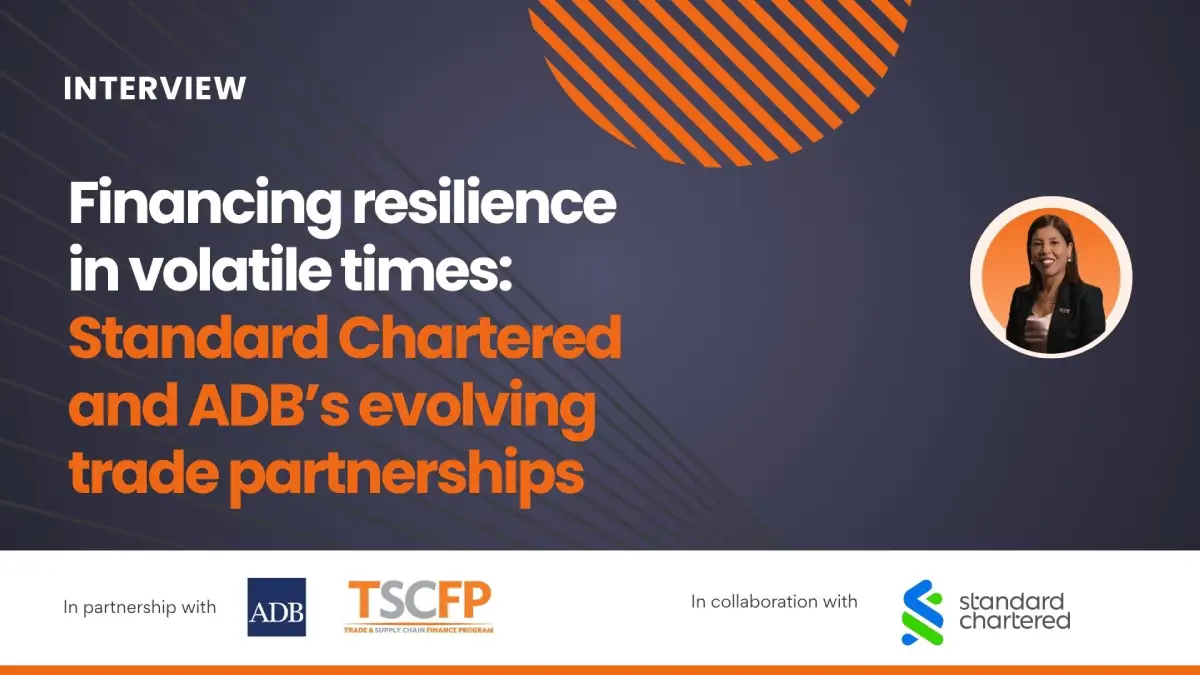
Financing resilience in volatile times: Standard Chartered and ADB’s evolving trade partnerships
Resilience has become the watchword for global trade. In an environment defined by geopolitical uncertainty, climate shocks, and volatile markets, the question is no longer whether businesses can withstand turbulence, but whether their financing structures can adapt and strengthen in response.
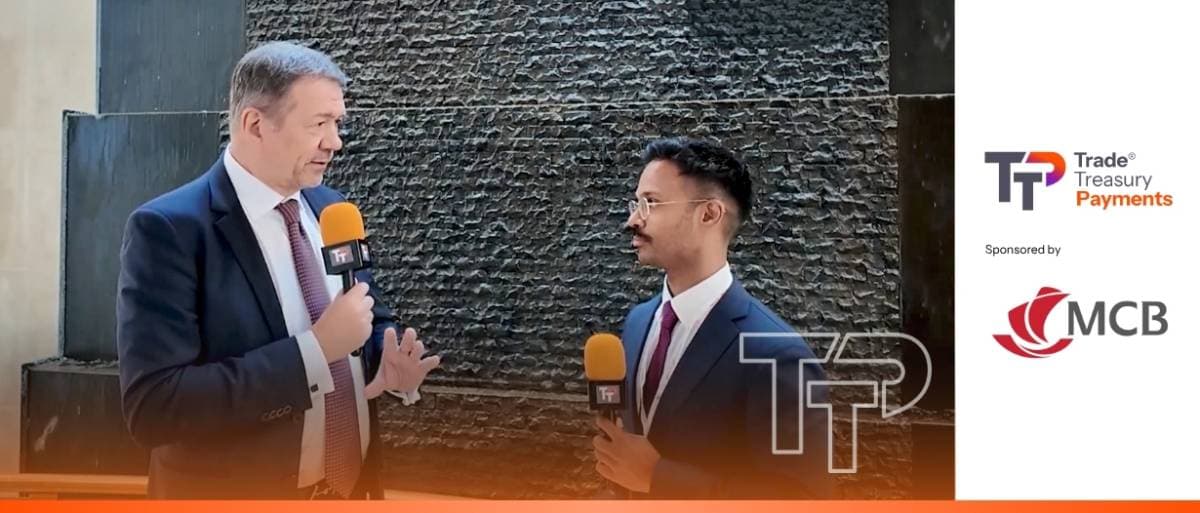
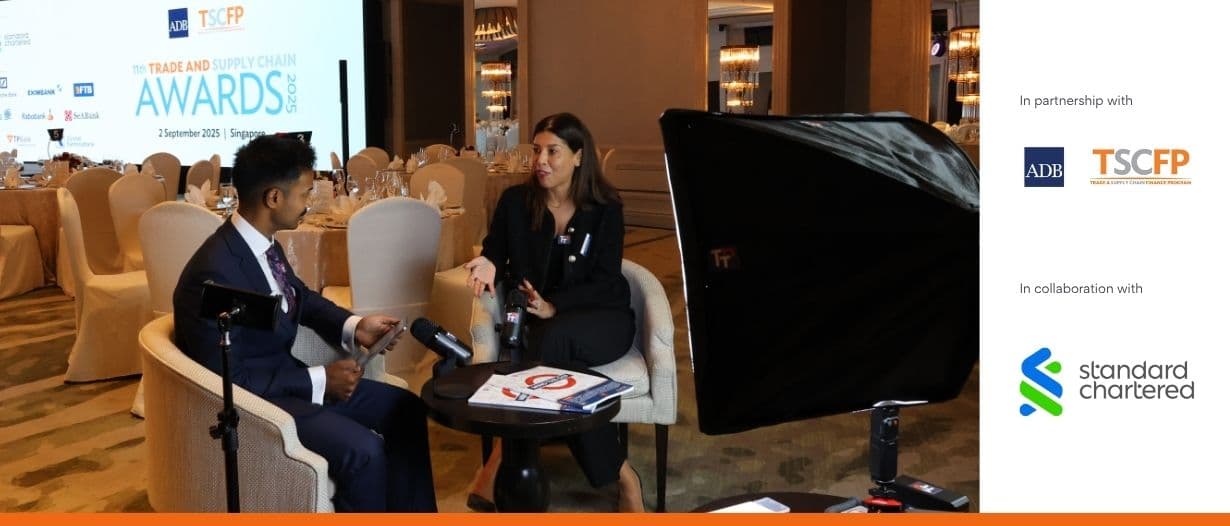
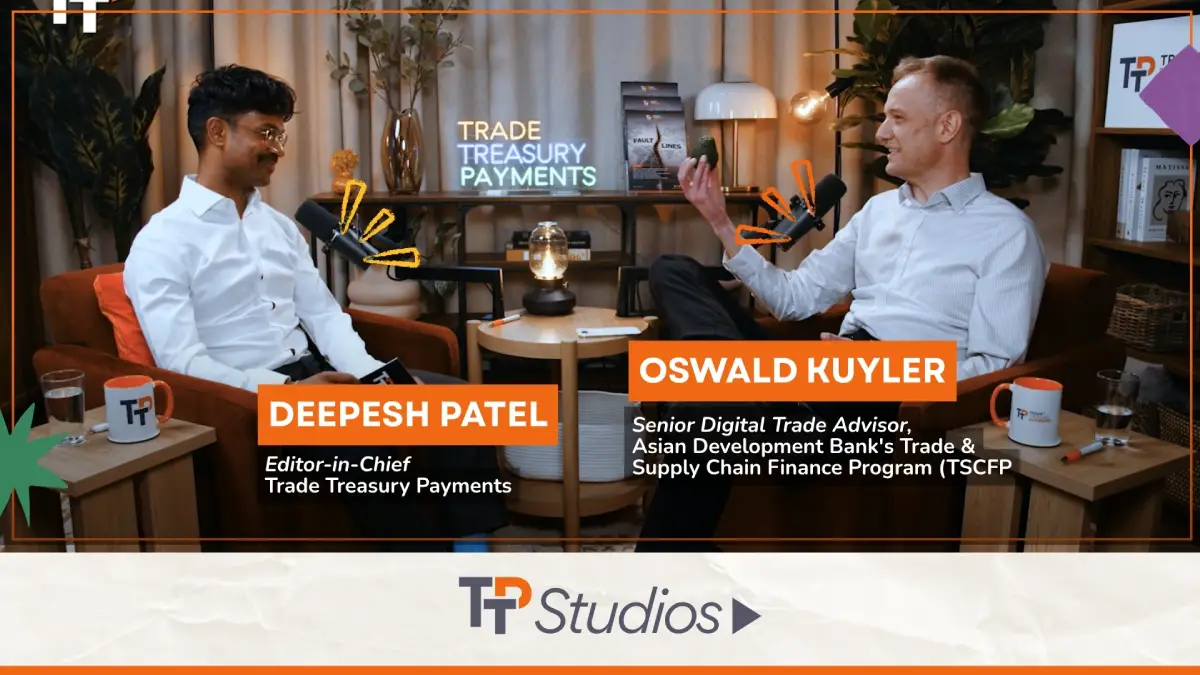
At the Asian Development Bank’s Trade & Supply Chain Finance Program (TSCFP) Awards in Singapore, we caught up with Sofia Hammoucha, Managing Director and Global Head of Trade and Working Capital at Standard Chartered.
Hammoucha said, “This is clearly a time for resilience. We have seen a lot of volatility this year from different angles, so it is a real conversation we are having every day with clients. From our perspective, it means sustainability and financing access. But it also means building ecosystems, supporting not just our clients, but their suppliers, distributors, and even their banks.”
South–South trade as a growth engine
Resilience in emerging markets is tied to the ability of firms and financial institutions to access trade credit at critical moments. Standard Chartered’s footprint across Asia, Africa, and the Middle East makes it a natural player in the South–South trade corridors that are reshaping supply chains.
Partnerships with multilateral development banks (MDBs) such as the Asian Development Bank (ADB) have become a cornerstone of this approach. By combining Standard Chartered’s on-the-ground presence with ADB’s guarantee capacity, deals that once looked too risky can be brought to market.
As Hammoucha explained, the goal is to look beyond a single balance sheet. She said, “One theme that is more and more prevalent now is how we support our clients’ credit ecosystem beyond just the clients themselves. It is about making sure their networks have access to the finance needed to keep moving.”
The importance of ecosystem-building was evident in Cambodia, where Standard Chartered and ADB partnered on the first-ever trade finance transaction supported by the TSCFP.
ADB had already been engaging with the Foreign Trade Bank of Cambodia (FTB), one of the country’s largest local institutions, to help establish a functioning trade finance framework in a market dominated by cash-backed facilities and advance payments. That work culminated in a milestone LC: issued by FTB, confirmed by Standard Chartered, fully risk-covered by ADB.
Cambodia’s economy has been expanding, an estimated 6% in 2024 according to ADB, on the back of garment exports, non-garment growth, and tourism. Yet financial sector depth remains limited, with credit to the private sector subdued by cautious lending. ADB is one of Cambodia’s largest sources of development finance, committing on average $360 million annually from 2020 to 2024. In this context, the first TSCFP-backed transaction was not only about funding an LC, but also about signalling confidence and demonstrating that modern trade finance structures can work in a frontier market.
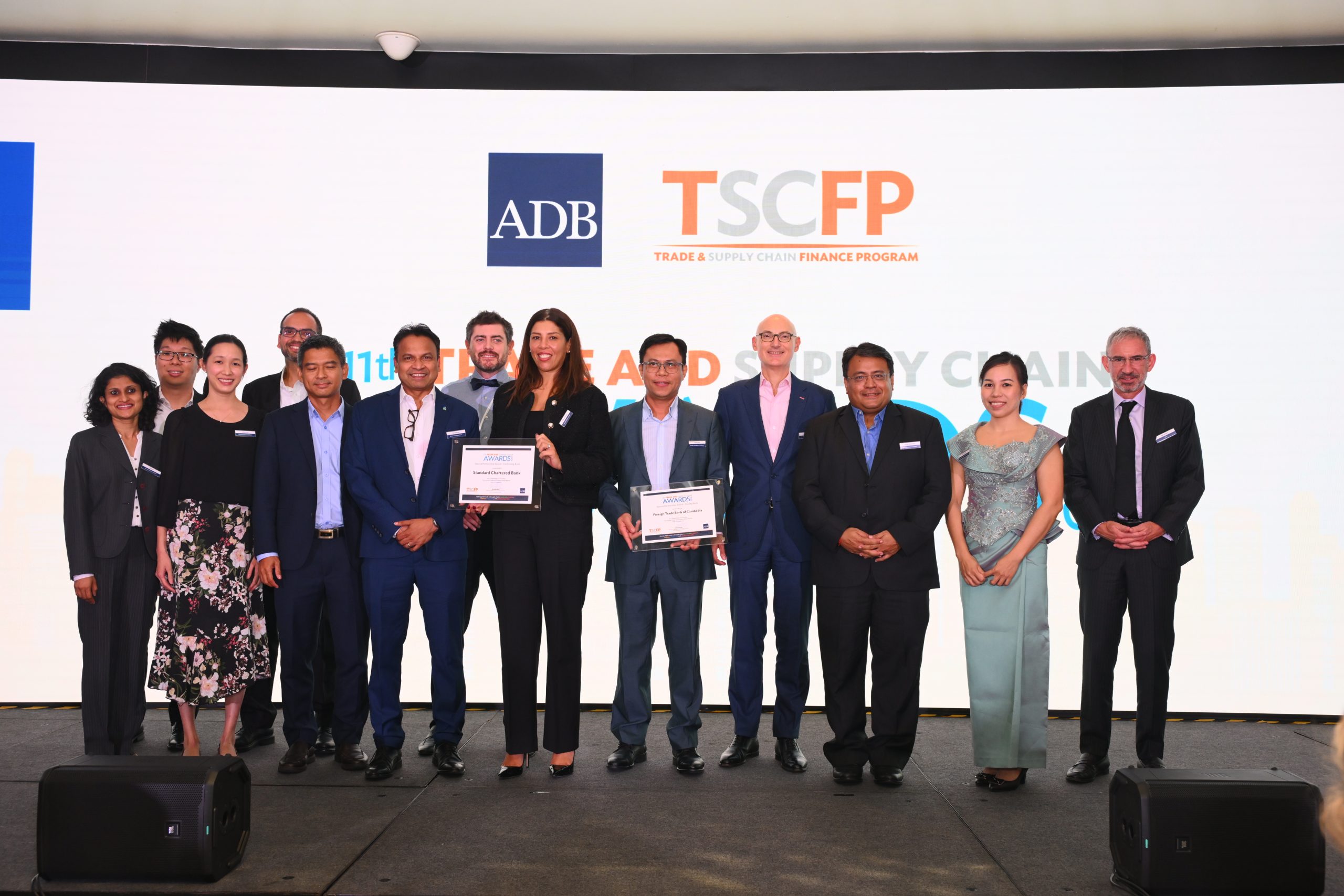
Pictured: Foreign Trade Bank of Cambodia and Standard Chartered Bank receive the Special Partnership Award at the ADB TSCFP Awards in Singapore, recognising the first-ever trade finance transaction under the programme in Cambodia.
Equally important was the twinning exercise, in which ADB coordinated knowledge sharing activities on trade practices between FTB and Standard Chartered. Standard Chartered and ADB worked directly with FTB’s transaction banking team, offering practical guidance on how to structure and manage trade finance products. For Sofia Hammoucha, this knowledge transfer was as critical as the capital itself.
She said, “From our perspective, resilience is about sustainability and access, but also about transferring knowledge. It is about enabling local banks to build capacity, so that markets can finance themselves over time.”
The initiative also aligns with ADB’s 2024–2028 country partnership strategy, which is anchored in Cambodia’s Pentagonal Strategy for growth, employment, equity, efficiency, and sustainability. By combining technical assistance with real-world transactions, the Cambodia deal advances national ambitions to diversify the economy and strengthen resilience to external shocks.
The deal demonstrates how public-private partnership can both unlock liquidity and open up opportunities in developing markets.
Green Deal Champion: Vietnam’s EV ambition
Resilience is not only about keeping the lights on; it is also about preparing economies for a low-carbon future. At the recent TSCFP Awards, Standard Chartered was recognised as the Green Deal Champion (Confirming Bank) alongside Vietnam Technological and Commercial Joint Stock Bank (Techcombank).
The award highlighted a trade finance transaction that supported Vietnam’s fast-growing electric vehicle (EV) industry by enabling the import of advanced battery components.
At a time when governments are racing to meet climate targets, the deal demonstrated how trade finance can catalyse supply chain shifts towards greener technologies, while also supporting jobs and industrial growth. It underscored Standard Chartered’s role in facilitating sustainable trade finance across the region, aligned with both Vietnam’s green transition policies and ADB’s broader development mandate.
Hammoucha said, “Sustainable trade finance and enabling the green economy of tomorrow is a core target for the bank, and definitely for our multilateral partners as well.”
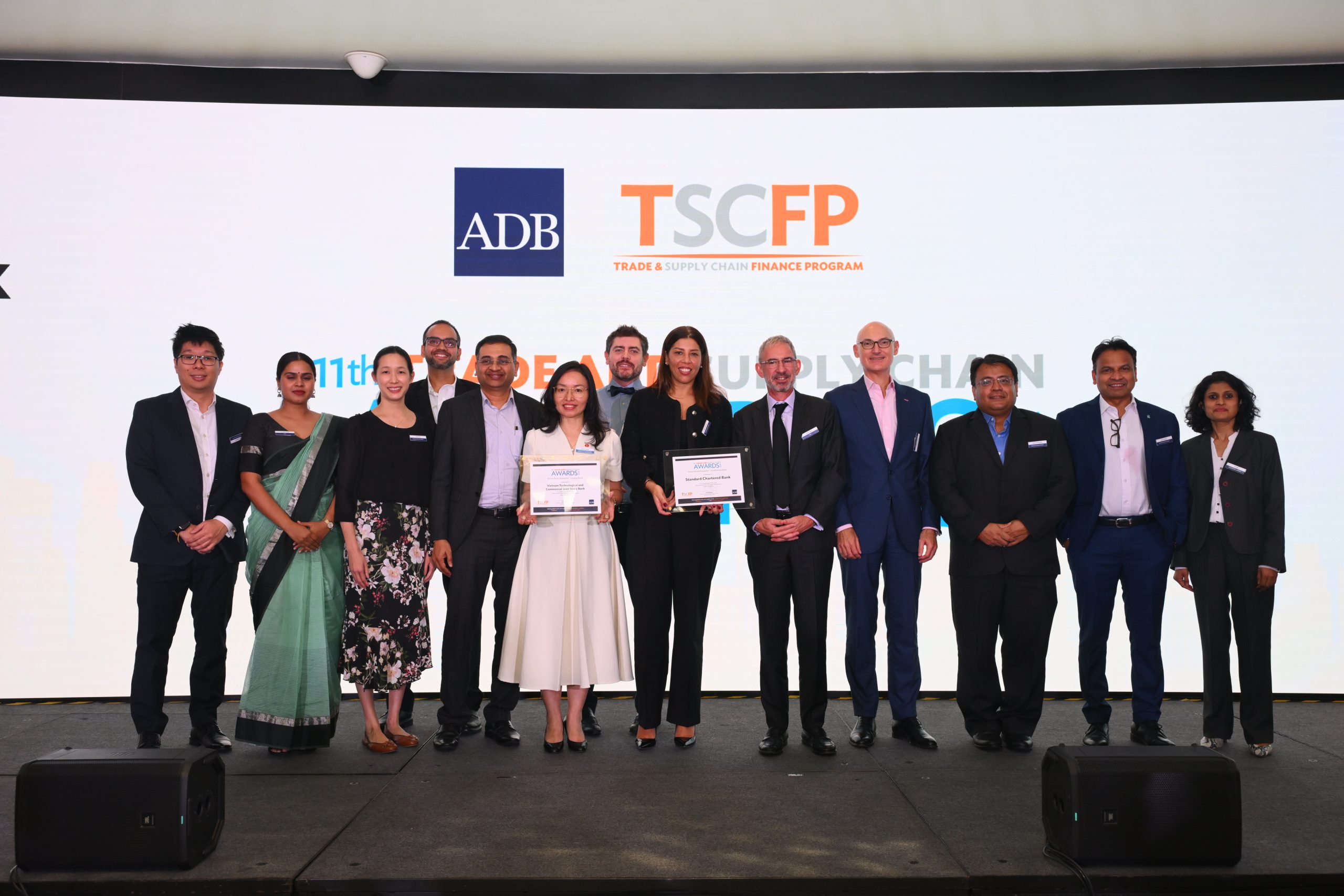
Pictured: Representatives from Standard Chartered and Vietnam Technological and Commercial Joint Stock Bank (Techcombank) accept the Green Deal Champion Award at the ADB TSCFP Awards in Singapore, recognising a trade finance transaction that supported Vietnam’s electric vehicle industry and highlighted how sustainable trade finance can accelerate the green transition.
Partnership as multiplier
From Cambodia’s first LC to Vietnam’s EV ambitions, the common thread is partnership. ADB’s guarantees and technical support have de-risked transactions that commercial appetite alone might not sustain. Standard Chartered has brought its South–South footprint, structuring expertise, and local relationships to bear.
For Hammoucha, this multiplier effect is precisely what resilience looks like in practice: “It is about looking beyond the immediate transaction to the ecosystem it supports, whether that is supply chains, financial institutions, or the green industries of the future.”
As volatility persists, these partnerships will remain essential to ensure that markets not only weather uncertainty but also move closer to sustainable growth.
Watch the video on YouTube here.
Key Topics
- Ecosystem-based trade finance
- Frontier market liquidity
- South–South trade corridors
- Sustainable finance in global trade
- Capacity-building through MDB partnerships
Key Insights
Expert Analysis
“From our perspective, resilience is about sustainability and access, but also about transferring knowledge. It is about enabling local banks to build capacity, so that markets can finance themselves over time.”— Sofia Hammoucha
Key Findings
- Trade resilience now hinges on ecosystem-based financing, not just individual firm strength.
- South–South trade corridors are reshaping supply chains and offer new growth opportunities in emerging markets.
- ADB and Standard Chartered’s partnership model enables de-risking of frontier market transactions through guarantees and on-the-ground presence.
- Knowledge transfer is as critical as capital, especially in building capacity at local banks.
Implications
- Firms and FIs must build resilience by supporting not only clients but also suppliers, distributors, and partner banks.
- Public–private partnerships, like the ADB–Standard Chartered model, are key to unlocking liquidity in high-risk markets.
- Local market development depends on both real-world transactions and technical assistance.
- Sustainable trade finance can enable green industrial transitions while supporting jobs and export-led growth.