
About This Video
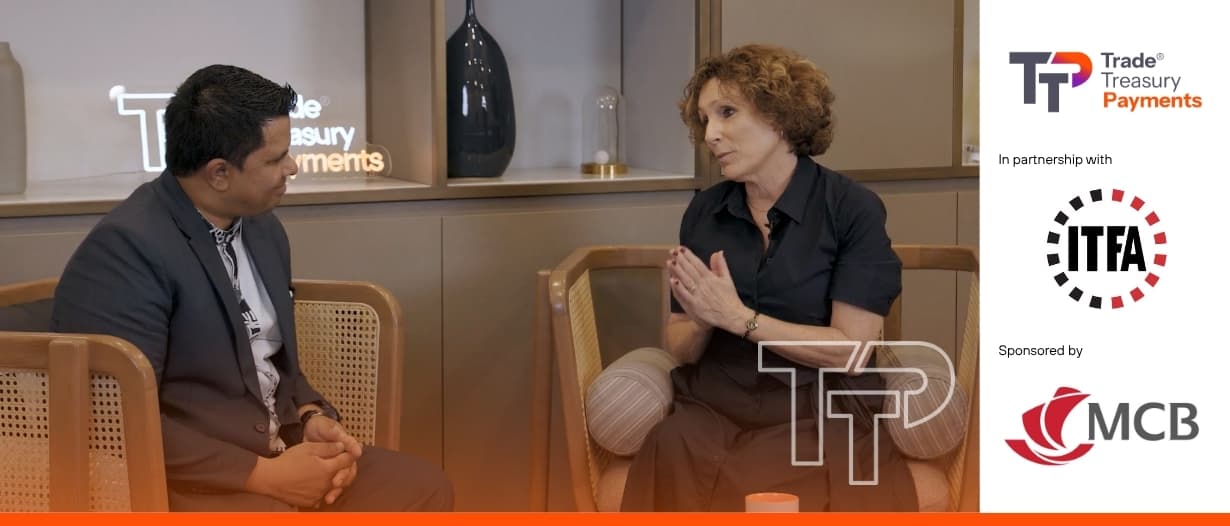
At the BAFT (Bankers Association for Finance and Trade) General Annual Meeting in Washington, DC, Trade Treasury Payments (TTP) spoke with Mariya George, CEO and Co-Founder of Cleareye.ai, about red flags in the compliance process for trade and supply chain finance.
George said, “Red flags are changing significantly in the banking industry because of the complexity of trade finance and also how sophisticated financial criminals are becoming these days.”
Beyond traditional inconsistencies in documentation, banks are now dealing with challenges like phantom shipments, over- and under-invoicing, and multiple invoices with differing goods descriptions. These types of issues are appearing more frequently and require a broader lens to detect.
George said, “It’s very important to understand… the full network of your customer’s contacts, even in the context of the transaction.”
“In addition to the transaction-level red flags that we look for, there are two other areas that we’re constantly looking out for. One is know your customer’s customer. It’s very important to understand the full network of your customer’s contacts, even in the context of the transaction. The second is called network analysis. When we are looking at a specific transaction, we look at all the parties involved in the transaction and then try to figure out how these parties are connected and look for potential red flags and anomalies there.”
Institutions are turning to technology to do this at scale. From digitising documents to automating compliance workflows, banks are using AI, machine learning, and natural language processing to reduce risk and improve efficiency.
George said, “Gone are the days when banks thought they could do this all manually. Every single bank we talk to is, in some shape or form, working on this.”
In trade finance specifically, Banks are using AI to convert unstructured documents into structured data, which enables automated red flag checks, sanctions screening, and regulatory compliance. In some cases, this is paired with distributed ledger technology to push toward straight-through processing.
George said, “In countries like the UAE, the Central Bank has mandated that all the banks have to do those checks. Most of the global banks have realised that they need it, and they’re automating it. Regional banks are catching up in North America, for example, and we are seeing significant traction in Europe as well.”
For those attending the conference, the message is: don’t wait.
George said, “The time is now to act on leveraging technology because it exists out there. Tap into that ecosystem and connect that with your banking systems to make sure that… financial crime is contained.”
As trade becomes more interconnected and more data-driven, the institutions that adopt the new tools early will be best positioned to lead.
Key Topics
- Emerging fraud risks in trade finance
- The role of artificial intelligence in compliance and risk detection
- Network analysis and extended customer due diligence
- Digitisation of trade finance documentation
- Technology partnerships to combat financial crime
Expert Analysis
Mariya George, Chief Executive Officer and Co founder of ClearEye.ai, highlights how the nature of risk in trade finance is changing. Financial criminals are becoming increasingly sophisticated, and the complexity of international trade transactions makes it harder for banks to detect suspicious activity through manual checks alone. While traditional red flag indicators such as inconsistencies within trade documents still play an important role, banks are now seeing more complex forms of manipulation. These include over invoicing, under invoicing, phantom shipments and the use of multiple invoices that describe the same goods in different ways. George notes that effective risk monitoring requires a broader view of each transaction. Banks need to understand not only their direct customer but also the wider network of relationships involved in a trade deal. This includes applying the principle of knowing the customer’s customer and analysing the connections between all parties involved in a transaction. Technology is becoming central to this effort. Many banks are using artificial intelligence to digitise paper based trade documentation, conduct sanctions screening and automate document checks. Once information is captured in a structured format, institutions can monitor transactions more effectively and move towards more streamlined processing. Regulatory expectations are also shaping this shift. In some markets, including the United Arab Emirates, regulators require banks to carry out trade based money laundering checks. Global banks have largely begun to automate these processes, while regional institutions in North America and Europe are increasingly adopting similar technologies. George’s message to industry participants is straightforward. The technology needed to strengthen trade finance compliance already exists. Banks should focus on connecting internal systems with external data sources and specialist providers in order to improve visibility and reduce the risk of financial crime.— Mariya George
Key Findings
- Banks are seeing a rise in complex fraud patterns including over invoicing, under invoicing and phantom shipments.
- Criminals are increasingly using multiple invoices and altered goods descriptions to disguise suspicious activity.
- Many financial institutions are adopting artificial intelligence to support document digitisation and compliance monitoring.
- Regulatory pressure is encouraging banks to strengthen controls around trade based money laundering.
- Structured data and automation are helping banks improve the speed and accuracy of trade finance risk checks.
Implications
- Banks will need to strengthen transaction monitoring by analysing the relationships between all parties involved in trade deals.
- Automation and advanced analytics are becoming essential to manage the growing complexity of trade finance compliance.
- Digitisation of trade documentation will play a key role in improving both efficiency and oversight.
- Regulatory expectations are likely to drive wider adoption of trade based money laundering controls.
- Collaboration between banks, technology firms and data providers will become increasingly important in tackling financial crime.