





About This Video
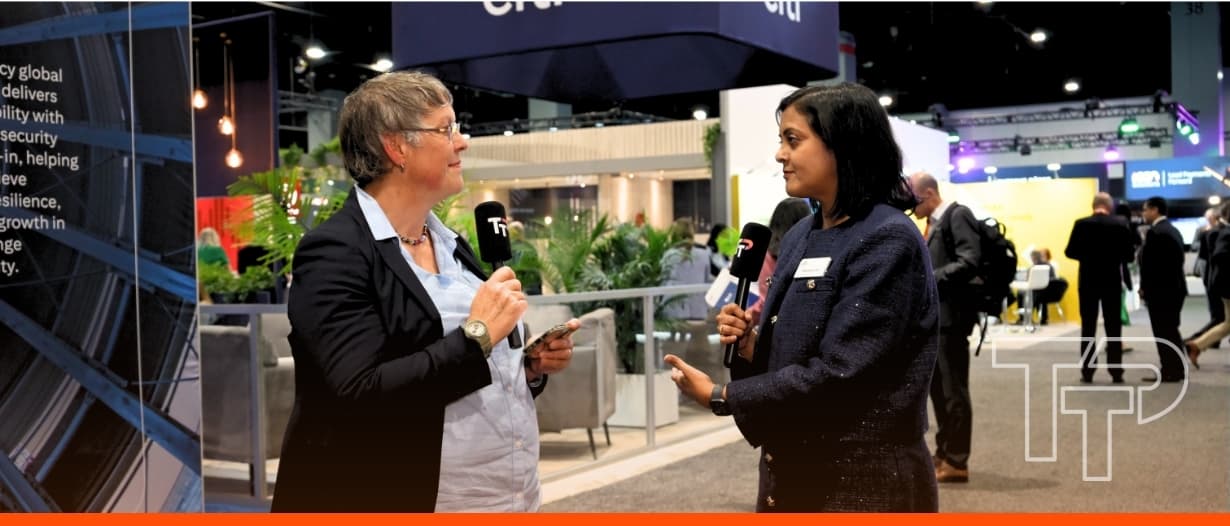
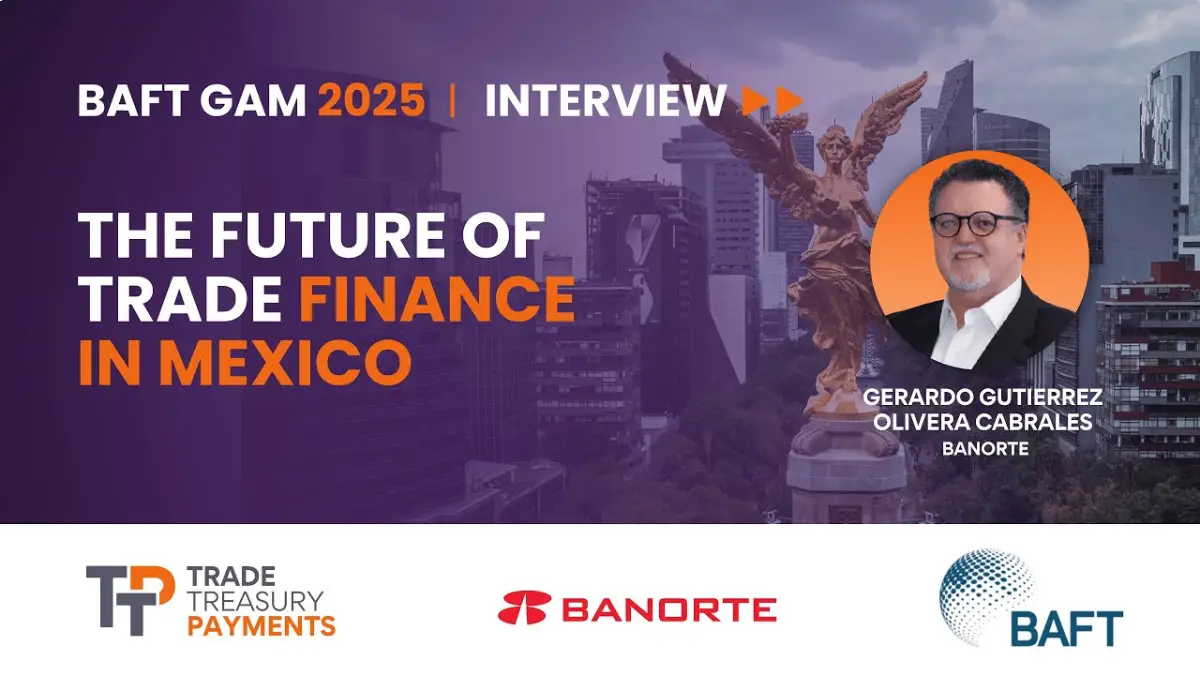
At the BAFT (Bankers Association for Finance and Trade) General Annual Meeting in Washington, DC, Trade Treasury Payments (TTP) spoke with Gerardo Gutiérrez-Olvera Cabrales, Head of Trade Finance and International Business at Banorte, and Vice Chair of the ICC Global Banking Commission, to discuss how Mexico’s local banks are addressing cross-border finance needs and what lies ahead for the region’s trade economy.
Gutiérrez-Olvera said, “Exports and imports account for almost 75% of the Mexican economy. So, a large portion of bank financing in Mexico is already somehow related to trade finance.”
Yet much of Mexico’s trade still moves on open account terms, particularly with the United States. For SMEs and unaffiliated traders, that can mean added exposure to payment risk and limited access to competitive working capital.
Gutiérrez-Olvera said, “That has given us a unique opportunity to work together with regional and local banks in the US and Canada in order to service our clients, specifically in the SME arena. What we have been trying to do is connect the dots in terms of which of these clients are already part of the global value chain and how we can leverage the receivables from larger clients with better credit quality to offer them more competitive financing opportunities.”
That effort comes at a time when political uncertainty is shaping how banks, businesses, and policymakers think about North American integration. That mindset is fuelling Banorte’s strategy. Whether through compliance with USMCA rules of origin or support for clients that are modifying their working capital strategy or adjusting CapEx plans amid the uncertainty.
Still, a broader challenge of improving inclusion in trade finance in Mexico and Latin America remains.
Gutiérrez-Olvera said, “The only way that countries like Mexico, Guatemala, and Honduras can make trade more relevant to their economies is by getting the local SMEs to participate in the global value chain. That takes joint efforts by the private and public sectors, as well as banks and education, so that we all become more comfortable with this high-quality asset that is trade finance.”
That means helping more local firms participate in global supply chains and increasing the share of domestic value added in exports.
Key Topics
- Mexican banks are exploring ways to better support SMEs and independent traders who face rising payment risks, particularly as many rely on open account trading with US partners.
- Closer relationships between Mexican banks and regional banks in the United States and Canada are becoming an important way to strengthen cross border trade finance support.
- Banks are increasingly relying on long term trade finance data and structured finance tools to assess risk while continuing to expand financing for businesses involved in international trade.
- Trade relations between Mexico, the United States and Canada continue to deepen, supported by stronger regional frameworks and supply chain integration.
- Increasing inclusion in trade finance remains a priority, particularly for SMEs that are often outside established banking channels and require greater support and education.
Key Insights
Expert Analysis
Gerardo Gutierrez Olivera, Executive Director and Head of Trade, Finance and International Business at Banorte, and Vice Chair of the ICC Global Banking Commission, highlights the role that collaboration and strong banking relationships play in supporting trade across North America. With nearly thirty years of experience in international banking across North America, Latin America, Asia and Europe, he explains that Mexican banks are uniquely positioned to support companies trading internationally because of their close relationships with local businesses. This proximity allows banks to better understand their clients’ operations and financing needs. At Banorte, this approach has helped strengthen partnerships with correspondent banks in the United States and Canada. These relationships allow banks to work together to support clients engaged in cross border trade, particularly SMEs that may face higher payment risks. Gutierrez Olivera also points to the strong performance of trade and supply chain finance as an asset class. Data gathered over many years by the ICC Banking Commission shows that trade finance continues to demonstrate low default rates and strong risk characteristics. In a country where exports and imports represent a significant share of economic activity, much of the financing provided by banks ultimately supports trade. As global conditions remain uncertain, he believes the focus should remain on staying close to clients, understanding how their working capital needs are changing and strengthening partnerships across the North American banking ecosystem.— Gerardo Gutierrez-Olvera Cabrales
Key Findings
- Strong relationships between Mexican banks and international correspondent partners help improve financing access for businesses engaged in cross border trade.
- Many SMEs remain exposed to payment risks because of the heavy reliance on open account trading with US partners.
- Long term industry data confirms that trade and supply chain finance remains a low risk asset class for banks.
- Regional cooperation and trade agreements continue to support deeper economic integration across North America.
- Greater education and wider access to trade finance solutions will be essential to bring more SMEs into global trade.
Implications
- Greater cooperation between banks across North America could expand access to trade finance for Mexican companies, particularly SMEs involved in cross border trade.
- Banks are likely to continue increasing their use of structured trade and supply chain finance tools in order to balance risk while supporting growing trade flows.
- Closer economic integration between Mexico, the United States and Canada may further strengthen the region’s role in global supply chains.
- Maintaining close relationships with clients will remain essential as businesses adjust their working capital strategies in response to policy changes and economic uncertainty.
- Improving financial inclusion within trade finance could unlock significant opportunities for smaller exporters and importers across Mexico and the wider region.
Key Takeaways
- Trade and supply chain finance continues to demonstrate strong asset quality and remains a reliable area of lending for banks.
- Partnerships between local banks and correspondent institutions are becoming increasingly important for supporting cross border trade.
- North America’s integrated trade ecosystem presents significant opportunities for growth and collaboration.
- Banks need to remain closely connected to their clients in order to understand and respond to changing financing needs.
- Expanding access to trade finance will be essential to ensure that smaller businesses can fully participate in international trade.