
How digital infrastructure is transforming risk domestically and across borders
The trade finance sector has had to battle persistent, but known, fraud typologies for years. Many traditional mechanisms exist to provide legal frameworks, but often fail to address the immediate risk faced by financiers. Furthermore, legacy manual verification processes are simply not scalable and so not effective in today’s environment.
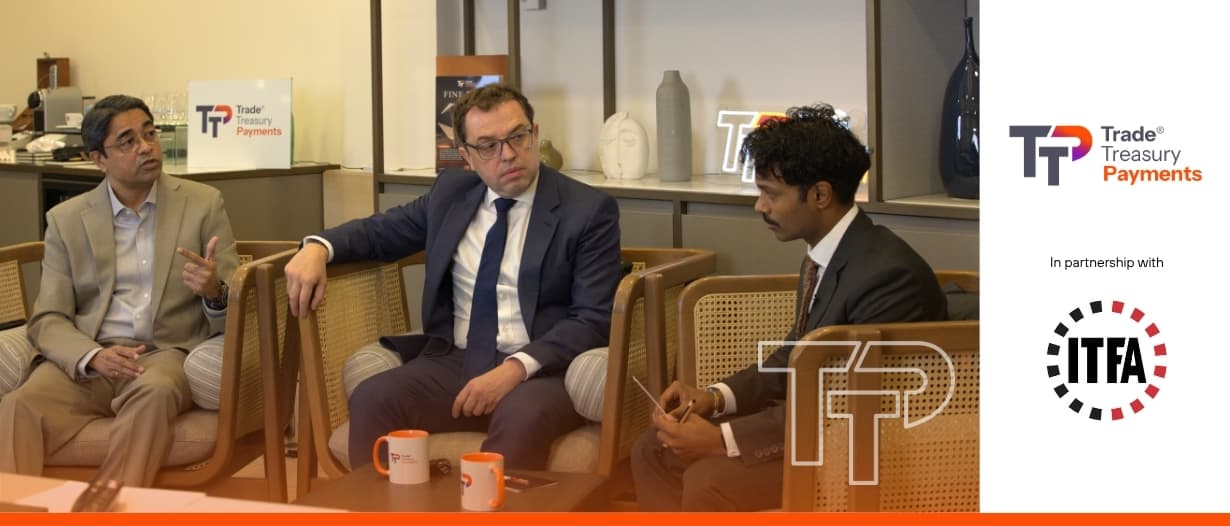
Deepesh Patel, Editor of Trade Treasury Payments (TTP), spoke with Neil Shonhard, CEO of MonetaGo, at the FCI 58th annual conference in Lisbon. The industry, the pair discussed, is at a critical juncture where the gap between legal protection and the operating reality is being bridged, and needs to be bridged, by technology.
This digital infrastructure is also becoming a foundation for MSME finance, enabling lenders to extend more credit safely while also offering governments greater transparency across trade finance ecosystems.
A growth narrative
Perhaps the biggest takeaway from the discussion is that creating confidence to lend through trusted financial infrastructure offers a catalyst for economic growth. If banks believe fraud is already manageable, then the more important question is why they are not lending more. Shonhard’s argument is that fraud prevention alone is the wrong lens. “One thing I’ve realised painfully over the years is that unless there’s also a narrative of growth aligned to prevention of fraud, then nothing really has moved that quickly”. The technology’s real value is in creating the confidence to extend more credit, not simply reducing losses.
Data from India provides a compelling case study to support this belief that meaningful traction only comes when measures are aligned with a growth narrative: MonetaGo, and the market infrastructure it provides, has contributed to a 319% increase in MSME liquidity since January 2023. The infrastructure creates a “trusted data layer”, and when financiers have confidence in the data, they have the confidence to lend more. This unlocks liquidity, “and that’s where you see that growth,” Shonhard explains.
In particular, there is more lending to the MSME sector, which has profound socio-economic benefits. In India, more women-led businesses have had financing, and there has been a notable change in GDP. The Indian government, recognising these benefits, is increasingly mandating the use of trade exchange underpinned by MonetaGo’s solutions, transforming the technology into a core component of national economic infrastructure.
Centralising trust
One of the fundamental challenges in trade finance is that banks often operate in silos. This is an immediate source of risk – a financier can do all the due diligence in the world, but without a centralised view of things, they cannot know if another institution has already financed the same underlying asset, or if the same collateral has been used in a different arrangement. “I can present to you an invoice and then, to another bank, a bill of lading, but this can represent the same underlying collateral. So, it’s not just double-pledging of collateral, it can be collateral pledged across different documents to different lenders also,” Shonhard explains.
MonetaGo’s solution, per Shonhard’s explanation, is to create a “privacy-preserving environment” where transactions are cryptographically hashed to form a digital public infrastructure (DPI) layer for trade finance. This trusted infrastructure enables real-time checks across the transaction lifecycle without exposing sensitive data. “And all of this happens in under a second at a scale of many hundreds of thousands of transactions every month,” which, Shonhard believes, is its crucial benefit.
This move away from post-transaction detection, where the damage is already done, to pre-disbursement prevention provides a system that fundamentally changes the economics of lending and the associated risks. In India, this approach has seen “fraud rates go in from 80-ish per cent to sub one,” Shonhard said, noting how the pre-disbursement risk is drastically reduced.
Building a global framework
Looking forward, MonetaGo is focused on expanding its model globally through national digital infrastructure projects. Bahrain provides one live example. A similar initiative is now underway in Nigeria. That initiative, which is “in partnership with local partners, [is working to] establish a national-level risk mitigation infrastructure, which has the support of the central bank, local banks, and international players in the space,” Shonhard explains.
Ensuring central banks and governmental bodies are key partners allows the full benefits of the infrastructure to be realised. “From a government perspective… I want increased visibility and transparency of my financial ecosystem”, Shonhard explains. A centralised repository of data also presents a revenue generation opportunity for governments, due to the visibility of potential extra duties they may not have known about.
But what about global infrastructure? When asked about the potential for a cross-border global registry, Shonhard noted the importance of data sovereignty and starting with domestic success. “Everybody’s focused on domestic growth, and that primarily is with the small businesses,” he explains. By de-risking MSME liquidity and notably increasing GDP, things “get big enough” to export overseas or attract the larger in-country corporations to engage with the system. When it is time to look cross-border, “interoperability in data standards is obviously key,” with data sovereignty also being crucial in domestic financing.
Interoperability is key
MonetaGo’s systems are future-proofed with ISO 20022 compliance and maintain cloud-agnostic capabilities to ensure domestic registries can eventually communicate across borders. “We’ve all been advocating at MonetaGo for focus on interoperability,” Shonhard explains. In his view, countries should retain ownership of their own infrastructure while adopting interoperable standards that allow trusted information to move securely across borders
The narrative for MonetaGo is joint ventures everywhere, but ensuring that one country on Azure, one country on AWS, and one country on GCP can still communicate. This is critical, and that’s where the importance of interoperable data standards becomes most apparent.
The failures of narrower blockchain-based, invoice-only registries in other jurisdictions are helping the industry to learn and progress. “The banks are starting to leave these kind of networks because they’ve realised it’s very limited use case,” Shonhard explains; “it needs to be cross-document, cross-border from the outnset”.
AI is supercharging fraud
Artificial intelligence (AI) is touching on virtually every aspect of business operations, finance, and daily life, it seems. But rather than being a threat to the MonetaGo business model, it appears to present an opportunity. “If anything, in this context, AI is supercharging fraud,” Shonhard explains.
AI has provided fraudsters with an opportunity, lowering the barrier to entry by making it easier to create synthetic invoices, fabricate audit trails, and create deepfakes. With technology making document generation easier, document verification becomes all the more vital.
“AI can create a lot of extra noise,” in Shonhard’s words, which only makes his work more important. In the face of this noise, “the reliance on a centralised, trusted database becomes even more critical,” he added.
What will the conversation be next year?
With one eye on next year’s conference in Kuala Lumpur, the industry must continue to press on with fraud reduction in the face of evolving threats. With the support for MSME growth already seen in India and new partnerships taking root in Africa, there seems to be a clear trajectory.
Digital public infrastructure is moving away from an optional add-on to a bedrock upon which the future of transparent, liquid trade finance can be built. This future isn’t a global registry, but rather nationally governed registries built on common standards that create trust in domestic markets first, while enabling secure cross-border interoperability when needed.
Prefer to listen? The full conversation is also available as a podcast below.
Key Topics
- The shift from legacy fraud detection to real time digital public infrastructure
- MSME liquidity growth driven by trusted data layers
- Centralised trust and pre disbursement risk mitigation
- National digital infrastructure models and data sovereignty
- Interoperability and the future of cross border connectivity
Expert Analysis
The conversation makes clear that digital public infrastructure is no longer a peripheral innovation but a structural requirement for modern trade finance. The Indian case study demonstrates how trusted data layers can shift an entire market’s liquidity profile. As Neil Shonhard puts it, “Unless there is also a narrative of growth aligned to prevention of fraud, then nothing really has moved that quickly.” His point underscores a broader industry truth: technology must not only reduce risk, but actively enable confidence, transparency and economic expansion.— Neil Shonhard
Key Findings
- Fraud typologies remain persistent, but legacy verification processes are no longer viable at scale.
- Real time, privacy preserving digital infrastructure materially reduces pre disbursement risk.
- National level registries supported by central banks create stronger adoption and economic impact.
- Interoperability across cloud environments is essential for future cross border communication.
- AI is accelerating fraud attempts, increasing the importance of trusted data layers.
Implications
- Digital public infrastructure will become a baseline requirement for transparent and liquid trade finance.
- Governments will gain greater visibility of financial ecosystems, including potential revenue opportunities.
- MSME sectors will benefit from safer access to credit, supporting broader socio economic development.
- Interoperable standards will determine which national systems can scale internationally.
- AI driven fraud will increase reliance on centralised trusted databases.