


The Financial Stability Board says the policy work on faster, cheaper cross-border payments is largely done. Its 2026 figures show retail costs unchanged since 2023, retail speed going backwards, and wholesale payments still 18 percentage points short of the 2027 goal.
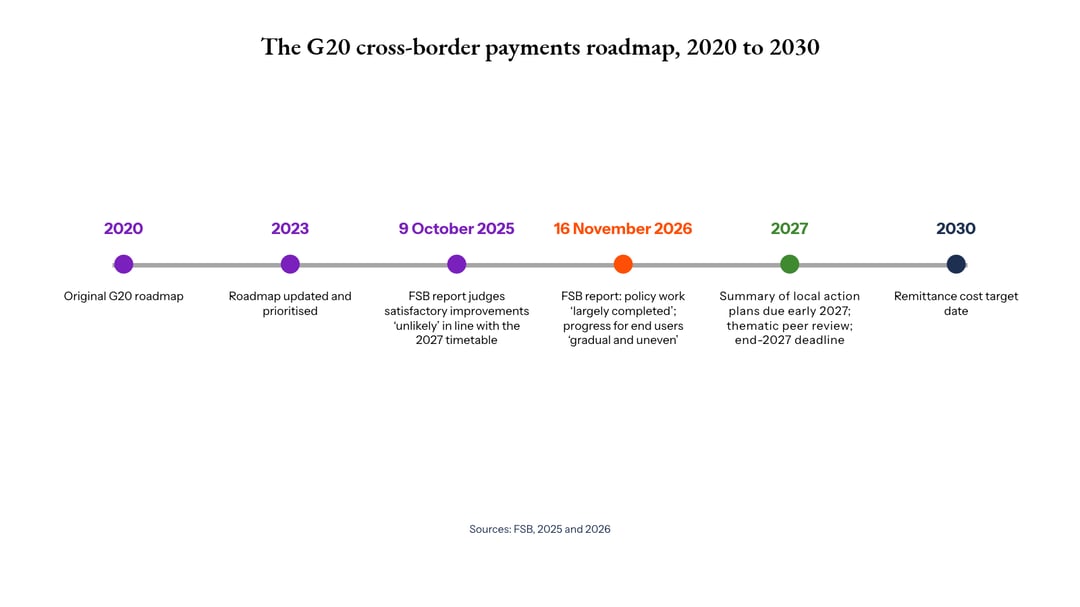
The Financial Stability Board (FSB) published its 2026 consolidated progress report on 16 November 2026. The international community has “largely completed policy work envisaged in the 2020 original and its 2023 updated and prioritised Roadmap”. Progress for end users “remains gradual and uneven across payment segments and jurisdictions”. Most of the 2027 targets will be missed.
On 9 October 2025, the FSB judged it “unlikely that satisfactory improvements at the global level will be achieved in line with the 2027 Roadmap timetable”. This year’s report says improvements in the KPIs are “starting to emerge after several years of limited progress”.
Sources: FSB, 2025 and 2026 consolidated progress reports
Most 2027 targets are already out of reach
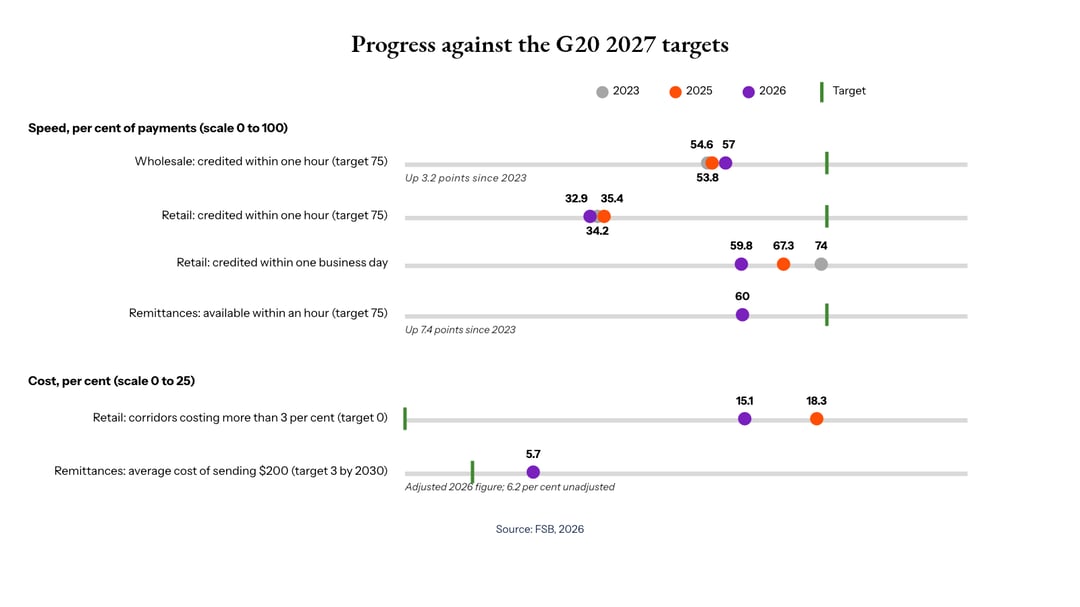
By end-2027, 75 per cent of wholesale payments should be credited within one hour. Retail payments should cost no more than 1 per cent on average, with no corridor above 3 per cent, and 75 per cent should arrive within an hour.
On the SWIFT network, 57 per cent of wholesale cross-border payments were credited within one hour in the first quarter of 2026, up 3.2 percentage points since 2023, after a fall to 50.6 per cent in 2024. That leaves an 18-point gap. The rise this year was 2.4 points, after a 4-point gain the year before. Some 93.9 per cent arrive within one business day.
Charlotte Schiøttz Hassing, Head of Products, Payments & Business Development at Banking Circle, said the report “highlights the gap between the ambition to improve cross-border payments and the progress being made in practice”.
The report states that “no measurable progress has occurred in the global average cost of retail cross-border payments since 2023”. The share of corridors costing more than 3 per cent has fallen to 15.1 per cent, from 18.3 per cent a year earlier and by 8.6 points since 2023.
The share of retail services crediting recipients within one business day fell from 74 per cent in 2023 to 59.8 per cent in 2026, including a 7.5-point drop last year from 67.3 per cent. Within one hour, it slipped from 34.2 per cent in 2023 to 32.9 per cent.
Some 60 per cent of remittance services now make funds available within an hour, up 7.4 points since 2023, against a target of 75 per cent in every corridor. The average cost of sending $200 is 5.7 per cent, against a 3 per cent goal for 2030. The fall in remittance costs since 2023 “was entirely due to adjustments to some local amount equivalents” to the $200 and $500 benchmarks. Without the rebasing, the averages would have been broadly unchanged at 6.2 per cent and 4 per cent.
Source: FSB, 2026 consolidated progress report, Annex 3
The delay sits in the last mile
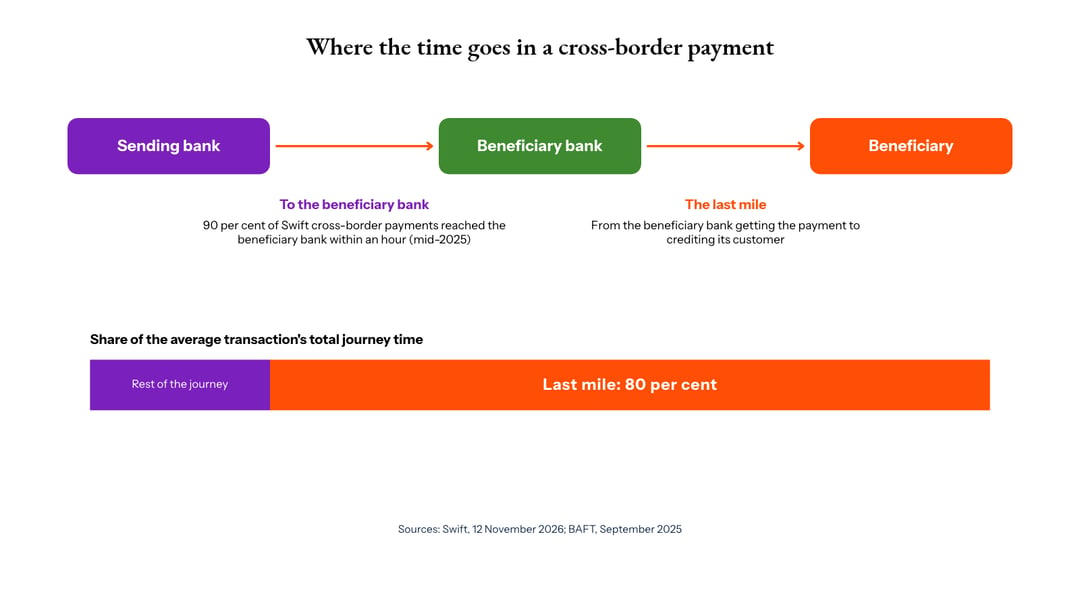
The report attributes faster wholesale crediting to a quicker beneficiary leg, the time between the receiving bank getting a payment and crediting its customer. SWIFT points to better data quality after the November 2025 move to ISO 20022. Data published on 12 November puts the last mile at 80 per cent of average journey time.
Thierry Chilosi, Chief Business Officer at SWIFT, said, “The challenge now is to tackle the inconsistency that we see in the last mile in markets around the world”. One-leg-out arrangements, which let domestic instant payment systems handle the local leg, “should absolutely be a priority”, he said.
In The BAFT G20 Global Roadmap: Accelerating Economic Stability for a Resilient Future, published on 23 September 2025, BAFT reported that as of mid-2025, 90 per cent of SWIFT cross-border payments reached the beneficiary bank within an hour.
Sources: SWIFT, 12 November 2026; BAFT, September 2025
Data localisation is getting worse
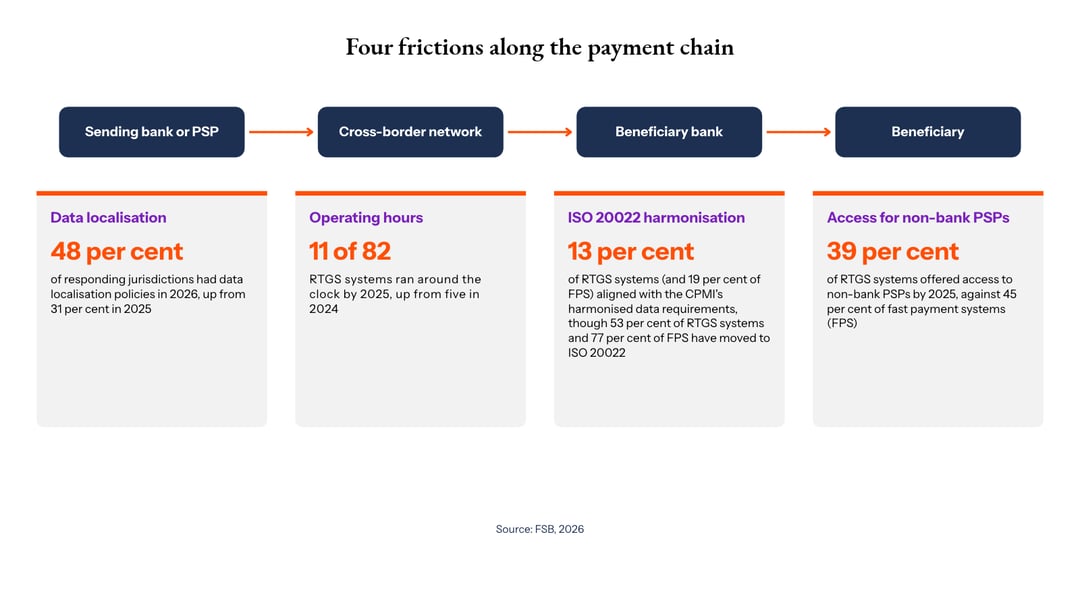
By 2025, 11 of the 82 real-time gross settlement (RTGS) systems surveyed by the FSB and the Committee on Payments and Market Infrastructures (CPMI) ran around the clock, up from five in 2024. Some 45 per cent of fast payment systems (FPS) and 39 per cent of RTGS systems offered access to non-bank payment service providers (PSPs).
Some 53 per cent of RTGS systems and 77 per cent of FPS have moved to ISO 20022. Only 13 per cent and 19 per cent respectively have aligned with the CPMI’s harmonised data requirements.
In 2026, 48 per cent of responding jurisdictions had data localisation policies, up from 31 per cent in 2025. Eight of them reported no legal pathway for cross-border data flows.
Source: FSB, 2026 consolidated progress report
A quarter of jurisdictions have no licensing or registration regime for PSPs. Some 32 per cent have not issued or updated regulatory and supervisory expectations since 2020, down from 43 per cent a year earlier. North America receives 74.2 per cent of wholesale payments within an hour, Asia-Pacific 28.8 per cent and Africa 26 per cent. Sub-Saharan Africa remains the most expensive region to receive a $200 remittance, at 6.6 per cent.
Treasurers should plan around actual corridor times
Treasurers paying suppliers in Africa and Asia-Pacific should plan around corridor-level times, not the one-hour target, and ask their banks for tracked end-to-end data. Receiver-side fees are 1.4 per cent on payments below $500, plus 0.9 per cent where currency conversion is needed, unchanged since 2024.
The report’s conclusion says the impact of the work “has not yet translated into the desired level of measurable improvements for end-users”.
“The focus now needs to shift from setting objectives to delivering meaningful improvements,” Schiøttz Hassing said.