



Large UK companies must publish how long they take to pay. We analysed 25,747 filings from 7,324 companies, with reporting periods starting between January 2024 and July 2026. Among the biggest filers, the 20 with the longest averages range from about 66 to 137 days – against a typical figure of 33.5 days in the same group. Drinks and packaging sit near the top, but chemicals, aerospace, wholesale and retail also appear. Most of these companies are paying within the terms they agreed. The next chapter of UK payment reform is about what happens when those terms get capped – and how supply chain finance can keep cash moving.
Ball Beverage Packaging Europe reported taking an average of 137 days to pay invoices in the second half of 2025. AB InBev UK reported 118. Telefónica UK, Coca-Cola Europacific Partners GB, Garmin (Europe) and Molson Coors all averaged between 84 and 93 days across their two 2025 reports.
That sounds damning. It mostly isn’t. Most of those companies are paying on time against long agreed terms. This story draws on 25,747 filings from 7,324 companies, all of them public statutory reports on the UK government’s payment practices register, organised for TTP by a data partner. It covers what the filings show about how large UK buyers fund their supply chains – and what the next wave of payment rules means for that model.
Why we can see this at all
Large UK companies and LLPs have been required by law to publish payment practices since 2017. Under the Reporting on Payment Practices and Performance Regulations 2017, a company is in scope when it exceeds two of three thresholds on its last two balance sheet dates: turnover of £54m, a balance sheet of £27m, or 250 employees. Reports must be approved by a director and filed at least twice a year on the government’s payment practices service.
From financial years beginning on or after 1 January 2025, the 2024 amendment regulations also require the value of invoices paid in each time bucket, not just the percentages, plus more on disputed payments. That is why monetary totals only appear in later filings.
TTP worked with a data partner to organise the filings. The analysis covers 25,747 reports from 7,324 companies, with periods starting between January 2024 and July 2026. Every company figure below is from that company’s own public report.
How we ranked the longest averages
Size still varies among qualifying companies. To keep the comparison fair we looked only at periods that started in 2025, and only at companies whose 2025 reports covered at least £1bn of paid invoices. That left 331 companies. We ranked them based on the average of their reported “average time to pay” figures filed for 2025.
The typical company in that group took 33.5 days (the median). Three-quarters took 46 days or less. The 20 with the longest averages sit well above that – from about 66 days up to 137 – and they span drinks, packaging, telecoms, chemicals, aerospace, engines, wholesale and retail. Read as a market snapshot of long contractual terms among very large buyers, not a league of villains.
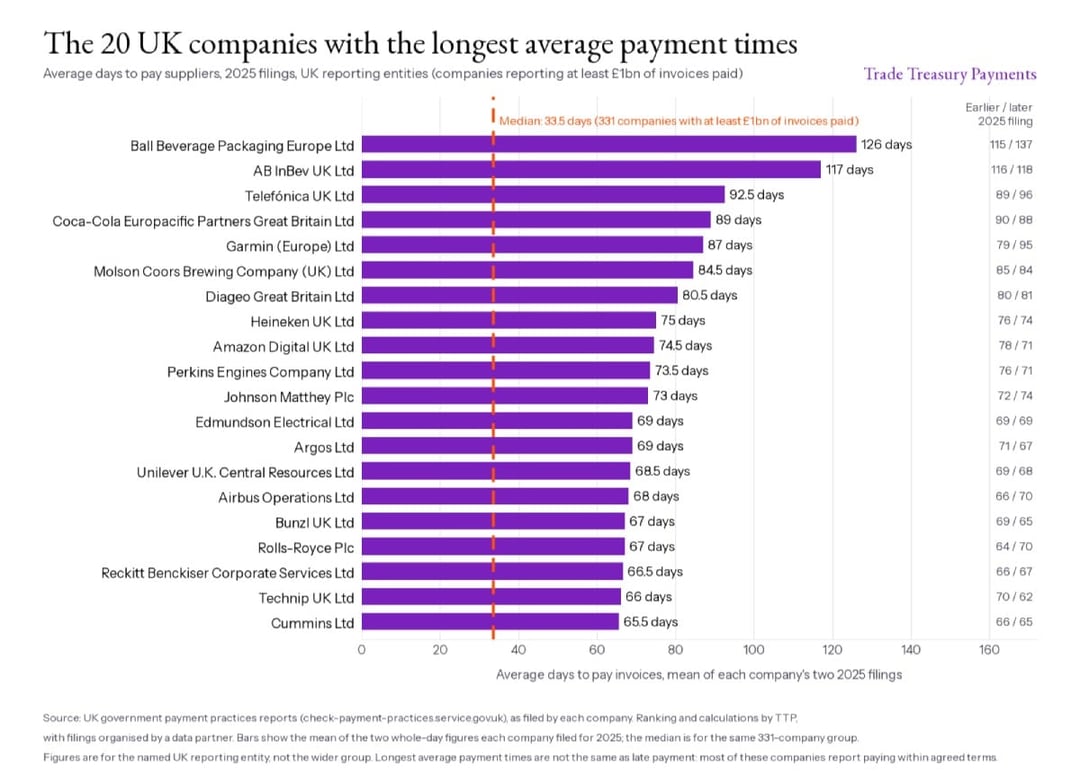
Source: UK government payment practices reports, as filed by each company. Ranking and calculations by TTP. Covers reporting periods starting January to December 2025, for companies reporting at least £1bn of invoices paid across their 2025 reports. Figures are for the named UK reporting entity, not the wider group. Most filers report calendar halves; Johnson Matthey reports April to September and October to March. Argos filed overlapping part-year and near-full-year reports from the same start date; both are shown as filed, and their invoice values should not be summed.
A note on supply chain finance (SCF)
How the government requires these figures to be reported can make some averages look longer than many suppliers actually wait. Where a supplier receives early payment through an SCF programme and bears a financing charge, the regulations count payment as made when the buyer settles with the finance provider, rather than when the supplier receives the cash. A supplier paid on day 15 could therefore appear in the data as having been paid on day 120. Where early payment is provided without a charge or deduction, the earlier date is used instead.
The reported averages may therefore include suppliers who have already received their money, and should not be read as the length of time every supplier waits for payment. Nor do the filings show how much of each company’s supplier spend is financed through SCF, or whether the buyer or the supplier bears the financing charge.
Drinks and packaging still dominate the very top. Further down the list the picture widens: chemicals (Johnson Matthey, Unilever Central Resources, Reckitt Corporate Services), aerospace and engines (Airbus Operations, Rolls-Royce, Perkins, Cummins), electrical wholesale (Edmundson), retail (Argos) and oil and gas services (Technip UK). That spread matters. Long averages are not confined to one industry.
For most of the 20, the share of payments made outside agreed terms was in single figures or low teens. AB InBev UK reported 1 per cent. Ball reported 2 per cent. Rolls-Royce reported 4 per cent. The exceptions are worth reading carefully rather than averaging away: Garmin (Europe) reported 39 per cent then 52 per cent outside agreed terms; Johnson Matthey 39 per cent then 55 per cent; Bunzl UK 40 per cent then 46 per cent; Cummins 42 per cent then 39 per cent; Technip UK 35 per cent then 30 per cent. Two names are also group service entities (Unilever U.K. Central Resources and Reckitt Benckiser Corporate Services), so their figures should not be read as the whole consumer brand.
Long terms, not late terms – and where SCF fits
What sets most of these companies apart is the length of the terms they agree, not a habit of missing them. A long contractual term is not the same as a late payment. The filings measure both, and they tell different stories. Average time to pay records how long the cash takes to arrive. The share not paid within agreed terms records whether the buyer missed the date in the contract. Ball’s latest filing gives standard payment periods of 180 to 270 days. Its later 2025 average of 137 days is shorter than those standard terms. Only 2 per cent of its invoices were reported as not paid within agreed terms. AB InBev UK, at 118 days in its later filing, reported 1 per cent outside terms. Rolls-Royce, at 70 days, reported 4 per cent. For most of these 20, the long averages record the terms on the contract, not bills left unpaid past their due date. Ball also says it “offers financing facilities that allow certain suppliers to obtain payment earlier than the contracted due date (subject to finance charges)”. Fifteen of the twenty companies in the table reported offering supply chain finance on at least one 2025 filing.
That is the constructive reading. Stretching contractual terms while offering early payment through SCF is often a deliberate working-capital strategy: the buyer’s cash stays longer, and suppliers that want cash sooner can sell the receivable. Done well, that need not starve the supply chain, and can get cash to smaller suppliers earlier at rates priced off the buyer’s credit. Done badly – long terms with no early-payment option, or access limited to a few large suppliers – it does. The filings do not show which programmes work for smaller suppliers. They do show that SCF is already common among the longest-term buyers. Supply chain finance, also called payables finance, works in three steps. The buyer approves a supplier’s invoice, a bank or other funder pays the supplier early at a discount priced off the buyer’s credit rather than the supplier’s, and the buyer pays the funder at maturity. Both sides gain: the supplier gets cash early and cheaply, while the buyer keeps its agreed terms and a steadier supply chain.
Treat the numbers carefully
These filings are useful. They are also imperfect.
The figures are self-reported and unaudited, though a director must approve each report and filing false or misleading information is an offence. They cover the UK reporting entity, not the parent group, and one corporate family can file for several companies. Payment terms can also vary by entity and by contract type, and companies describe those terms in narrative form rather than from a fixed list, which makes it harder to compare like with like when judging whether a buyer has paid on time. There is no company-declared sector field. Reporting periods are not always aligned. Invoice values have only been required for financial years beginning on or after 1 January 2025, so older reports are thinner, and many entries still leave values blank even when they report payments after 60 days. A few filings contain obvious outliers, which we excluded from the cross-year averages. Supplier mix also matters: terms with other large companies, and intra-group payments, can pull an average up without saying much about how a buyer treats its smallest suppliers – and the bill’s large-to-large exemption makes that distinction material.
Across the cleaned set, average time to pay was 34.4 days in both 2024 and 2025. The share of invoices paid after 60 days was 11.9 per cent in both years. The share not paid within agreed terms fell from 23.0 per cent to 21.7 per cent. Among companies that reported values, £236bn of about £1.98tn of invoices (11.9 per cent) was paid after 60 days.
How we got here – and where the rules go next
UK late-payment law did not start with this bill. The Late Payment of Commercial Debts (Interest) Act 1998 gave businesses a statutory right to interest on overdue commercial debts. The EU’s Late Payment Directive 2011/7/EU, transposed in the UK in 2013 mainly through the Late Payment of Commercial Debts Regulations 2013, set a 30-day limit for public authorities and a 60-day limit for business-to-business deals unless a longer term was expressly agreed and not “grossly unfair” to the supplier. Interest runs at the Bank of England reference rate plus 8 percentage points, plus fixed recovery costs. France already applies a hard 60-day maximum for most business-to-business payments, or 45 days end of month, and did not take up the 2011 directive’s option to allow longer terms where they are not “grossly unfair”.
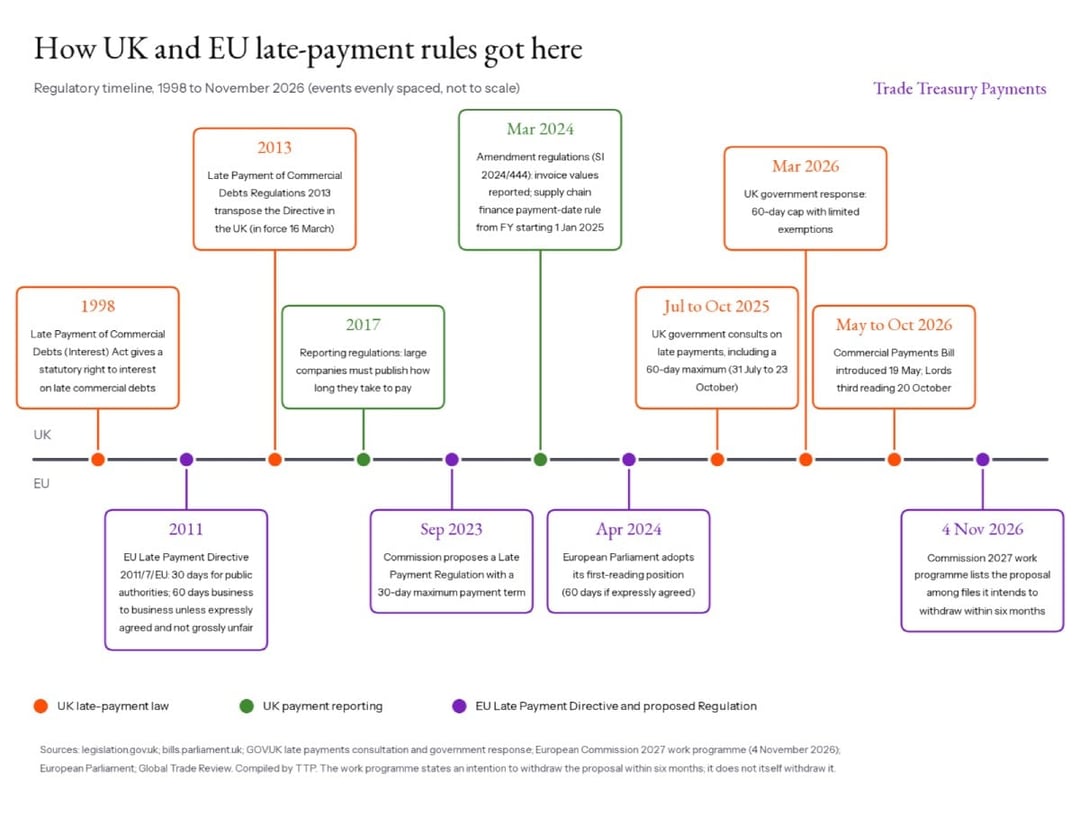
The 2017 reporting regulations then added sunlight. The old Prompt Payment Code has been replaced by the Fair Payment Code, run by the Office of the Small Business Commissioner, with Gold, Silver and Bronze awards.
In the EU, a 2023 Commission proposal would have replaced the 2011 directive with a hard 30-day maximum on payment terms. Trade bodies including ITFA and FCI warned that a 30-day cap would leave banks without a reasonable return on funding supply chain finance and push businesses towards costlier alternatives, as Global Trade Review reported. Parliament adopted its first-reading position in April 2024, allowing 60 days where expressly agreed, but a sizeable number of member states opposed the file in the Council. In its 2027 work programme, published on 4 November 2026, the Commission listed the proposal among the files it intends to withdraw within six months, saying it was unlikely to secure Council support within a reasonable timeframe. ITFA’s chair, Sean Edwards, said in July 2024 that member state delegations in the Council had picked up the association’s point that the draft would “suck liquidity out of the supply chain”. If the Commission follows through, the 2011 directive would remain the EU baseline – the result the trade bodies had argued for. SME groups such as SMEunited have criticised the planned withdrawal.
In the UK, a late-payments consultation ran from 31 July to 23 October 2025. The government responded on 24 March 2026 and introduced the Commercial Payments Bill on 19 May. The bill would cap payment terms at 60 days (30 days where a public authority is the buyer), a looser limit than the 30 days Brussels proposed for business-to-business deals, and remove the current “grossly unfair” test that lets longer terms stand. The cap is aimed at larger buyers paying smaller suppliers: under the bill text, contracts between two large companies, and contracts where the buyer is the smaller party, can be exempted, provided the contract is in writing and says so, and once regulations define company size.
The government response also proposed exempting imports and exports. Neither the response nor the bill’s exemption clause names supply chain finance. The bill would also mandate interest at 8 per cent above base rate, and contractual terms seeking to exclude or vary that rate would have no effect. It would strengthen dispute rules, ban construction retention clauses, and expand the Small Business Commissioner’s powers to investigate poor payment practices, adjudicate disputes between small and larger businesses outside the courts, and impose financial penalties of up to 1 per cent of annual turnover, with the detail of those penalties to be set in regulations. Where a contract does not specify a payment term, or a term is void for exceeding the cap, the bill would imply a term of 30 days, though the parties could still agree another period within the statutory maximum. It completed its Lords third reading on 20 October 2026 and now goes to the Commons. There will be a transition period. No commencement date has been fixed in the bill itself. The government told Parliament on 19 October 2026 that, subject to royal assent and secondary legislation, most measures are expected to come into force in late 2027 or early 2028.
What treasurers should take from this
The filings already do what the 2017 regulations intended: they make payment behaviour visible. The next rules will go further, by capping many of the long terms that currently drive the averages in our table. Buyers that have built working capital around 120- to 270-day terms will need to rethink the contracts that fall inside the cap – and how they keep suppliers funded if those terms shorten.
That is where supply chain finance earns its keep. If statutory terms compress, early-payment programmes, dynamic discounting and payables finance become more important for getting suppliers paid sooner, not less. But programmes that work by extending contractual terms, particularly where the supplier bears the financing charge, will sit awkwardly with a 60-day cap on the contracts that fall inside it. The opportunity is to treat payment terms and supplier funding as one design problem: transparent, within the law, and usable by the suppliers that need cash most. The data is messy. The direction of travel is clear.