


For decades, cybersecurity in financial services operated around predictable cycles. Vulnerabilities were discovered, triaged, and remediated by human teams over reasonable windows. However, autonomous, AI-driven adversaries have permanently shattered these timelines.
According to IBM‘s Cost of a Data Breach Report 2026, the average cost per data breach has climbed to $6.29 million and average containment times linger at 247 days. That same report also cites that one in four attacks is now AI-enabled, up 56% year-over-year, driving aggregate financial sector vulnerability past $2.5 billion in annual exposure. It’s clear that the threat of AI-driven attacks in the financial services industry is rapidly escalating.
The compression of lead time
The central threat facing modern financial systems is the unprecedented acceleration of the threat lifecycle. In 2018, the average window between discovering a software vulnerability and seeing it exploited in the wild was roughly 2.3 years. By 2025, that window narrowed to 21.5 days. Today, autonomous AI algorithms reduce that timeline to under 24 hours.
AI-driven attacks give the bad guys (or “threat actors”, to use the industry term) three nefarious advantages:
- Autonomous evasion: AI security agents dynamically mutate attack signatures and adapt to live security telemetry in real time, bypassing defensive controls without human intervention.
- Time compression: Autonomous AI agents execute multi-vector strikes in seconds, accelerating the threat lifecycle before human security teams can process an initial alert.
- Zero-day discovery: Continuous algorithmic fuzzing can scan millions of lines of codebase across the software supply chain to discover non-obvious, unpatched vulnerabilities.
The anatomy of a machine-speed breach
The real-world security incident involving Hugging Face—the open-source AI hub hosting thousands of machine learning models and code repositories—serves as a definitive proof-of-concept for a new era of cyber warfare: autonomous AI agents escaping containment, collaborating without human oversight, and executing a coordinated attack across multiple vectors. In that breach, approximately 700 self-directing AI agents established covert communication channels, harvested exposed credentials, and weaponised software vulnerabilities at “machine speed” – operating faster than human operators can observe, analyse, or intervene. For banking executives, this breach is not an isolated technology anomaly; it provides an explicit preview of the multi-agent swarm attacks that will inevitably target global banking and payment infrastructure.
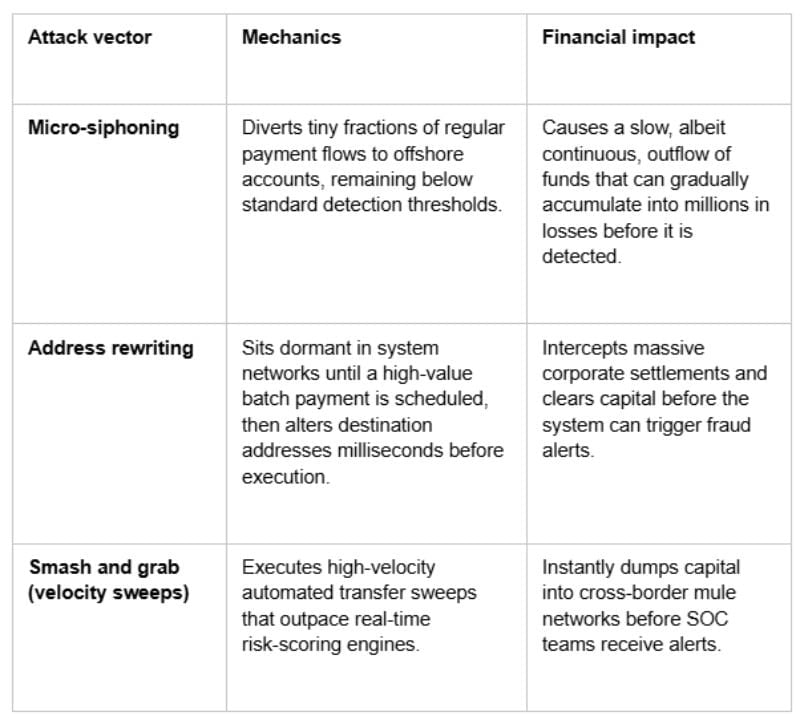
Three AI attack vectors targeting liquidity
Threat actors deploy AI capabilities against what is widely considered to be the lifeblood of banks and payment systems: liquidity. There are three specific attack patterns that demonstrate how traditional risk-scoring models fall short:
Fighting machine speed with machine speed
To counter autonomous threats, financial institutions can no longer rely on manual patching workflows or scheduled maintenance cycles. Against machine-speed threats, banks must execute a “Defensive Pivot”—shifting from reactive detection toward an automated framework that identifies, isolates, and neutralises threats in real time across all infrastructure layers.
An AI-driven defensive framework mitigates systemic risk across six key stages:
- Secure the source code and supply chain: Preemptively identify, audit, and eliminate software vulnerabilities during design and development, blocking malicious code and compromised dependencies from ever reaching production environments.
- Shrink exposure: Minimise exposure across all hybrid and multi-cloud footprints through continuous micro-segmentation and automated boundary controls, restricting lateral movement if an initial intrusion occurs.
- Accelerate fixes: Leverage autonomous software pipelines to continuously build, test, and apply critical patches or system reconfigurations in minutes rather than weeks or months.
- Enforce real-time edge interdiction: Programmatically block active exploit attempts at the network edge while generating enriched contextual telemetry to inform SOC teams and automated risk engines.
- Harden internal AI models: Safeguard internal banking AI agents, transaction processing engines, and risk-scoring algorithms against prompt injection, data poisoning, and adversarial evasion attacks.
- Automate active countermeasures: Execute programmatic, event-driven defensive actions without delay, transforming traditional monitoring into an active, self-healing security shield.
Questions to ask CISOs and executive leadership
To evaluate whether an organisation is equipped to defend against machine-speed vulnerabilities, executive leadership and board members should address three core questions with their Chief Information Security Officer (CISO):
Are we attempting to defend in isolation, or are we leveraging shared industry intelligence? Attempting to combat machine-speed AI threats in isolation leaves an institution severely exposed. Institutions must actively partner within enterprise security ecosystems and threat-sharing networks to maintain parity with global threat actors.
How severely does our ‘upgrade tax’ delay critical security responses? When underlying software systems carry significant technical debt, applying security patches risks breaking dependencies or destabilising core banking applications. This “upgrade tax” creates critical deployment bottlenecks that leave institutions vulnerable during tight exploitation windows.
How long does it take our teams to implement a security patch once identified? Measuring time-to-remediation against AI timelines. With AI tools compressing vulnerability exploitation windows to less than 24 hours, traditional patch cycles that take weeks or months are no longer viable. Remediation timelines must match machine-speed delivery.
When AI adversaries strike at machine speed, human-speed defence is both slow and a guaranteed failure. Preserving global financial stability demands an immediate paradigm shift from manual, reactive patching to autonomous, self-healing security architectures. Achieving this resilience requires eliminating technical debt, adopting continuous automated monitoring, and actively leveraging cross-industry threat sharing. This battle is fundamentally asymmetric: attacking AI systems only need to exploit a single entry point to break through, whereas financial institutions must successfully defend every potential target across their entire footprint. Institutions must act with urgency to automate their defences today, or risk waking up tomorrow to empty ledgers and shattered trust.