

When the AI is right and the payment is wrong: the other side of the ledger
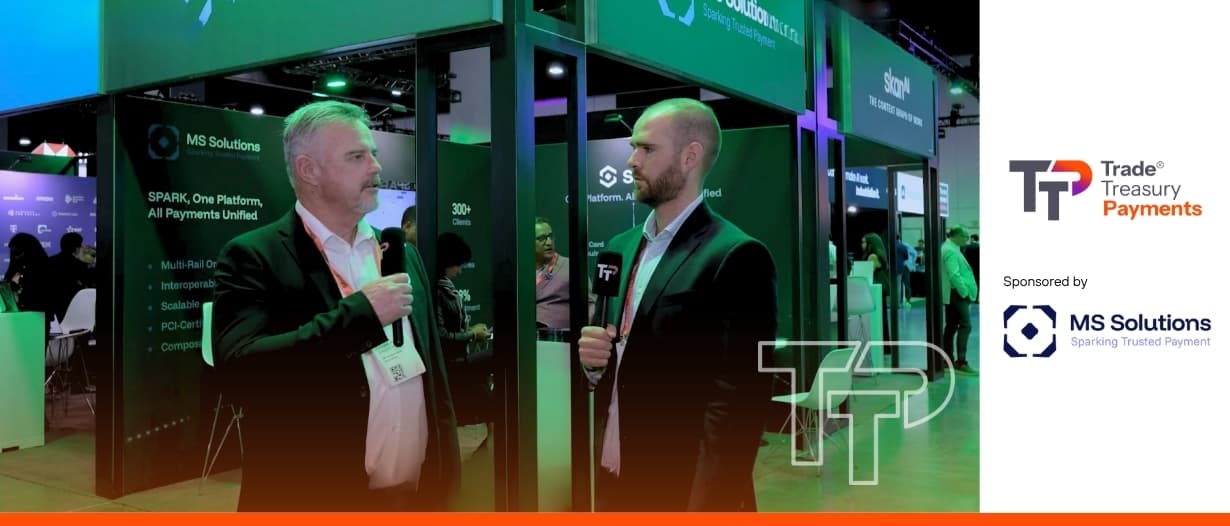
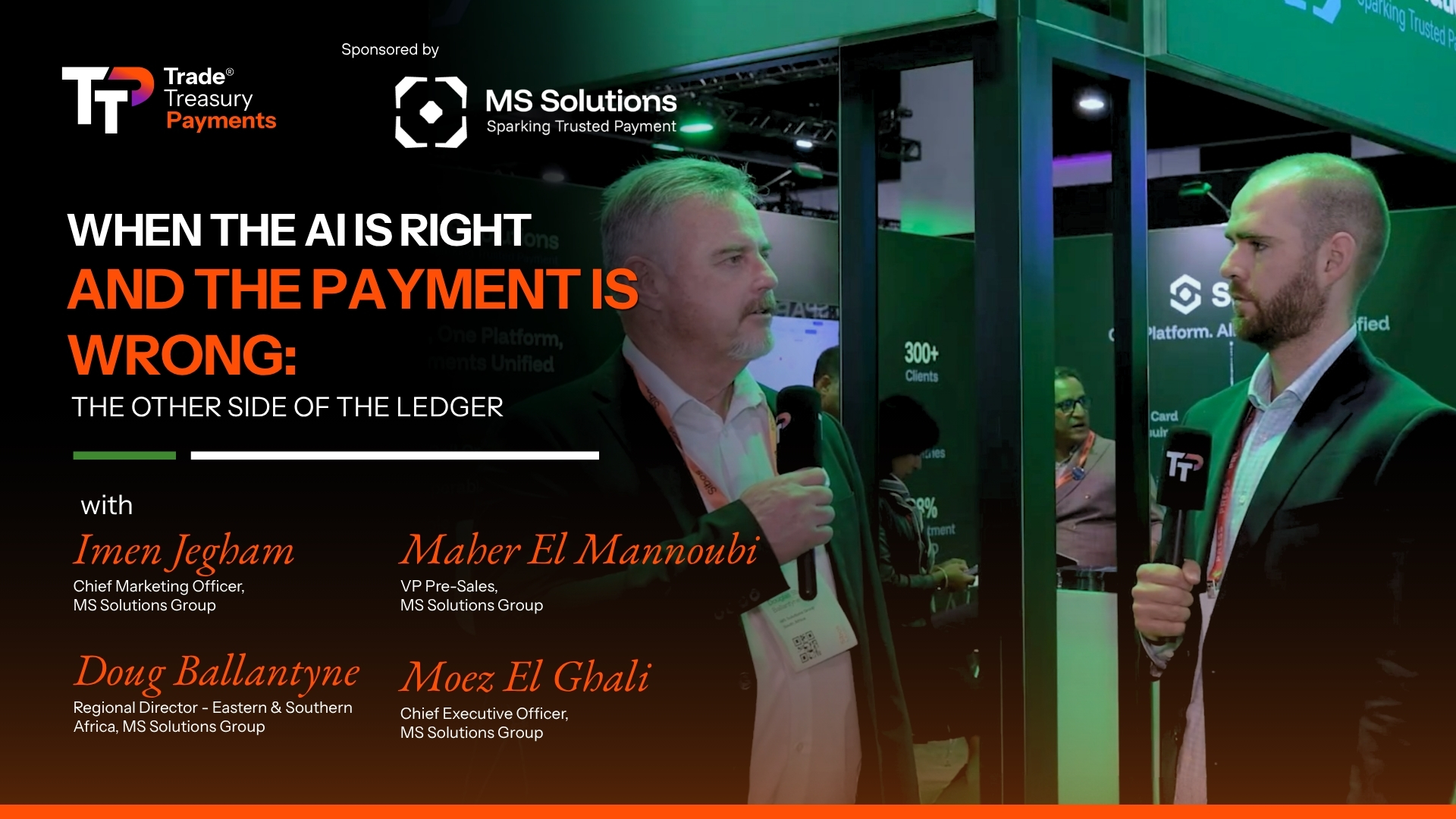
Doug Ballantyne, Regional Director for Anglophone Africa at MS Solutions Group told a live session on the Discover stage at Sibos in Miami that banks rushing to add AI to clearing and settlement may be starting at the wrong end of the transaction.
In April 2024, a Californian middleware company called Synapse filed for bankruptcy, and around 100,000 people discovered what happens when their money sits in two sets of books that nobody can reconcile. Synapse sold banking-as-a-service, the software that lets consumer apps offer accounts without being banks themselves. Its clients included Yotta, a savings app that paid lottery-style prizes instead of interest, and the crypto app Juno. Synapse kept one ledger of who owned what, and the partner banks holding the money kept their own. When the company went under, the records disagreed. By June, the court-appointed trustee, former FDIC chair Jelena McWilliams, had put the shortfall at $85 million. Deposit insurance was no help because the FDIC does not cover the failure of non-banks such as Synapse.
A year earlier, Circle had $3.3 billion of the roughly $40 billion backing its USDC stablecoin sitting at Silicon Valley Bank. It sent wires on Thursday 9 March 2023 to move the money. They had not been processed when regulators closed the bank the following day. Over the weekend, USDC fell to 87 cents. It recovered after US authorities guaranteed every SVB depositor on the Sunday, but for three days the issuer of a digital dollar could not say where one in 12 of its dollars was.
Doug Ballantyne put both cases on screen during his Sibos session, “Why AI alone won’t accelerate payment clearing and settlement”. “Both had AI available to them, but neither could prove what was true,” he said. His thesis followed from it: “AI can improve settlement intelligence, but it can’t replace settlement control.”
Luca Pacioli would have recognised the problem
When the Franciscan friar Luca Pacioli set out the rules of double-entry bookkeeping in Venice in 1494, the principle was that every entry has another side, and somebody answers for the balance. Five centuries later, the transaction has been cut into pieces. Ballantyne showed nine stages in a transaction’s life cycle. Any one of them might sit with a different system, team, or provider, each doing its own job perfectly well. Fraud minimises losses, authorisation maximises approvals, operations protects the cut-off and finance closes the ledger. “You can hit every local target and still lose that transaction,” he said.
Ballantyne called fragmentation “the most misdiagnosed word in payments”. “Fragmentation is where every system has a valid view, and nobody owns the end-to-end story,” he said. Operations sees an unmatched item, finance a suspense balance, IT an interface incident, compliance an alert, and the processor a file-status problem. Every one is right in its own lane, but nobody owns the outcome. At Synapse, the individual books could balance while the handover between them did not. “I’d never tell a bank its problem is too many vendors,” Ballantyne said. “The breaks happen at the handover, not inside one box.”
Being right after the money has gone is still wrong
A fraud model correctly identifies a suspicious transaction. The authorisation system can’t act on that decision in time, and the payment clears and settles anyway. “The model was right,” Ballantyne said. “The loop wasn’t there.”
On older rails, there may be a route back. On instant payment rails, control increasingly has to happen before acceptance. A warning delivered after an irrevocable payment has gone is not much of a control. Ballantyne described the necessary loop in five verbs: observe, decide, enforce, record, and learn. Most institutions, he said, stop at decide. The intelligence layer is visible and “demos really well”: buy the model, build the dashboard, create the alert queue. Unless somebody has established what happens next, the result may simply be better detection of problems that still go unresolved. “Intelligence without enforceability is just another alert.”
Whoever owns the ledger holds the leash
More of the payments stack can now be rented. Ballantyne listed the ledger, tokens, and agents among the infrastructure that can sit outside a bank’s own estate. If a bank rents its system of record from a middleware provider, wallet platform, or hyperscaler, who owns the authoritative version of the transaction?
An AI agent transacting on a customer’s behalf needs credentials, limits, and authority that can be revoked. In the trade’s terms, it needs a token domain. “The only question is who holds the leash?” If the domain belongs to the bank, the agent operates as a client of its ledger, within rules the bank controls. If it belongs elsewhere, the bank is relying on another party’s version of the transaction, and its AI may be learning from only part of the story.
Ballantyne pointed to an unlikely group of payments pioneers: coffee chains, grocers, and other large retailers with their own wallets. “Retailers worked this out before banks did,” he said. “None of them rents the ledger.”
Start with one payment flow
Ballantyne identified reconciliation assistance, settlement-break prediction, fraud scoring, and liquidity forecasting as areas where AI can earn its keep. As he put it, AI can forecast a position, but only a position you can see.
His prescription is a 90-day programme built around one critical payment flow. Map every system, file, interface and handover, and identify where references change, transaction statuses conflict or ownership becomes unclear. Then set a baseline from the measures operations teams already track: unmatched items, exception ageing, manual intervention, suspense balances and the share of risk decisions that end in an enforced action.
With that in place, name the authoritative source and the control owner for each critical transaction state, and connect the events that carry a decision through to its outcome. Only then pilot one bounded AI use case, with known ground truth, reversible actions, and governance, audit evidence and a deterministic fallback in place before it goes into production. After 90 days, nothing has been rebuilt, but the institution knows where the payment chain breaks. Skip that work and, in Ballantyne’s phrase, the bank risks “automating ambiguity”.
MS Solutions Group says it serves more than 300 clients in over 30 countries, including Société Générale, QNB, and Ecobank. Its SPARK platform covers issuing, acquiring, clearing, settlement, and fraud management, bringing the stages Ballantyne described into a single environment.
Pacioli’s rule has survived every technology since the printing press helped spread it. AI does not repeal it. Or, as Ballantyne put it five centuries later: “AI can help you see and decide. It can’t post the other side.”