
How tokenisation and AI is shaping transaction banking modernisation
Within transaction banking, we are seeing legacy architecture built around messaging and delayed settlement slowly give way to real-time, data-driven systems designed to facilitate immediate execution. As the industry marches forward towards instant clearing, automated decision-making, and digital assets, it must manage a major structural hurdle: technology can only move as fast as the trust that underpins it.
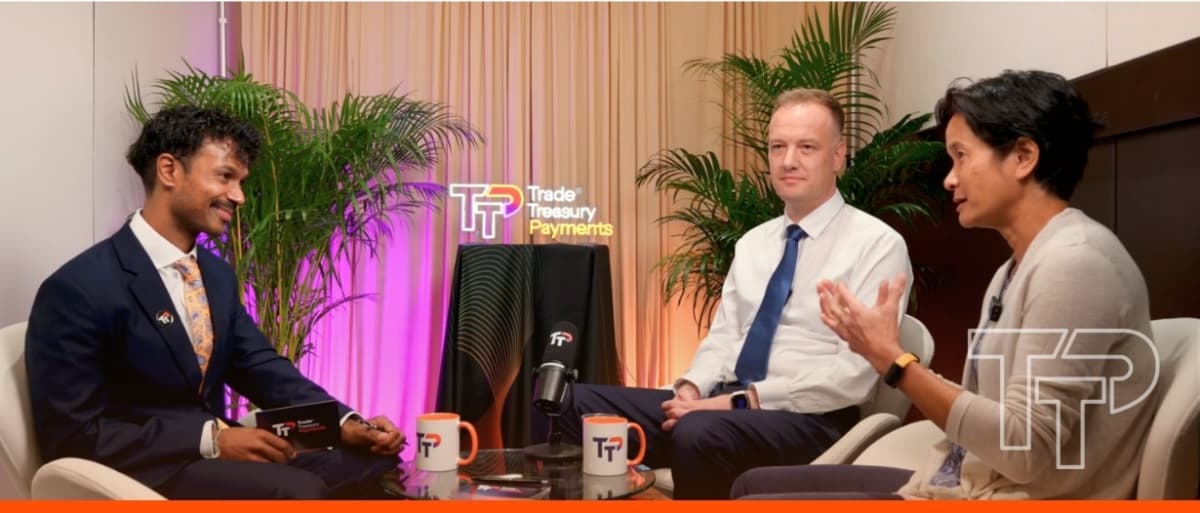
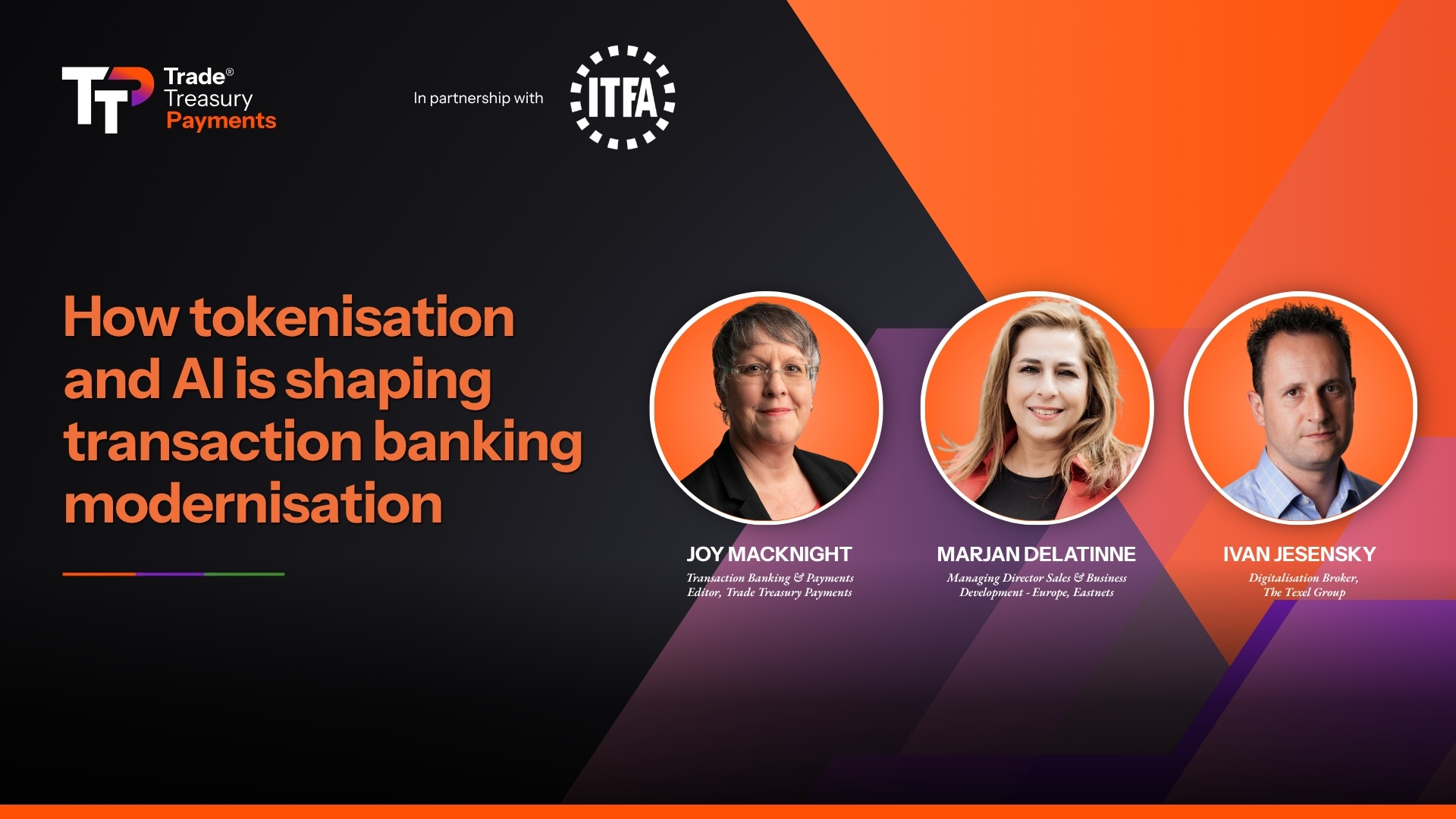
In a TTP Studios production from on the ground at the ITFA Annual Conference in Split, Croatia, Joy Macknight, Transaction Banking and Payments Editor at Trade Treasury Payments, was joined by Marjan Delatinne, Managing Director Sales and Business Development Europe, Eastnets, and Ivan Jesensky, Digitalisation Broker, The Texel Group for a fascinating conversation exploring how the convergence of structured data, AI, tokenisation, and digital identity is beginning to redefine liquidity, risk, and operational trust across global finance.
The role of data and AI
Artificial intelligence (AI) is becoming embedded in every aspect of daily life. Certainly, it is being woven more and more into transaction banking. To deliver meaningful modernisation, however, it needs a clean, reliable foundation. That foundation is data. “AI could be very good, but it is as good as the data,” observes Delatinne.
This isn’t necessarily to say there is a lack of information to feed AI systems. Indeed, banks sit on vast reserves of information, but extracting value from it remains a complex challenge. For Delatinne, structure is the key to overcoming this challenge. “You cannot create… magic if the data is not structured enough,” she explains. “The problem is not that data doesn’t exist; data is there, but it needs to be consumed and structured in the right way so that AI can make the right decision”.
As Jesensky observes, moving from manual, paper-based processes to structured digital data and leveraging AI’s ability to handle “mass data sets” leaves behind slow, periodic reviews and allows institutions to execute real-time credit assessments and continuous risk monitoring. “It reduces the fraud, it reduces the defaults, and it increases your productivity”.
Beyond formatting and structuring data, provenance is key. Being able to verify where data originates, who stands behind it, and how risk has been evaluated is particularly crucial in high-speed financial operations, where instant execution leaves virtually no margin for delayed risk reviews.
Fragmentation creates challenges
While technological strides are undoubtedly being made, operational fragmentation remains a major roadblock in digital operations. Within a single institution, many systems like screening, anti-money laundering (AML), Know Your Customer (KYC), and transaction monitoring frequently operate in isolated silos. Fraud is often only detected after transactions have already been settled because these systems are not synchronised. Connecting disparate systems internally is a big enough challenge; connecting them across external market infrastructure presents a significant hurdle.
There is no single ecosystem at the moment, “even though we would love to have one,” observes Jesensky. Rather, “it is about considering how many different integrations you have to do and how can you then connect all of those different participants… selecting the right components across the desired ecosystem… still remains very difficult to execute.”
Navigating regulatory frameworks presents further complications to integration efforts. While institutions look to automate workflows, they must strictly adhere to evolving compliance mandates. The foundational standards, however, are beginning to align. ISO 20022 presents the standard for rich data structuring, while global frameworks like the FATF Travel Rule are in place for cross-border asset tracking.
Digital identity and portable trust
Underpinning efficient real-time operation must be trust; specifically, trust that moves seamlessly alongside financial assets. This need has driven the emergence of a call for what Delatinne describes as “portable trust” – a mechanism whereby verified compliance, entity details, and transaction data are bound together and move across the transaction lifecycle.
At the centre of this paradigm shift toward portable trust is digital identity. Verifiable credentials, for example, allow entities to automatically verify data without exposing sensitive underlying information. For Delatinne, digital identity is “at the heart of everything that will enable scalable migration”. Theoretically, this identity would be created at initiation, embedded, and move “with the transaction like a compliance passport”.
Regulatory pushes like Europe’s eIDAS 2.0 framework are mandating that financial institutions accept these digital credentials in a push to accelerate their adoption across trade and transaction banking and turn this theory into reality.
Jesensky reinforces Delatinne’s view, noting that digital identity is also often the missing link in broader transformation initiatives. “You have your digital token, but that digital ID is often forgotten,” he observes. If when the token is created, a digital ID is associated with it that “travels with it for the life cycle of the transaction,” Jesensky believes this will help all institutions find the requisite level of trust.
Tokenisation’s true value
On the topic of tokenisation, its immense potential cannot be denied. Its real-world implementation in corporate banking, however, requires deeper integration. Many tokenised assets still funnel back into legacy architecture because secondary market liquidity remains underdeveloped.
To unlock real value, tokenisation must connect separated domain silos like trade finance, payments, and capital markets to release trapped collateral and optimise corporate balance sheets. We are already seeing early examples of how capital markets and real-time payment channels are beginning to merge in the rapid rise of fiat-backed stablecoins and tokenised money market funds. Indeed, Delatinne believes that the proliferation of stablecoins backed by fiat currencies besides the USD could, in coming years, have an impact on “the financial inclusion and the accessibility that the market would get”.
Jesensky offers insight into how this evolution applies to complex debt and risk structures. “Tokenisation can provide opportunities, new models, and growth for trade finance, syndicated loans, bond issuance, and credit insurance”. While banks will not immediately migrate en masse to new platforms, “having the ability to connect with APIs… to a tokenised platform and take advantage of the digital assets and bonds being issued… I think that’s the way to go”.
The future is data-driven
Looking forward to the next five years is to hopefully look at an industry that is moving away from viewing emerging technologies in isolation. Market participants instead seem to be envisioning an integrated framework where AI, tokenisation, and digital identities are not seen as separate technologies, but rather operate as a single, cohesive engine.
This is certainly Jesensky’s view. “We would love to say that we envisage tokenisation and AI to be considered as one technology rather than splitting them,” he says. His ideal digital ecosystem five years from now is one supported by AI and tokenisation where counterparties like corporate borrowers, arrangers, and insurers manage syndicated loans and credit policies on a unified, DLT-driven platform with real-time settlement and automated risk monitoring.
But even in such a future, challenges abound. As Delatinne warns, “AI will help us take faster decisions, but AI has its own danger,” noting the caution banks take even in using AI solutions within the context of compliance. But she concludes with optimism: “we are at the beginning of something that should converge in order to remove the whole risk with settlements, with liabilities, with the impact on the balance sheets”.
Prefer to listen? The full conversation is also available as a podcast below.
Key Topics
- Transaction banking is moving from messaging-based, delayed-settlement architecture towards real-time, data-driven systems.
- Structured, reliable data is the foundation that AI needs to support meaningful modernisation in transaction banking.
- Digital identity and portable trust are needed so that verified compliance and transaction data travel with financial assets.
- Tokenisation could connect trade finance, payments and capital markets to release trapped collateral and optimise balance sheets.
- Fragmented, siloed systems across institutions and external market infrastructure remain a major barrier to digital operations.
Key Insights
Expert Analysis
Marjan Delatinne, Managing Director Sales and Business Development Europe at Eastnets, argues that AI is only as good as the data behind it, and that structure is the key to extracting value from the information banks already hold. She describes digital identity as central to scalable migration, and proposes "portable trust" as a mechanism in which verified compliance, entity details and transaction data are bound together and move across the transaction lifecycle. She cautions that AI carries its own dangers, particularly in compliance, while expressing optimism that convergence could remove settlement and liability risk.
Key Findings
- Legacy architecture built around messaging and delayed settlement is giving way to real-time, data-driven systems.
- Fraud is often detected only after transactions have settled because screening, AML, KYC and monitoring systems are not synchronised.
- There is no single ecosystem at present, and selecting and connecting the right components across an ecosystem remains very difficult.
- Many tokenised assets still funnel back into legacy architecture because secondary market liquidity remains underdeveloped.
- ISO 20022 provides the standard for rich data structuring, and the FATF Travel Rule applies to cross-border asset tracking.
Implications
- Institutions that move from manual, paper-based processes to structured digital data can carry out real-time credit assessments and continuous risk monitoring.
- Digital identity is often the missing link in broader transformation initiatives, so tokens need an associated digital ID that travels with them.
- Instant execution leaves little margin for delayed risk reviews, which makes provenance of data and risk evaluation particularly crucial.
- Regulatory moves such as Europe's eIDAS 2.0 framework require financial institutions to accept digital credentials, which may accelerate adoption across trade and transaction banking.
- Fiat-backed stablecoins beyond the USD could, in coming years, affect financial inclusion and market accessibility.
Key Takeaways
- Clean, well-structured data is a precondition for AI to deliver meaningful modernisation in transaction banking.
- Integrating siloed systems internally and across external market infrastructure is a significant and ongoing challenge.
- Portable trust, supported by digital identity, is central to enabling real-time, scalable transaction processing.
- Tokenisation needs deeper integration with corporate banking and secondary market liquidity to deliver real value.