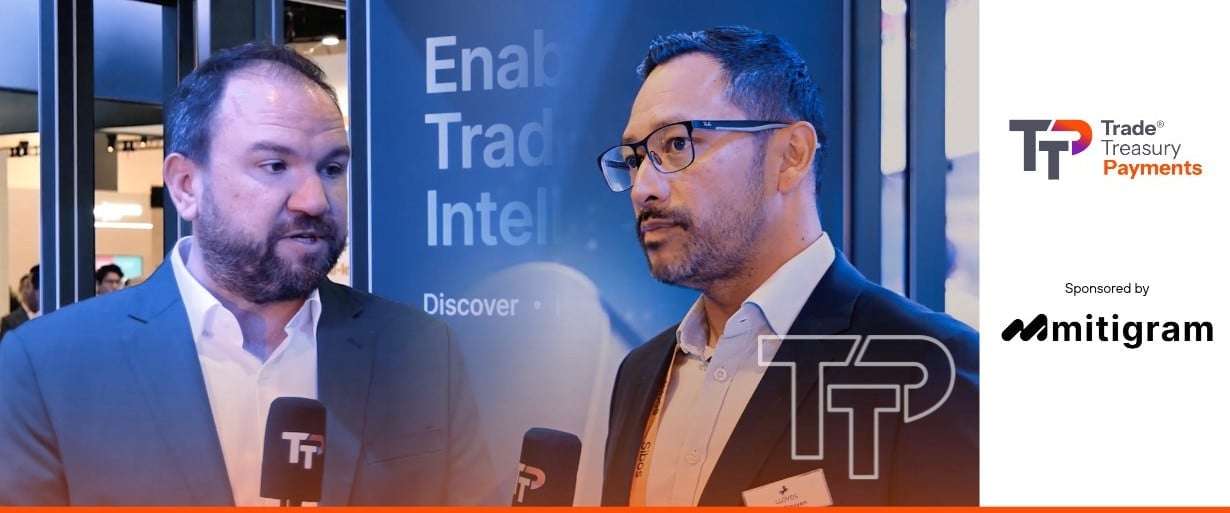


At Sibos in Miami, Lisa Francis and Surath Sengupta of Lloyds told TTP Studios why the bank moved on electronic trade documents before UK legislation was in place, and why it is now building routes with partner banks in markets still waiting for theirs.
Lloyds Bank started trialling digital trade documents before the UK’s Electronic Trade Documents Act (ETDA) came into force. It is now building digital corridors with partner banks in jurisdictions that still haven’t given electronic documents full legal standing.
Speaking to Deepesh Patel, Editor-in-Chief of Trade Treasury Payments, at TTP Studios in Miami, Surath Sengupta, Managing Director and Head of Transaction Banking Products at Lloyds, said the decision to move early was driven by client demand.
“Why is digital trade important? Not because it’s a great innovation, not because there’s paper that’s taken out,” he said. “It’s because from a client perspective, it shortens their working capital cycle, and they get to money faster and hence cheaper.”
Lloyds says it completed the first transaction under the ETDA, a digital promissory note for retailer Matalan, after the Act came into force in September 2023.
Documentary trade is the last stronghold of paper
Patel suggested to Sengupta that Lloyds’ growth in digital trade might simply reflect a low base. Sengupta said the industry tends to overstate how much trade still runs on paper.
“The whole of open account trade just happens on data. That’s what we finance,” he said. “Then you have the last bastion, which is documentary trade, which is quite heavily paper-based and has been heavily paper-based for centuries.”
Changing that, he said, depends on banks, importers, exporters, customs authorities, shipping companies, logistics providers and freight forwarders moving together. “It has to go through that journey,” he said.
He described the bank’s roadmap in two stages. The first replaced paper with digital versions of the same documents, exchanged on chain, so users kept the familiar form of a bill of lading while possession passed electronically. The second, which Lloyds is working on with Microsoft and others, dispenses with the document altogether. Instead, the relevant data, such as invoice number and value, moves from the client’s ERP system to the bank, customs and logistics providers.
Treasurers want simpler journeys before they want new technology
Lisa Francis, Managing Director and Head of CIB Coverage at Lloyds, said corporate treasurers judge digital trade on whether it makes life simpler. “Less administration, greater efficiency and that faster access to getting hold of the financing is all strategically important for our clients,” she said. “Technology for me is more of the enabler.”
She pointed to Matalan, which began its digital guarantee journey with Lloyds in 2022. Patel recalled that Matalan’s Sue Ashworth once had bills of lading, the paper documents that confer title to a ship’s cargo, delivered to her cul-de-sac. The retailer now runs trade digitally across several jurisdictions.
Asked how to scale that beyond one retailer, Francis said the answer was knowledge. Sengupta said retention was the clearest evidence. “Most clients that have gone on this journey with us have done more and more transactions digitally with us,” he said. “They’ve not gone back to paper.”
Lloyds wants its corridors ready for when the law changes
Sengupta said Lloyds has worked on digital corridors with India, China, Africa, the US, Singapore and the Middle East, and most recently Europe. In June, Société Générale confirmed a fully digital letter of credit issued by Lloyds for UK packaging manufacturer Board24. In September, Commerzbank completed its first digital letter of credit with Lloyds, financing a conveyor system shipped from Germany to a UK importer. Both ran on Enigio’s trace:original platform.
Some of those markets, such as Singapore, already have a legal framework. Elsewhere, Sengupta said, banks have relied on contract law while waiting for legislation. In India, the Directorate General of Foreign Trade published a draft Digital Trade Facilitation Bill for consultation in February. “As that legal certainty happens, these digital corridors which we have now established just boom, because you’ve already established the technology, you’ve already established between banks how this whole thing will work,” he said.
France, which gave electronic transferable records the same legal standing as paper in June 2024, opened the way for Europe, he said, a “massive” corridor for Lloyds’ clients.
Francis said Lloyds has fewer people on the ground globally than some peers, so it relies on partner banks to serve clients abroad and shares what it has learned to help them develop their own digital propositions. “So it’s a win-win.”
Lloyds wants to sit inside clients’ ERP and treasury systems
Sengupta linked the work to Lloyds’ Accelerate 2030 plan, which he said includes significant technology investment in the corporate and institutional bank. Clients, he said, increasingly want to run transactions inside their own ERP and treasury management systems without going to a bank.
He gave the example of a client uploading a payment file for a payment due in 30 days. That could trigger early payment to the supplier, an FX hedge, and liquidity to cover the interval. “All of those things can now be much better orchestrated using AI models as well,” he said.
Lloyds deliberately brought trade, payments and FX together. “I don’t need to think of trade separately versus payments, which is where some other banks do,” Sengupta said. Francis said clients “come to us for solutions. We do not think about the component parts.”
Digital money will be judged on speed and cost
On tokenised deposits, stablecoins and central bank digital currencies, Sengupta said Lloyds is investing heavily in digital assets and co-chairs the UK’s Great British Tokenised Deposits initiative.
“I don’t think the client will come to us and say I want to make a tokenised deposit payment or a stablecoin payment,” he said. “What they would say is I want a faster, cheaper, more efficient way of paying.” Digital rails, he said, would complement traditional ones.
He told banks in emerging markets that Lloyds is ready to share its experience. “On digital documentary trade, I don’t think there is one winner,” he said. “I think everybody will win as more people come on this journey.”
Prefer to listen? The full conversation is also available as a podcast below.