

The future of 24/7 global payments
A prevailing dialogue around Sibos in Miami was that corporate payments may be undergoing a fundamental shift. The future of the financial services is architecture capable of supporting an always-on, 24/7 global economy.
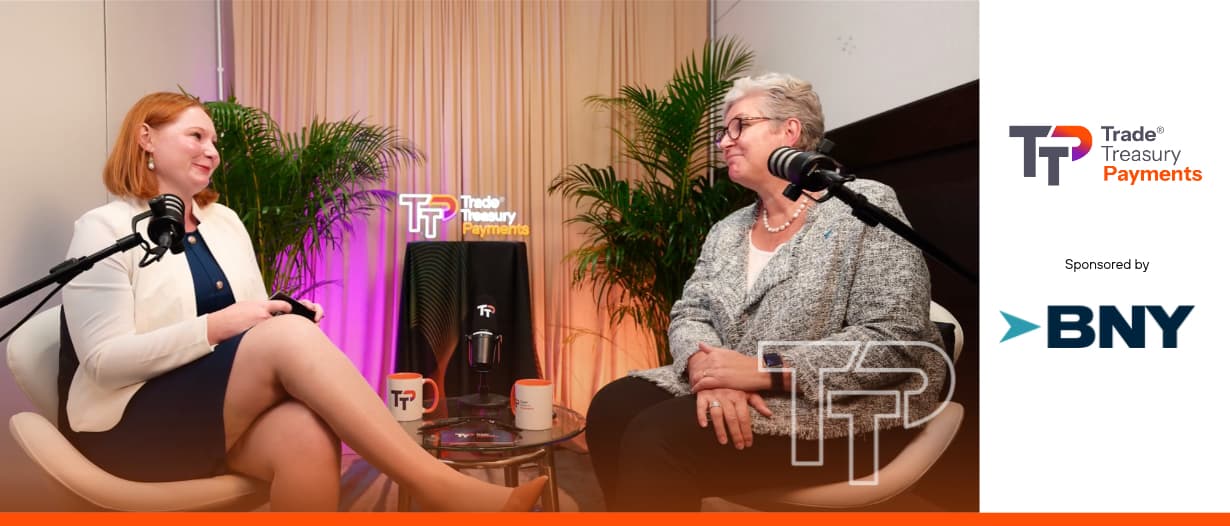
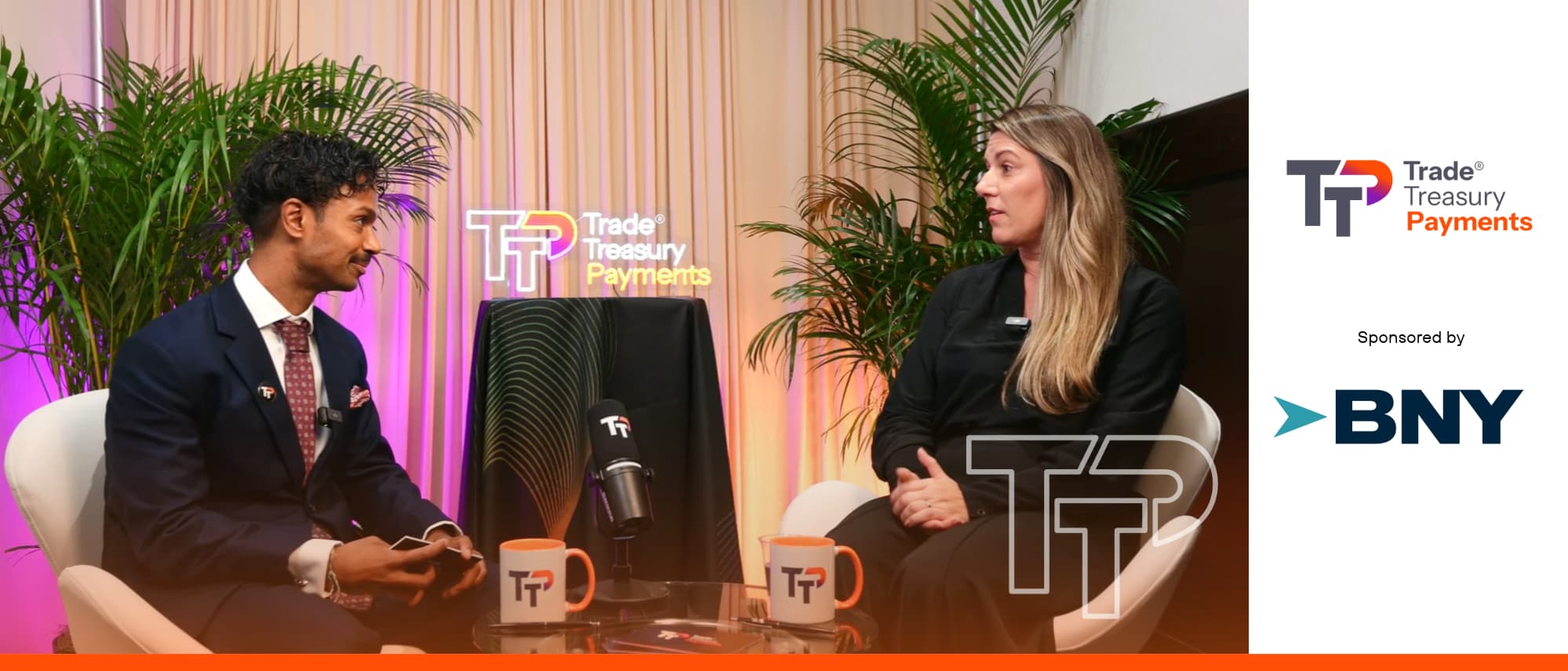
As TTP Studios hit the road to talk to experts at the conference, Carter Hoffman, Deputy Editor at Trade Treasury Payments, sat down with Fabian Khoshbakht, Head of Global Payments and Trade for APAC at BNY, to explore how the institution is navigating the emergence of new rails, digital assets, and technological tools like artificial intelligence (AI).
Payments without pause
Khoshbakht, a 27-year veteran of transaction banking, reflects on the stark evolution of client expectations in a changing global financial ecosystem. He describes the modern landscape of the world as one of “instant gratification” in general, focusing specifically on a growing expectation for instant payments. There is an established expectation for speed in retail transactions that is now bleeding into the corporate and institutional sphere.
Meeting these demands, however, isn’t simply about faster individual transactions – it requires an operational philosophy of “payments without pause”. As Khoshbakht explains, “the 24-by-7 ability to move funds globally, that’s just the where the world is headed towards… the industry is moving towards that as well”. If a corporate treasurer, CFO, or shared service centre wants to move funds globally 24 hours a day, 7 days a week, BNY is enabling that.
In terms of how BNY is enabling this, “not much has really changed,” according to Khoshbakht. “We’re still getting the same instructions from our clients, we’re just keeping our platforms running 24 hours a day, 7 days a week”. For BNY, and the large network of correspondent banks it services as clients, funds can be moved “within our four walls,” as he puts it. Liquidity can be moved from bank to bank, consumer to consumer, around the clock. Regional time zones can be seamlessly bridged when liquidity needs arise, say, in Europe out-of-hours in the US.
A joint path of new and old
Another key theme permeating Sibos was the proliferation of new ways to move money. Stablecoins, tokenised deposits, and digital ledgers were the talk of the Miami conference halls, but Khoshbakht remains pragmatic about balancing innovation with the actual needs of clients. Clients ultimately want money moved securely, quickly, and cheaply. While innovations offer new ways to do this, he does not see them changing how BNY operates overnight.
Khoshbakht foresees that traditional rails and new rails “will coexist for quite some time to come”. Swift, for example, which has anchored global transactions for over half a century, will not “cease to exist and then we’re all going to use digital assets and stablecoins and digital ledgers to move funds”. There is room for both the old and new.
While they may not necessarily be particularly interested in the precise technical details of how funds are moved, Khoshbakht does believe clients will be interested in the presence of choice. He draws an analogy to streaming platforms with differing tiers of service (i.e., without commercials, at a premium), suggesting new technology will ultimately offer payment choices based on convenience and cost. Within this space, payments can be automatically routed through the smartest, cheapest, and most effective pathway for clients.
This collaborative push extends to institutional infrastructure. BNY is actively participating in initiatives like the Swift digital ledger program, bringing major global banks together to tackle the fragmentation of digital tokens and establish true cross-border interoperability. “Everyone talks about interoperability and yes interoperability is important,” Khoshbakht explains, “but if we are collectively investing in Swift… collectively using that as our vehicle… I think the financial institutions globally are eventually going to have to come together”.
AI: the great enabler
Alongside the explosion of digital payment options, AI has rapidly evolved from an industry buzzword – a technological curiosity – into an integral operational layer. BNY were ahead of the curve in this regard. “Our executive team really pushed it upon everyone to embrace AI and to use it in our everyday work”.
Rather than realise some of the early industry fears that AI would displace human roles, Khoshbakht believes this push has been an enabler of operational efficiency, allowing him and his colleagues to “do all of the value-added tasks”. Technology handles repetitive tasks, preparing client meetings, accelerating information flows, and assisting with payment repair and operational routines, while human oversight remains to ensure precision. “It’s enabled us to do a lot more for our clients”, he points out.
Rethinking liquidity
Looking to the future, Khoshbakht predicts these technological layers fundamentally transforming how corporate treasurers manage liquidity. The traditional “follow-the-sun” model of cash management, as he puts it, will need to give way to dynamic, around-the-clock deployment of cash using tokenised deposits and digital ledgers, allowing excess liquidity to be invested to get a yield back. “That again is going to evolve,” he expands, cautiously musing on the possibility that we may “get to a point in the next couple of years where…excess liquidity is going to become maybe a thing of the past”.
BNY is actively pushing to turn these theoretical concepts and ideas into practical realities. This commitment was demonstrated at Sibos, where the firm announced a new capability enabling clients to execute pay-to-wallet transactions. Phase one focuses on the APAC region, allowing retail customers of BNY’s clients to seamlessly bridge bank accounts with dominant digital wallets and super-apps like GCash, Alipay, and WeChat Pay.
In his closing thoughts of the interview, Khoshbakht emphasises that navigating the future of global trade and treasury requires a dual focus. The trusted reliability of established infrastructure must be maintained alongside investment in the bold, digital, intelligent tools of tomorrow.
Prefer to listen? The full conversation is also available as a podcast below.
Key Topics
- Corporate payments are moving towards always-on, 24/7 global payment architecture as client expectations for speed spread into the corporate and institutional sphere.
- New payment rails, stablecoins, tokenised deposits and digital ledgers are being adopted alongside established infrastructure rather than replacing it.
- Artificial intelligence has become an integral operational layer in transaction banking, handling repetitive tasks and supporting payment repair.
- Corporate treasurers are rethinking liquidity management, moving from follow-the-sun cash management towards dynamic, around-the-clock deployment of cash.
Expert Analysis
Fabian Khoshbakht, Head of Global Payments and Trade for APAC at BNY, believes corporate payments are shifting towards always-on architecture. He expects traditional and new rails to coexist for some time, with clients valuing payment choice based on convenience and cost. He also argues that interoperability will require financial institutions to come together through collective investment in shared infrastructure such as Swift, and that AI has enabled staff to focus on value-added work while human oversight ensures precision.
Implications
- Traditional and new payment rails are expected to coexist, so banks may need to offer clients a choice of payment routes based on convenience and cost.
- Payments may be automatically routed through the smartest, cheapest and most effective pathway for clients.
- The traditional follow-the-sun model of cash management may give way to dynamic, around-the-clock deployment of cash using tokenised deposits and digital ledgers.
- Interoperability between digital tokens may depend on financial institutions collectively investing in shared infrastructure.