
Simplify first, then orchestrate: BNY on what treasurers need from payments modernisation
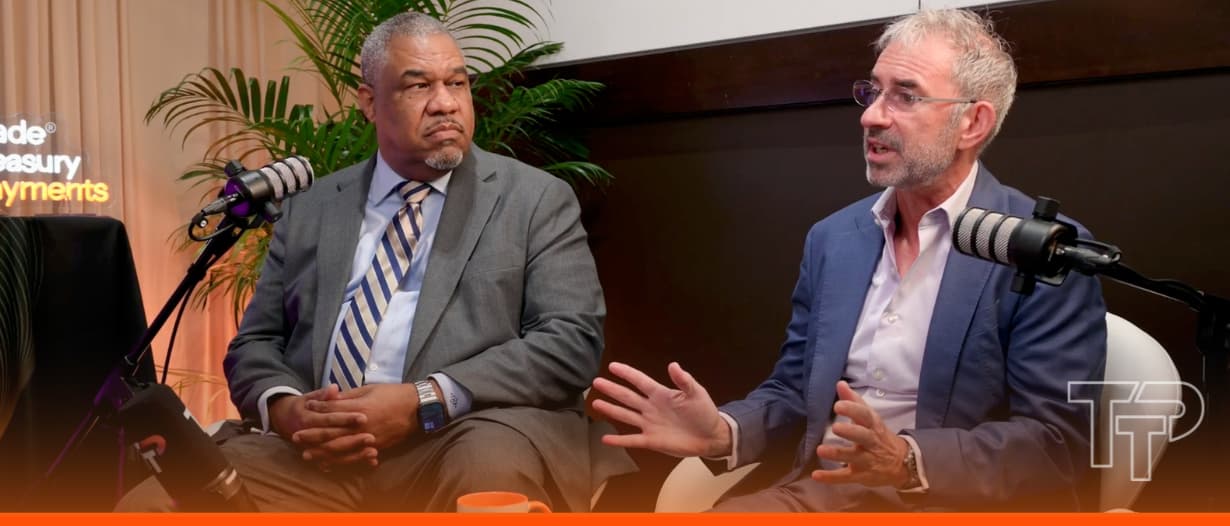
At Sibos 2026 in Miami, Isabel Schmidt, Executive Platform Owner, Enterprise Payments at BNY, sat down with TTP Treasury Editor Eleanor Hill to discuss how banks should handle a growing number of rails and forms of money, and why certainty matters to treasurers as much as speed.
Stablecoins, tokenised deposits, instant payment schemes and the traditional correspondent rails are all now competing for corporate payments. In a white paper published during Sibos week, Schmidt counts nearly 100 real-time payment rails worldwide. Hill asked whether that gives treasurers more opportunity or more to keep track of. Schmidt, who calls herself “a glass half full person”, sees mostly opportunity. A wider range of rails, she said, lets treasurers choose “the right speed, the right cost, the right transparency on FX rates”.
The catch is that each rail has its own formats, rules for how instructions are delivered, and cut-off times. “That can introduce quite a bit of complexity for the underlying client,” she said. “We shouldn’t expect our clients to be payment rail specialists.”
An orchestration layer has to keep up with rails that don’t exist yet
BNY’s response is orchestration: a single, coherent client experience that still reaches every rail behind it. Schmidt said its value lies as much in what comes next as in what exists now. “What we have today is not going to be what’s there tomorrow,” she said. “We don’t know necessarily what’s going to be there. So a good orchestration capability is essential, because it gives you that optionality to build for the future.”
Jurisdictions still apply the same rules in different ways
Some of the friction sits beyond any one bank’s reach. The Financial Stability Board’s October 2025 progress report on the G20 cross-border payments roadmap concluded that “it is unlikely that satisfactory improvements at the global level will be achieved in line with the 2027 Roadmap timetable”, and found that the average global cost of a cross-border payment had barely moved.
Schmidt credited the industry with progress on harmonising standards and on the operating hours of market infrastructures, but said “there is still discrepancy in rule books across the different jurisdictions.” The bigger hurdle, in her view, is “the inconsistency between implementations in different regulatory environments and different supervisory environments.” Friction like that adds cost, she said. Asked whether a single bank’s orchestration layer could remove it, she pointed to work still needed across the industry and the public sector. The G20 roadmap is clear, and the FSB has laid a strong foundation, she said. “Now it really is time for all of us to focus on implementation.”
A payment is not finished until the receiver can reconcile it
Speed gets most of the attention in payments modernisation, partly because it is easy to measure. Schmidt accepted its importance in an industry moving to round-the-clock operation, but said “the certainty is almost more important”: knowing when a payment will arrive, what it will cost and which FX rate will apply.
She also asked the industry to look at the other end of the transaction. “We very often as an industry think about what it takes for the sending client, but think about the receiving client,” she said. When money arrives but cannot be applied or reconciled, “your treasury life cycle is not done yet”, and “the cash really doesn’t have its full value.” A good orchestration engine can normalise differences in data between rails, she said, with AI applied on top to close that last mile and give the receiving customer a more predictable experience.
Fixing the message has proved easier than fixing the data
The same concern ran through her answer on ISO 20022. In August, Swift deferred the payments portion of Standards Release 2026, lifting the November deadline for structured addresses in cross-border messages. Schmidt backed the decision, taken after engagement with the community. “Otherwise, we would have created major situations for the global economy.”
Schmidt said banks and market infrastructures had done a lot of the work. “Where we see the friction is in the data that our clients, the corporate clients, have in their treasury management workstations, ERP applications,” she said. She wants banks to work with the vendors of those systems to help corporates clean up their data. Better data means fewer payments fall out of straight-through processing and reconciliation is easier, she said. It also matters for AI, because banks need structured, governed data before they can deploy it.
BNY treats orchestration without simplification as a short-term fix
Hill asked whether modernisation comes down to building an orchestration layer that hides the complexity underneath. “That is one way to do it. We do not believe that’s a good way to do it,” Schmidt said. “It could be a short-term [approach]. It’s definitely not the long-term approach.”
BNY’s approach is orchestration after simplification: normalising processes, data, control mechanisms and client channels beneath the layer. She tied this to resilience in an always-on market, which she said is only achievable on a simpler stack. “We really think of orchestration as the value we deliver for clients, and the simplification is how we do that.” Her white paper puts it in architectural terms: “Reliability, resilience and simplification must be embedded as foundational architectural principles.”
Stablecoins and tokenised deposits will still differ on the balance sheet
Looking ahead to 2030, Schmidt expects more channels. “That channel proliferation and the optionality will continue to increase across the industry,” she said, which keeps orchestration strategic. Whether stablecoins, tokenised deposits and other forms of digital money remain distinct may matter less from a payments processing perspective, she said, but the distinction will stay relevant as clients think about risk capital, liquidity and their balance sheet. BNY plans across the whole finance life cycle as a result: payments, end-of-day balance management, deposits, collateral management and financing.
Prefer to listen? The full conversation is also available as a podcast below.
Key Topics
- Treasurers must weigh a growing number of payment rails, including stablecoins, tokenised deposits, instant payment schemes and correspondent rails, against speed, cost and FX transparency.
- Orchestration layers allow banks to offer one coherent client experience while still reaching every payment rail beneath them.
- Inconsistent rule books and supervisory practices across jurisdictions continue to add friction and cost to cross-border payments.
- Certainty over payment timing, cost and FX rates matters to treasurers as much as speed.
- Corporate payment data quality in treasury management systems and ERP applications is a key barrier to straight-through processing and reconciliation.
Expert Analysis
Isabel Schmidt, Executive Platform Owner, Enterprise Payments at BNY, argues that the wider range of payment rails gives treasurers more opportunity, provided the complexity beneath is managed. She believes orchestration without simplification is at best a short-term fix, and that banks must work with corporate clients' software vendors to clean up payment data so that payments flow straight through and reconcile more easily.
Key Findings
- Schmidt counts nearly 100 real-time payment rails worldwide in a white paper published during Sibos week.
- The Financial Stability Board's October 2025 progress report concluded that satisfactory global improvements in cross-border payments are unlikely to be achieved in line with the 2027 Roadmap timetable.
- The average global cost of a cross-border payment has barely moved, according to the Financial Stability Board's October 2025 progress report.
- In August, Swift deferred the payments portion of Standards Release 2026, lifting the November deadline for structured addresses in cross-border messages.
Implications
- Orchestration without underlying simplification is unlikely to be a long-term approach to payments modernisation.
- Poor data quality in corporate treasury and ERP systems can cause payments to fall out of straight-through processing and make reconciliation harder.
- Banks need structured, governed data before they can deploy AI effectively.
- Differences between jurisdictions' rule books and supervisory environments will continue to add cost to cross-border payments until addressed across the industry and public sector.
- Stablecoins and tokenised deposits may matter less for payments processing, but the distinction remains relevant for risk capital, liquidity and balance sheet management.