

A reality check on trade finance digitisation
There was a feeling at Sibos 2026 of an industry at somewhat of a crossroads. With the financial world gathered in Miami, a lot of familiar conversations were had – perennial cost pressures and efficiency drivers remain at the heart of banking agendas, but these were now coloured by a new narrative. Emerging technologies and customer experience are intersecting to create a new commercial reality, with new players coming to the fore.
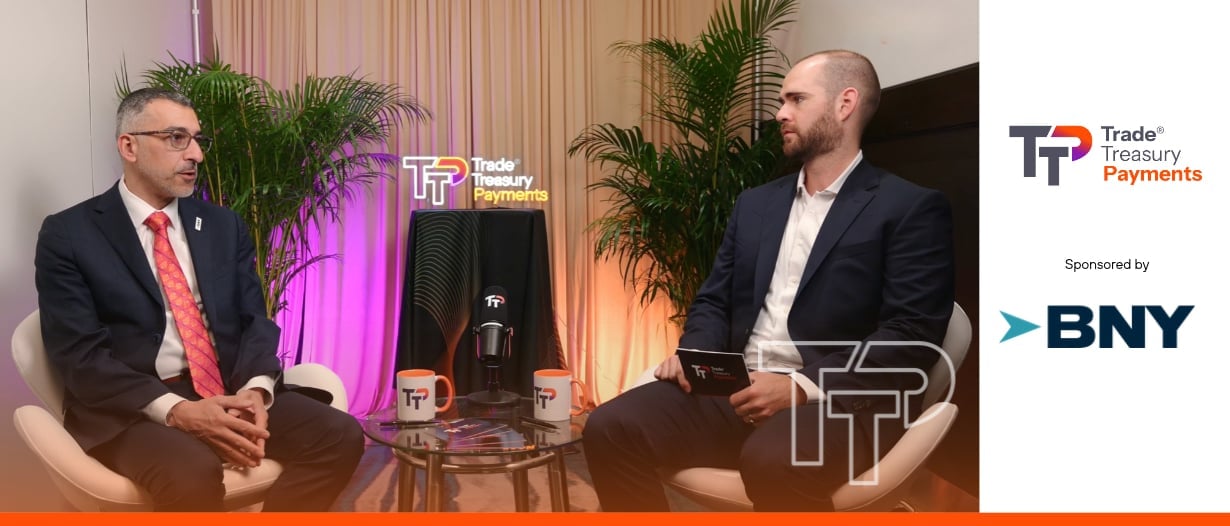
In an on-the-road TTP Studios production, Carter Hoffman, Deputy Editor at Trade Treasury Payments, sat down with Enno-Burghard Weitzel, Chief Solutions Officer at Surecomp and member of the TTP Global Advisory Panel, to discuss some of the key takeaways from Sibos. This encompassed the true state of artificial intelligence (AI) implementation in trade finance and the fundamental hurdles still facing a digital transformation of the industry.
What is AI really going to bring?
AI has dominated discussions across the sector, particularly at conferences like Sibos, for years. But this year, Weitzel felt there was something of a shift in these conversations. The theoretical possibilities of a wonderful new technology were giving way to its practical, real-efficiency deployment. The financial industry is increasingly grappling with the emerging gap between experimental capability and production-grade execution. AI’s immediate value, in his view, does not lie in upending operations overnight, but rather in accelerating innovation cycles and speeding up software release schedules.
For software vendors like Surecomp that serve banks, the stakes are very different from consumer-facing use cases. “We as a software vendor to banks have a completely different challenge because we need to bring software that is in production used by banks for system-critical operations,” Weitzel explains. Undoubtedly, rapid prototyping of software has become astonishingly fast and inexpensive thanks to AI, but moving “vibe-coded” prototypes into production still requires rigorous testing, security checks, and deterministic answers – particularly when determining financial exposure.
Weitzel is also pragmatic when he hears talk of companies achieving 90% workforce reductions through AI and indeed challenges such claims. However, he is confident there are massive benefits to be had from the technology. Even a sustainable 30% efficiency gain would represent a massive step forward for the industry, “and that’s something that I would argue we’re currently at,” he believes.
The digitisation gap
AI capabilities are frequently part of the wider discussion on the digitisation of trade and trade finance. Despite years of discourse around trade digitisation, the operational reality remains stark, particularly when contrasted with the payments sector. Trade finance significantly lags behind in terms of straight-through processing (STP).
“If we compare the STP rate in payments with the STP rate in trade, there is a massive gap,” notes Weitzel, observing that for many institutions, manual intervention remains a fixture of the workflow of virtually every transaction processed. Data from Surecomp indicates that roughly 50% of all trade finance transactions involve counter values below 50,000 US dollars – virtually every single one is touched manually by bank staff at some stage.
The root of this bottleneck is not a lack of multi-bank platforms or bank portals, but rather is driven by corporate convenience, in Weitzel’s view. “We know that about 70% of all the letter of credit and guarantee applications hit… the banks via email,” he explains. Email remains deeply entrenched in corporate workflows, as do Microsoft Office suite applications. Forcing users to abandon familiar communication channels and applications would create friction, so they remain tied to legacy systems like Outlook and Office. Furthermore, Copilot is making such systems seem more convenient, not less.
Encouraging adoption of new tools in place of the familiar and apparently ‘convenient’ is no small undertaking, but Weitzel points to the work being done by the International Chamber of Commerce (ICC) Digital Standards Initiative (DSI) as a vital step forward. He draws parallels to how the music industry transformed audio with the MP3 format, arguing that the industry needs a standardised digital trade document format. Corporate could continue to use ‘convenient’ email to send attached documents embedded with digital proof stamps, enabling banks to automate processing without forcing a behavioural overhaul on their clients.
The emergence of challenger banks
Another recurring theme in discussions around Sibos observed by Weitzel, outside of cost efficiencies, was the customer experience. In particular, how can banks use technology to enable a better user experience for their customers. For the first time, Weitzel was noting that multiple banks were openly discussing the struggles they were facing in this regard, with competitive pressure being exerted by new, digital-native challenger banks who were presenting an attractive alternative to their customers.
Weitzel also observes that these new challengers were largely absent from Sibos, noting that perhaps such institutions often bypass traditional industry gatherings. He ruminates that “maybe Sibos is a very traditional way of doing business in this correspondent banking space and these challenger banks simply don’t go because they don’t think they need to come here”. Nevertheless, their user-friendly, digital-first offerings are capturing market share from the incumbent institutions in attendance, particularly in small business and corporate banking.
In the face of these new challengers, banks are increasingly recognising that they must leverage modern technology and AI-driven customer-facing applications to stem customer bleed and win back market share. As Weitzel advised, for banks to remain competitive in this space the key is to “focus on your customers and walk in their shoes”.
It’s time to be brave
As the discussion came to a close, Hoffman and Weitzel looked ahead to next year’s Sibos gathering in Singapore. When asked what changes he expects to see this time next year, Weitzel expressed his belief that the dialogue around technology will mature. Inflated expectations of the capabilities of AI will be left behind in favour of more critical, measurable focus on user experience and higher digitisation rates.
If these predictions are to become a reality, there is a need for a level of measured boldness in tackling new technological frontiers. For financial institutions and corporate stakeholders alike, Weitzel left a pithy, proactive parting message “Don’t be afraid of challenging yourself. Because if you don’t challenge yourself, someone else will… so that would be the message. Be brave”.
Prefer to listen? The full conversation is also available as a podcast below.
Key Topics
- Artificial intelligence is moving from theoretical promise to practical deployment in trade finance, with the gap between experimental capability and production-grade execution now the central challenge.
- Trade finance lags well behind the payments sector in straight-through processing, with manual intervention still touching nearly every transaction.
- Corporate convenience and entrenched email workflows, rather than a lack of multi-bank platforms, are driving the digitisation bottleneck in trade finance.
- Digital-native challenger banks are competing for small business and corporate banking customers by offering user-friendly, digital-first services.
Expert Analysis
Enno-Burghard Weitzel, Chief Solutions Officer at Surecomp and member of the TTP Global Advisory Panel, is pragmatic about claims of sweeping AI-driven workforce reductions, which he challenges. He is nonetheless confident that the technology offers major benefits, and believes that even a sustainable 30% efficiency gain would represent a massive step forward for the industry. He argues that the industry needs a standardised digital trade document format, comparing the need to the MP3 format's effect on audio, and sees the ICC Digital Standards Initiative as a vital step forward.
Key Findings
- Roughly 50% of all trade finance transactions involve counter values below 50,000 US dollars, and virtually every one is touched manually by bank staff at some stage.
- About 70% of letter of credit and guarantee applications reach banks via email.
- Trade finance significantly lags the payments sector in straight-through processing, with a massive gap between the two.
- Multiple banks were openly discussing struggles with customer experience and competitive pressure from digital-native challenger banks for the first time.
Implications
- Corporates can keep using email with attached documents embedded with digital proof stamps, allowing banks to automate processing without forcing a behavioural overhaul on clients.
- Banks increasingly need modern technology and AI-driven customer-facing applications to stem customer bleed and win back market share.
- Inflated expectations of AI are expected to give way to a more measurable focus on user experience and higher digitisation rates.
- Vendors serving banks must meet a higher standard of testing, security and deterministic output than consumer-facing AI use cases require.