

At the conference, FCI Secretary General Neal Harm presented these insights, highlighting the industry’s stability and its critical role in providing liquidity and risk mitigation for businesses worldwide, particularly SMEs navigating challenging economic landscapes.
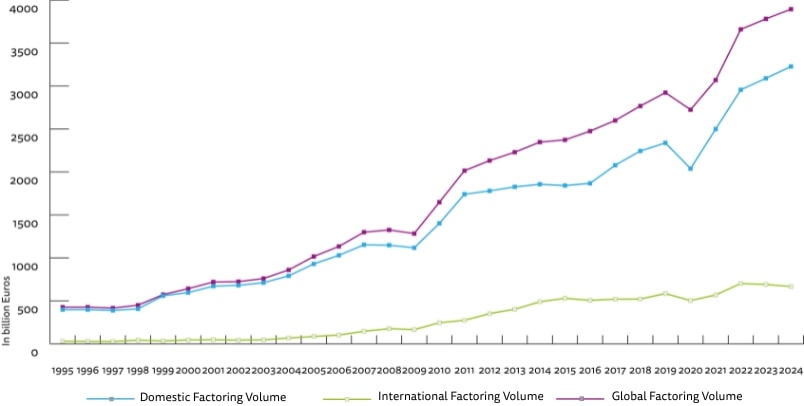
The data indicates a period of consolidation for the industry following three years of robust post-pandemic recovery. Notably, factoring’s 2.7% growth outpaced the 1% increase in global product sales volumes, underscoring its resilience amid ongoing economic uncertainties.
The modest increase in the factoring market underscores its stability amid a year marked by significant global challenges, including geopolitical conflicts, high interest rates, and persistent inflation. While many sectors faced volatility, factoring continued to provide essential liquidity and risk mitigation for businesses worldwide, particularly SMEs navigating uncertain economic conditions.
Over the past two decades, factoring has demonstrated consistent growth, with a compounded annual growth rate of 7.8%. Its role in supporting open account trade and providing working capital solutions has become increasingly vital, especially during periods of economic uncertainty.
”Harm noted that factoring is no longer just a financing tool, it is “a legal purchase of a legally signed receivable” underpinned by an architecture of enforceable rules, education, and digital infrastructure. The strength of the FCI network, based on its Four Corner model, has helped members reduce dilution to below 3% and credit loss rates to less than 0.04%—among the lowest in financial services.
“This shows how our system is not just operationally efficient, but risk-robust,” Harm said.
4,451 companies contributed data for the 2024 figures, a record number for this annual survey. Europe accounted for nearly two-thirds of global turnover (€2.6 trillion), with Germany, France, the UK, and Italy leading. Meanwhile, India’s 120% growth and Argentina’s 122% surge stand out, pointing to rapid adoption in markets traditionally underserved by receivables finance.
But the figures also pointed to fragilities. Ukraine’s factoring volumes plummeted by 79%, while Hong Kong saw an 11% drop. The Middle East registered the sharpest regional contraction, down nearly 14%—a reflection of wider geopolitical and economic headwinds.
Taken together, the 2024 data suggest a maturing global industry—resilient, increasingly diversified, and more essential than ever to trade liquidity, particularly for SMEs navigating the sharp edges of today’s macroeconomic environment.
Deeper dive by region
Europe held its ground as the world’s largest factoring market, generating €2.6 trillion in turnover in 2024, roughly two-thirds of the global factoring volume. Growth remained modest at 1.8%, but regional divergence prevailed. While Ukraine and the Netherlands recorded minor contractions, likely due to the conflict and economic recalibration, other markets in Europe surged. Moldova more than doubled its volumes (+122%), with North Macedonia (+63%), Georgia (+51%), Türkiye (+36%), and Latvia (+25%) all showing strong upward momentum, suggesting a renewed appetite for receivables finance across parts of Eastern and Southeastern Europe.
Asia-Pacific followed as the second-largest region, with €964 billion in turnover and a 2.4% annual increase. China contributed the most within three region, €679 billion of factoring volumes. Elsewhere in the region, growth was uneven, with Japan, India, Singapore, and Hong Kong posting mixed results in line with varied macroeconomic headwinds and domestic conditions.
In the Americas, factoring volumes climbed sharply to €271 billion, up 14.5% year-on-year. The United States and Canada led the rebound, posting a 28% increase after previous years of decline, while South and Central America continued their upward trajectory with a 5.8% rise. Brazil, Chile, and Mexico grew, as economic recovery and stronger SME demand helped drive adoption.
Africa’s factoring volumes reached €50 billion, reflecting a solid 5.9% increase over 2023. South Africa remains the continent’s dominant player, though Nigeria, Egypt, and Morocco are beginning to register as markets to watch.
The Middle East, by contrast, recorded a decline. Turnover fell to €8 billion—down nearly 14%—as geopolitical volatility and broader macroeconomic uncertainty weighed heavily on activity across the region.
The figures are compiled by FCI from its network of nearly 400 members across more than 90 countries, providing one of the most comprehensive datasets on global receivables finance available.
Explore the full set of statistics by clicking here.
Key Topics
- Global growth and stabilisation of the factoring industry
- The role of receivables finance in supporting SME liquidity
- Regional shifts in factoring adoption and market development
- Risk management and legal frameworks underpinning factoring
- The importance of factoring in supporting open account trade
Expert Analysis
Speaking at the BCR 25th Annual Receivables Finance International Convention in London, Neal Harm, Secretary General of FCI, reflected on the changing role of factoring in global trade. Harm noted that factoring should no longer be viewed simply as a financing mechanism. Instead, it represents the legal purchase of receivables supported by clear contractual frameworks, established rules and increasingly sophisticated digital infrastructure. He pointed to the strength of the FCI network and its Four Corner model, which allows members to manage risk effectively while facilitating international transactions. According to Harm, the system has helped maintain dilution levels below 3 per cent and credit loss rates of less than 0.04 per cent, figures that rank among the lowest across the wider financial services sector. The steady growth recorded in 2024 also reflects the industry’s ability to adapt to changing market conditions. As businesses continue to navigate high interest rates, inflation and geopolitical uncertainty, receivables finance is playing an increasingly important role in supporting trade and maintaining liquidity across supply chains.— Neal Harm
Key Findings
- Global factoring volumes increased by 2.7 per cent in 2024.
- Europe generated around €2.6 trillion in turnover, accounting for roughly two thirds of the global market.
- Factoring volumes in the Americas rose by 14.5 per cent year on year.
- Africa recorded steady growth, reaching €50 billion in turnover.
- The Middle East saw a decline in activity, with volumes falling by almost 14 per cent.
Implications
- Factoring is likely to remain an important source of working capital as businesses continue to navigate economic uncertainty.
- Growing adoption in emerging markets could expand the global receivables finance landscape in the coming years.
- Investment in digital infrastructure and industry standards will remain essential to support risk management and operational efficiency.
- Regional variations in growth highlight the influence of geopolitical and economic stability on trade finance activity.
- As open account trade expands, factoring will continue to play a central role in supporting supply chain liquidity.