
About This Video
When we look back on how export finance has shifted in years past, it is often easy to recall major deals and policies and the impacts that they had on shaping the industry.
While these are certainly important and have been a powerful driver in the past, many meaningful shifts that have taken place are far more subtle. The type of slow-burning trends that arise from industry stakeholders adjusting and responding to small changes in their operating environment.
The world of export credit is one such example as these institutions rethink their purpose and relevance amid a tumultuous and uncertain global commercial state. At the heart of this is a redefinition of the role these export credit agencies play.
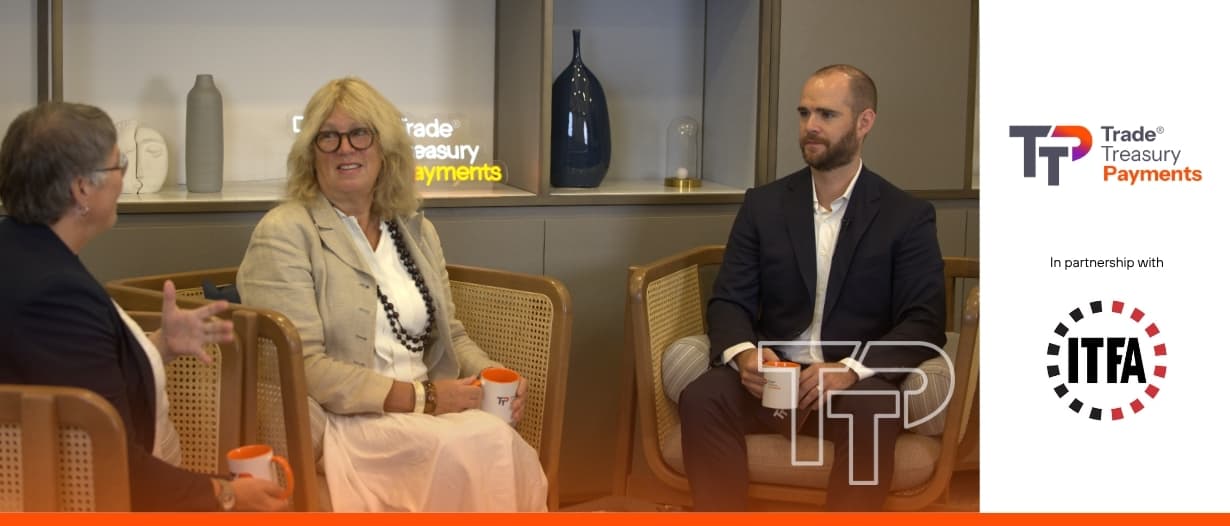
To learn more about the export credit space and how these forces are playing out on a global scale, Trade Treasury Payments (TTP) Editor Deepesh Patel spoke with Yuichiro Akita, President of the Berne Union, ahead of the Berne Union Spring Meeting held in Dubrovnik, Croatia.
Export credit is stretching beyond borders and old definitions
Export credit used to be all about underwriting big-ticket items and backing cross-border buyers. While that core foundation still matters a great deal, the conversations around where export credit agencies (ECAs) fit in have begun to shift.
Akita said, “ECAs are now expected to play a more diverse role beyond export credit. Including contributing to industry policy, economic security policy, science, technology, innovation policy, and international development.”
As the tools and funding mechanisms available are expanding, so too are the expectations of what these firms provide. Untied finance (which is funding from an export credit agency that doesn’t require the borrower to purchase goods or services from the lender’s country) is one example. Once widely considered to be niche, this approach is now considered to be mainstream, though the approaches differ.
Akita said, “Even in terms of how untied finance is being used, we see divergent approaches, some ECS are positioning it as a tool to support SMEs and help them to access export opportunities. Others are using it with broader political mandates to support overseas business expansion.”
This tells us that traditional definitions no longer apply. There’s no single model and no one-size-fits-all, but there is a pattern. Export credit is becoming less about borders and more about outcomes, and the mandate is moving with it.
In many cases, the goal is to secure access to resources, support new industries, and anchor long-term economic growth, with the end result of achieving a more fluid approach to both what export credit can do and who it serves.
Untied, but together: The changing relationship between public and private actors
The shift in export credit norms is also ushering in a stronger alignment between public and private finance.
Akita said, “Traditionally, the relationship between ECAs and private insurers has been one where ECAs are reinsured by private insurers.”
Risk was sometimes shared, but the philosophies and incentives were rarely aligned. That model served its purpose, but given the high degree of uncertainties in the world today, collaboration needs to run deeper. Public agencies are increasingly working with private insurers as co-architects of new financial solutions, rather than just as reinsurers, as was more typical in the past.
Private players bring in flexibility, speed, appetite for innovation, portfolio-style underwriting, tailored structures, and sharper analytics. Public agencies, on the other hand, bring reach, stability, and a mandate that can stretch to higher-risk or policy-driven projects.
Put them together, and you get the kind of alignment that also opens the door to blended finance structures, which is especially useful when a deal calls for both commercial viability and long-term impact.
Akita said, “Exploring such combinations where the public and private sectors take on complementary risk positions could open up new possibilities for structuring deals that neither party could pursue alone.”
As mandates evolve and ECAs stretch into untied finance and development-linked goals, these private sector partnerships will continue to become more central.
A rebalanced sustainability agenda calls for pragmatism, not posturing
The renewed push toward sustainability is shifting away from rhetoric and toward measurable resilience.
Akita said, “I see it as my mission to plant seeds for future growth, for both the members of Berne Union and the industry as a whole. I have set my Presidential Platform called STRIDE, which consists of acronyms of ‘Sustainability Through Resilience, Innovation and Diversity for Empowerment’.”
This includes investment in basic infrastructure, water and sanitation, healthcare, and food security, all of which are sectors that are central to achieving the UN’s Sustainable Development Goals (SDGs).
As public development budgets tighten, the need to mobilise private capital becomes more urgent and, while ECAs have historically supported such mobilisation, their contributions have often gone unrecognised.
Akita said, “We need to speak more clearly about the role we play and take on more responsibility in this space.”
The Berne Union’s 2024 State of the Industry report reinforces this trajectory. It shows a record $3.3 trillion in new commitments, with continued growth in renewable energy financing, up to $15 billion, a 2.5x increase from 2019.
Political risk insurance has a bigger role than people realise
Political risk insurance tends to sit in the background. It doesn’t headline announcements or dominate industry panels, but it quietly makes a lot of things possible. Especially now.
As long-term infrastructure investment edges into more complex markets, the risks are just as much political as they are technical or financial.
When a project hits a political roadblock, particularly in some bureaucracy-heavy developing regions, it can be delayed for years or collapse entirely. A stalled permit, a regime change, or a policy reversal are all real friction points that can derail a project entirely and cost businesses and investors millions (or more) in the process.
Akita said, “When political risk actually materialises, it can be really costly for investors to abandon an infrastructure project. So the important thing is to avoid those severe consequences.”
Insurance can certainly help to protect capital, but an even stronger value proposition that it can offer clients might be its ability to influence a situation and avoid the need to call on a policy at all.
When PRI comes from a public agency or a multilateral organisation, it carries institutional weight, diplomatic networks, credibility, and the ability to sit across the table from a host government when tensions rise. Ideally, they can help to mediate disputes and prevent projects from going off track in the first place. That kind of leverage is important to investors, especially given how prohibitively expensive it can be to walk away from a large capital project.
In an era where political volatility can eclipse commercial logic, this type of active resolution mechanism provides the stability that investors often need, even if they may not always realise it at first.
—
The boundaries that once defined the work of export credit are now more flexible, shaped by strategic priorities that go beyond trade alone. Public and private sectors are learning how to share risk, expertise, and responsibility in ways that are both innovative and grounded, while political risk insurance is proving to be a core pillar of investment confidence.
Together, these shifts are forming a new architecture for trade finance that reflects the complexity of the global economy and the need for tools that match that complexity.
The questions being asked now are the kind that define what comes next. Not loud. Not rushed. But necessary.
Key Topics
- The changing role of export credit agencies in global trade
- The need to modernise international export finance frameworks
- The growing influence of Asian export credit agencies
- Risk appetite and collaboration within the export credit community
- Sustainability, resilience, innovation and diversity in export finance
Expert Analysis
Akita Yuichiro, President of the Berne Union and Chairman and Chief Executive of NEXI, believes the export credit industry is approaching a significant turning point. The international rules that have guided export finance for decades were created under very different circumstances. While there have been efforts to update them, deeper questions are now emerging about the role export credit agencies should play and how they should operate. According to Yuichiro, there is no single model that fits every agency. Each institution operates within its own national priorities and economic environment. What matters is that agencies remain adaptable and open to collaboration as global trade continues to evolve. He also highlights the growing influence of Asian export credit agencies. One of their defining characteristics is the provision of short term credit insurance, which proved particularly important during the global financial crisis and the Covid pandemic. In those periods, ECAs in the Asia Pacific region were able to support trade when private market capacity was under pressure. Another important area of focus is risk appetite. Yuichiro notes that export credit agencies must continue to assess how much risk they are willing to take and communicate this clearly to partners and stakeholders. Doing so helps strengthen cooperation across the industry. As President of the Berne Union, Yuichiro’s two year platform focuses on sustainability through resilience, innovation and diversity for empowerment. His aim is to help create the conditions for future growth and ensure the export credit community continues to support global trade in a meaningful way.— Yuichiro Akita
Key Findings
- Export credit agencies are reconsidering their role as global trade dynamics evolve
- Short term credit insurance has been an important stabilising tool during market disruptions
- Several sectors including infrastructure, manufacturing and renewable energy are driving export credit demand
- Stronger collaboration between agencies supports resilience across the trade finance system
- Strategic leadership and long term planning will shape the next phase of export credit development
Implications
- Export credit agencies may need to revisit their mandates as global trade conditions change
- Demand for export credit support is likely to remain strong in sectors such as infrastructure, manufacturing and renewable energy
- Asian ECAs are expected to play an increasingly influential role in global export finance
- Cooperation between agencies will remain essential in maintaining stable trade flows
- Clear communication of risk appetite can improve coordination across the export credit ecosystem