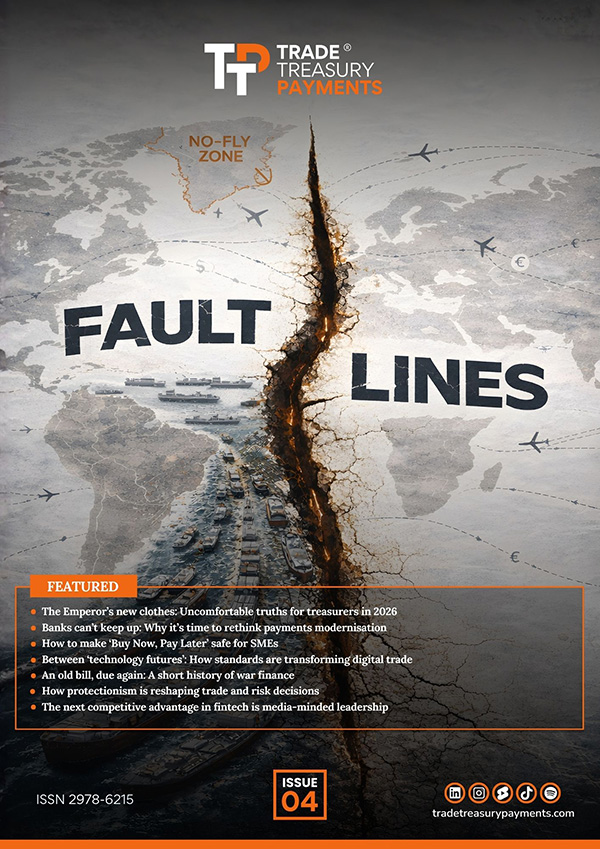
Issue 04 | Fault Lines
 120 pages
In this edition of the Trade Treasury Payments magazine, we turn our attention to the fault lines running through global finance. As supply chains stretch across borders, rules multiply, and new technologies collide with legacy systems, pressure is building across the trade ecosystem.
Through in-depth features, interviews, and reporting, Fault Lines looks at the seams where those forces meet – between globalisation and fragmentation, legacy systems and new rails, liquidity needs and risk constraints, and more – and how firms are responding.
Rather than predict the next shock, we invite readers to spot the signals early, read the fault lines, and understand what they reveal about the future of cross-border finance.
Welcome to Fault Lines.
From This Publication : Issue 04 | Fault Lines
Contents

The missing ingredient in SME lending and what Bahrain is trying instead
Every good recipe does two main things. It tells you what you’re trying to make, and it tells you how

Banks can’t keep up: Why it’s time to rethink payments modernisation
Banks are under growing pressure to modernise payment infrastructure as customer expectations, regulatory demands and technological innovation continue to evolve. This article explores why traditional approaches are no longer enough and examines the strategies financial institutions need to build faster, more resilient and future ready payment systems.

The Emperor’s new clothes: Uncomfortable truths for treasurers in 2026
Over one-third of treasury technology implementations fail. Too many FX hedging strategies leak value. And a fair amount of so-called

Between ‘technology futures’: How standards are transforming digital trade
International standards are playing an increasingly important role in the future of digital trade. This article explores how common frameworks are improving interoperability, supporting technology adoption and helping businesses build more efficient, trusted and connected trade ecosystems.

Musings on the US National Security Strategy, Venezuela, Greenland, and what it might all mean for trade
Whether you love it or hate it, the United States is one of the world’s superpowers, which means that the

Stop hedging when it hurts! Less painful ways to manage FX risk in 2026
For many finance and treasury teams, FX risk has long been treated as an irritant rather than a strategic threat