Leveraging business information to manage uncertainty in global trade
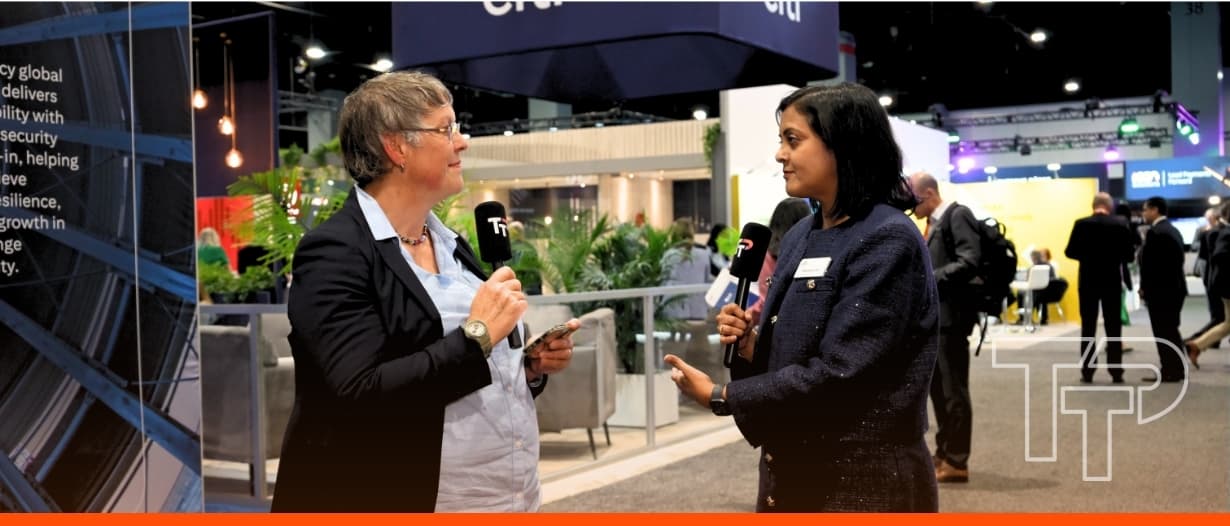
At the ITFA Americas Annual Conference in Miami, Trade Treasury Payments (TTP) spoke with Chelsea Starley, Global Solutions Business Information Executive at Coface, to explore how business information is helping firms navigate today’s risk environment.
Starley said, “Many people know Coface as one of the world’s leading trade credit insurers. What they don’t always realise is that we also offer our internal underwriting tools, like scores, credit opinions, and business reports, to the market. It’s essentially underwriting as a service.”
The demand for these services is growing, particularly in regions where data is scarce and financial reporting is inconsistent.
Starley said, “We’re seeing a lot of need in Latin America, where transparency is limited and fraud is a concern. We’ve also had strong demand from parts of Asia. To strengthen our data in these regions, we’ve acquired providers like Cedar Rose in the Middle East and Africa, and we continue to invest in expanding our information base.”
In the current climate, geopolitical risk and macroeconomic uncertainty are top of mind for many clients, but the ripple effects often come through the supply chain.
“Clients are no longer just looking at buyer risk,” Starley said. “They’re trying to assess supplier vulnerability, too. If a supplier goes down due to conflict or economic pressure, replacing that supplier isn’t easy. So understanding upstream risk has become more important.”
That risk, she added, is often buried under too much noise.
“There’s too much information out there. People are overwhelmed, and they don’t know what’s relevant or trustworthy. That’s where we can help, because we’re combining public data with insights from our own insurance policies, claims, and payment experiences, which gives us a much more complete risk picture.”
One area where this is particularly valuable is the mid-market.
Starley said, “Larger companies usually have strong credit procedures, but mid-market and non-investment grade firms are harder to assess. These companies still need capital, but traditional data sources often miss them. That’s where our value comes in. If we don’t already have the data, we’ll go get it, because we underwrite it like it’s our own portfolio.”
Looking across her conversations at the conference, Starley pointed to one consistent theme.
“There’s a clear appetite for better insight into mid-market credit. Everyone’s trying to solve that gap. And Latin America has been a big focus here in Miami, it keeps coming up in conversations.”
Starley added, “Don’t wait for risk to materialise. Use information to predict it.”
Key Topics
- The role of business information in trade credit and risk management
- Turning underwriting expertise into a commercial service
- Data challenges across Latin America, Asia, and emerging markets
- Growing importance of supply chain risk visibility
- Closing the information gap in the mid-market
Key Insights
Expert Analysis
Chelsea Starley, Business Information Executive at Coface Global Solutions, explains how business information has evolved beyond its traditional role within trade credit insurance to become a valuable service in its own right. Drawing on decades of underwriting experience, Coface now provides access to the same insights it uses internally, including credit opinions, scores, payment data and detailed business reports. With a presence in 200 countries, the organisation is able to offer a global view of risk that is difficult for individual companies to build on their own. Starley highlights that ongoing economic and geopolitical uncertainty is driving demand for clearer, more dependable information. Many businesses are overwhelmed by the volume of data available but still struggle to identify what is truly relevant or reliable. This is particularly true in private and international markets, where transparency is often limited. She also points to a growing need for better visibility across supply chains. Businesses are increasingly aware that supplier disruption can be just as damaging as customer default, yet assessing that risk is far from straightforward. Another persistent challenge is the lack of insight into the mid-market. While larger firms are generally well covered, smaller and mid-sized companies often fall into a gap where information is harder to obtain and financing becomes more difficult. In this context, business information plays a crucial role in helping organisations cut through uncertainty, improve efficiency and make more informed decisions.— Chelsea Starley
Key Findings
- Many businesses struggle to make sense of the volume of information available
- Reliable data on private companies and international markets is often limited
- Fraud and low transparency remain key concerns in certain regions
- Large organisations are well structured but still face efficiency challenges
- Mid-sized businesses face the greatest barriers when it comes to accessing finance
Implications
- Better access to reliable data is likely to improve credit decision making across markets
- Demand for external intelligence will continue to grow, particularly in regions where data is limited
- Assessing supplier risk will become a standard part of credit management
- Improved transparency could help unlock financing for mid-sized businesses
- More companies will look to external partners to support underwriting and risk analysis
Key Takeaways
- Good information underpins confident decision making in uncertain markets
- Underwriting expertise can deliver value beyond insurance when shared more widely
- Emerging markets require deeper and more reliable insight
- Supply chain risk deserves the same attention as customer risk
- Data driven decisions lead to better risk management and use of capital