




The world is a bit upside down – but that is exactly our function
By: Tim Staheli
ICISA turns 100 this year. Jan Müller thinks it’s time more people noticed what his industry actually does.
There is a peculiarity to trade credit insurance that Jan Müller has spent 36 years learning to live with. The industry covers roughly 15% of global trade, accounting for some €3 trillion in insured receivables in 2025 alone, and yet outside the industry itself, few grasp quite how much of the world’s commerce depends on it.
He has had time to develop a philosophical relationship with the paradox. Müller joined Hannover Re straight from university and has never left, which makes him something of a curiosity in an era of permanent career pivoting. He is, in his own words, “a kid of the industry.” He is also currently its president: ICISA, the International Credit Insurance and Surety Association, held its centenary AGM in Vienna last week, and Müller oversaw the ceremonies.
Founded in 1926, ICISA was born into a world already well-acquainted with the consequences of uncovered trade risk. The Depression and two world wars of that era were, in a grim sense, proof of concept. Since then, it has expanded its membership well beyond its European origins, adding surety in the 1950s and, more recently, companies from Asia, the Middle East, and Latin America whose markets are still being introduced to trade credit insurance for the first time. That evolution stands out to Müller. One of the changes he has observed over his years at ICISA is the association becoming less European – and with that, a new set of expectations. “Their call and their expectation,” he says of newer members from outside Europe, “is, please help us as well.” The help they need is not product development but groundwork: educating regulators, building awareness, and bridging the gap between an industry with deep institutional roots and markets where it has none.
The Vienna meeting arrived at an interesting moment. Global insolvencies rose 6% in 2025 and are forecast to rise a further 6% in 2026 – the fifth consecutive year of increases. Tariffs, geopolitical friction, and what Müller calls the “polycrisis” (the tendency of modern risk to arrive in overlapping rather than sequential waves) have made the industry’s core argument more urgent. He is careful, though, not to overstate the novelty. “Each crisis on its own might not be immediately the biggest challenge,” he says, “but if you add them all together, for certain industry sectors, this brings real challenges. And we are there to give the answers.” “The world is a bit upside down,” he adds, “But that is exactly our function.”
The argument makes sense. Trade credit insurance works because individual companies cannot price and absorb the volume of risk that underpins open-account trade on their own. A buyer defaults, a receivable disappears, a supply chain seizes. The insurer absorbs the loss, and trade continues. The function is prosaic and, most of the time, invisible – which is kind of the point. Industries that work best tend to be the ones you never have to think about.
His priority for his presidency is not to sell the world on trade credit insurance but to make ICISA work harder for the parts of its membership that are still building their markets. Smaller members need infrastructure they cannot build on their own. Regulators in newer markets need educating. It is the kind of work that rarely makes headlines but determines whether an industry grows or stagnates. And the broader public (policymakers, business leaders, anyone with a stake in how global trade is financed) needs a better introduction to an industry it has been relying on without realising it.
“Our luxury situation,” Müller says, “is that in many countries our products are not yet known.” The luxury is the market opportunity. The problem is that capturing it requires the kind of patient, institutional work that trade associations are not always set up to do quickly.
The centenary report, published to coincide with Vienna, makes the case to policymakers and business leaders for the industry’s work. It is a belated introduction to a world that trade credit insurance has been serving for a century without ever being properly introduced.
Müller is sanguine about the pace of change. The world keeps generating risk, the industry keeps absorbing it, and somewhere in that arrangement lies the justification for another hundred years. “There’s always something going on,” he says, “and always a need for our products.” For an industry built on other people’s uncertainty, a turbulent world is not a problem. It is the business model.
–
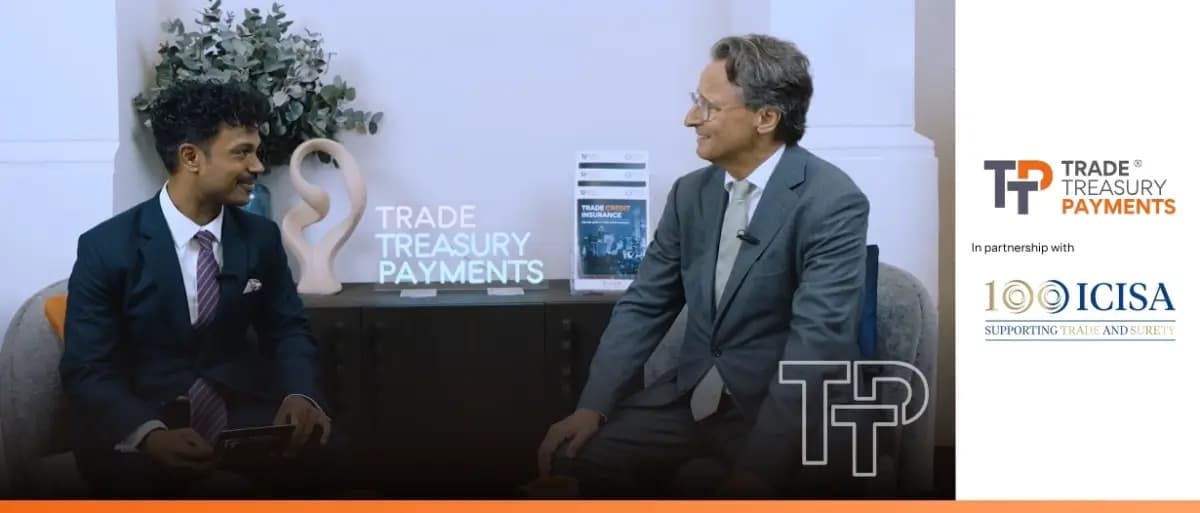
Jan Müller is President of ICISA and Managing Director for Credit, Surety and Political Risk at Hannover Re. He was speaking to TTP’s Deepesh Patel at ICISA’s centenary AGM in Vienna.
Prefer to listen? The full conversation is also available as a podcast below.
Key Topics
- The scale and invisibility of trade credit insurance in global commerce
- ICISA’s centenary and its evolution beyond Europe
- Rising insolvencies and the modern polycrisis
- The industry’s role in absorbing risk and enabling trade continuity
- The need to support emerging markets through regulatory education and institutional groundwork
Key insights
Expert Analysis
Jan Müller’s reflections capture an industry that has quietly stabilised global trade for a century. His emphasis on overlapping risks, rising insolvencies and the need for institutional groundwork in emerging markets shows how trade credit insurance is becoming more strategically important, not less. His remark that “The world is a bit upside down, but that is exactly our function” encapsulates the industry’s purpose: to absorb uncertainty so commerce can continue. In a world where shocks increasingly arrive in waves, the value of that function becomes clearer.
Key Findings
- Trade credit insurance remains essential yet under recognised in global trade.
- ICISA’s evolution reflects a broader shift toward supporting emerging markets.
- Rising insolvencies and overlapping risks are reshaping industry priorities.
- The insurer’s role is fundamentally about continuity: absorbing losses so trade can proceed.
- The centenary highlights both legacy and future opportunity for global market development.
Implications
- Greater demand for risk absorption
- Institutional development in emerging markets
- A more visible role in policy conversations
- Resilience as a competitive advantage
- A widening global footprint
Key Takeaways
- Trade credit insurance is a foundational but often invisible part of global trade.
- ICISA’s centenary marks a shift toward broader global engagement and regulatory education.
- Rising insolvencies and the polycrisis reinforce the industry’s relevance.
- The insurer’s role is continuity: keeping trade moving when risks materialise.
- Growth opportunities lie in markets where the products are not yet widely known.