Commodity finance in 2026: Bigger deals, fewer players
By: Scott Sanchon, Trade Treasury Payments
For the first time in history, the average global commodity finance deal surpassed the $1 billion mark in 2025. Total commodity finance volumes rose by 25% throughout the year, reaching around $168 billion, despite the number of deals remaining flat at approximately 153, according to the latest data from TXF.
This trend, often referred to as a “flight to size,” or “flight to quality”, is seeing existing players upsizing and diversifying their facilities, though perhaps at the expense of new participants’ ability to break into the market.
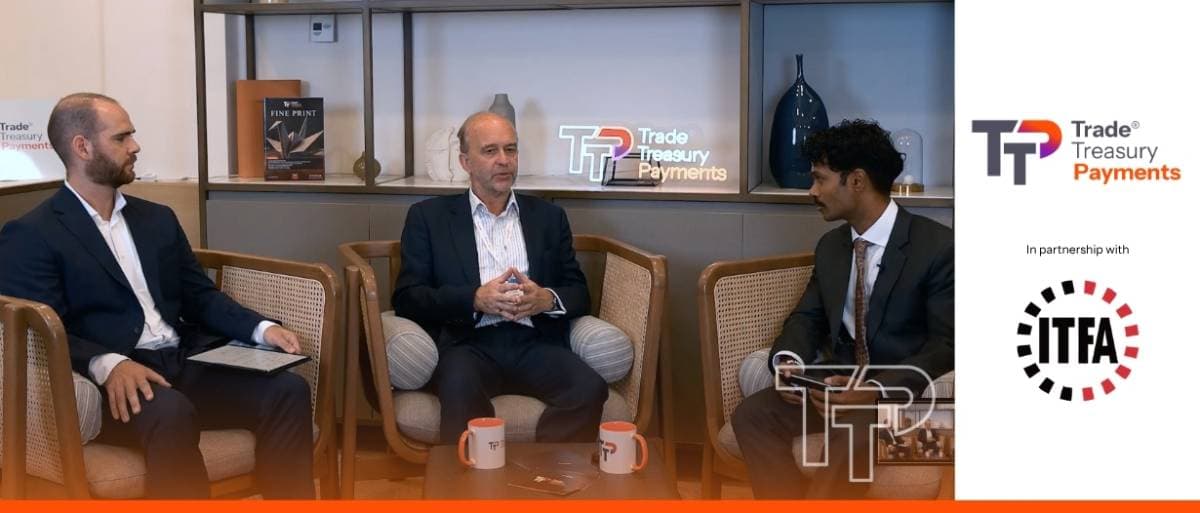
To explore this further, Deepesh Patel, Editor in Chief at Trade Treasury Payments (TTP), spoke with Ralph Ivey, TXF’s Commodity Editor, at TTP Studios in London.
How are volumes rising?
Despite the considerable market growth that commodities finance has experienced, the pool of lenders has not grown. This mismatch seems to indicate that, while more money is flowing through the market, it is concentrated among the same group of borrowers and lenders.
“If you go to talk to any bank, they’ll tell you that anything up to $1 billion is now mid-tier to them, which again will be unfamiliar to a lot of the SMEs within the commodities business. But the biggest deal in 2025 in our database was a $15 billion revolving credit facility,” said Ivey.
As bigger players now have more accessibility to trade finance tools. It results in shrinking lower-tier markets, such as smaller businesses and SMEs, so that they can not grow into an important part of the supply chain.
Another key aspect of the market’s growth has, perhaps intuitively, been volatility. In agriculture, price movements for commodities like cocoa and coffee had pushed traders to secure larger credit lines as a buffer. At the same time, in the energy market, such as the oil and gas industry, margins had tightened in 2024 and 2025. Because profits were tighter, big companies are trying to strengthen their balance sheets to invest more aggressively in other companies. When companies do this, it usually leads to larger deals and acquisitions.
“In 2025 alone, we had Vitol investing in upstream assets in the Republic of Congo and Cote d’Ivoire, Glencore taking on a refiner in Singapore off of Shell,” Ivey said.
On the lending side, the new Basel IV regulation is not favourable to short-term, collateralised loans, suggesting that banks are struggling to onboard new clients. Plus, it’s important to remember that for banks, it generally takes the same amount of administrative effort to work to finance a $500 million deal as it does a $5 million deal, so naturally, the incentive to invest in larger and more familiar customers is higher.
The market is being split into two.
From the outside looking in, it seems today that the commodities market is being split into two distinct camps. In the one camp is a small group of larger traders that now operate more like major corporate clients, engaging with their banking partners with strong relationships to access enormous, multi-year credit facilities. In the other (much more modest-looking) camp, a larger number of smaller commodity companies are finding it harder to finance themselves while integrating into global supply chains.
“SMEs describe how hard they have to work just to get through onboarding procedures at new lenders,” said Ivey. For companies without banking relationships, navigating compliance and due diligence processes has become a significant burden. Often it entails these smaller companies diverting resources from their core businesses simply to be able to comply with a set of regulations that were largely designed for much larger counterparties in the first place.
TXF’s 2025 data indicates that there is a decline in the lower-tier market, with 44% of deals falling below $400 million, and roughly half of those being under $200 million. Financing smaller transactions has not entirely disappeared, but the conditions that support them are becoming more difficult to sustain.
The concentration risk forward
If access to capital continues to narrow toward large traders, those large corporations will be better positioned to exert control over global commodity flows, thereby reducing market diversity.
“It is important for the commodities industry to have a vibrant and indeed diverse group of SMEs that still operate,” said Ivey. “I think big producers and traders still rely on SMEs as part of their supply chains. And in many cases, smaller companies are much better placed to adapt to the needs of a particular market, a particular region.”
It seems then that we may be seeing the early warning signs of concentration risk taking shape around a handful of the largest traders in the market. If smaller players and SMEs are struggling to access financing or are being excluded from the market, the consequence would be a rather unhealthy industry.
It seems that now is the time for action.
Our TXF-TTP commodities conversations will continue with the next edition of our joint roundtable series held as part of TXF in Amsterdam, taking place from 11 to 13 May.
Prefer to listen? The full conversation is also available as a podcast below.
Key Topics
- Rising deal sizes and the flight to size
- Market segmentation between major traders and SMEs
- Regulatory pressure and the shrinking lender pool
- Growth of alternative finance and traders acting as financiers
- Volatility, liquidity needs and emerging vulnerabilities
Key Insights
Expert Analysis
Larger traders benefit from deep banking relationships, diversified operations and the ability to secure multi year tranches, while SMEs face rising barriers to entry. As Ralph Ivey observes, “the pool of borrowers isn’t expanding… the pool of lenders isn’t expanding or indeed contracting.” This dynamic risks creating a self reinforcing cycle in which capital, commodity flow and market influence become increasingly concentrated among a small group of global players.
Key Findings
- Forty four percent of 2025 deals were below four hundred million dollars, showing activity remains but access is harder for smaller firms.
- Major traders are using strong balance sheets to pursue acquisitions and vertical integration, particularly in energy.
- Emergency liquidity lines have already been raised by Trafigura, Vitol and Gunvor as volatility intensifies.
- Fraud concerns continue to shape bank risk appetite, especially following past high profile cases.
- Access to capital increasingly determines access to commodity flow, reinforcing the dominance of the largest traders.
Implications
- Concentration risk is rising as a small group of traders secure the bulk of available capital and use it to strengthen control over commodity flows.
- SMEs face structural barriers to entering or scaling within the market due to compliance burdens and limited lender appetite.
- Volatility benefits large traders in the short term but may expose weaker borrowers and new entrants when prices fall.
- Bank exits and regulatory pressure reduce diversity in the lender base, increasing reliance on alternative finance and trader led funding.
- Market resilience may weaken if SMEs struggle to access capital, despite their importance in regional and niche supply chains.
Key Takeaways
- Deal sizes are rising sharply while the number of transactions remains flat.
- Market segmentation is deepening between major traders and SMEs.
- Regulatory pressure is pushing banks toward larger, established clients.
- Alternative finance helps but cannot fully bridge the gap.
- Concentration risk is now a central concern for the future of commodity finance.