The year 2025 marked a pivotal moment in the global fight against trade-based money laundering (TBML). Despite representing only 2% of fentanyl-related suspicious activity reports (SARs) filed in 2024, TBML accounted for 42% of the aggregate dollar value involved in such cases, says the 2025 TBML Year End Report: Trade Finance Fraud Analysis & Global Compliance Outlook by Cleareye.ai.
This concentration highlighted the increasing sophistication of criminal organisations using trade finance and the pressing need for improved regulatory and technological measures.
Retrospection on enforcement and regulatory developments
In 2025, enforcement efforts increased significantly. U.S. Attorney General Pam Bondi issued a February memo calling for the elimination of cartels and transnational criminal organisations.
This increased the risk of investigations for financial institutions involved in suspicious cross-border payments linked to fraudulent trade. The message was clear – such activities would no longer be tolerated.
In April, FinCEN published an alert detailing TBML schemes associated with cartels. It uncovered broker networks linking Chinese nationals to cartel members, illustrating the level of coordination among these operations.
Additionally, it showcased how these organisations used the electronics trade, especially cell phones and vaping devices, to launder billions in illegal funds.
The Corporate Transparency Act, enforced after Supreme Court approval in January, reduced the anonymity of shell companies by requiring disclosure of beneficial owners.
Along the same lines, Europe strengthened its rules with the 6th Anti-Money Laundering Directive (6AMLD) and established the EU Anti-Money Laundering Authority. This centralised supervision replaces inconsistent national enforcement. These regulatory advances increased the operational burden on financial institutions and trade entities, mandating enhanced due diligence, beneficial ownership verification, and suspicious activity reporting.
Regional and sectoral concentrations of TBML Risk
The report identifies regional hotspots and sectoral focuses for TBML activity.
The Asia-Pacific region is now a hotspot for trade-based financial crime, with payment fraud losses of over $190 billion. Regulatory measures in Singapore and Hong Kong have led to longer onboarding times because of stricter due diligence requirements.
Latin America loses about $160 billion each year, mainly due to trade-based money laundering. Trade-based laundering remains the preferred method, facilitated by proximity to major drug trafficking routes.
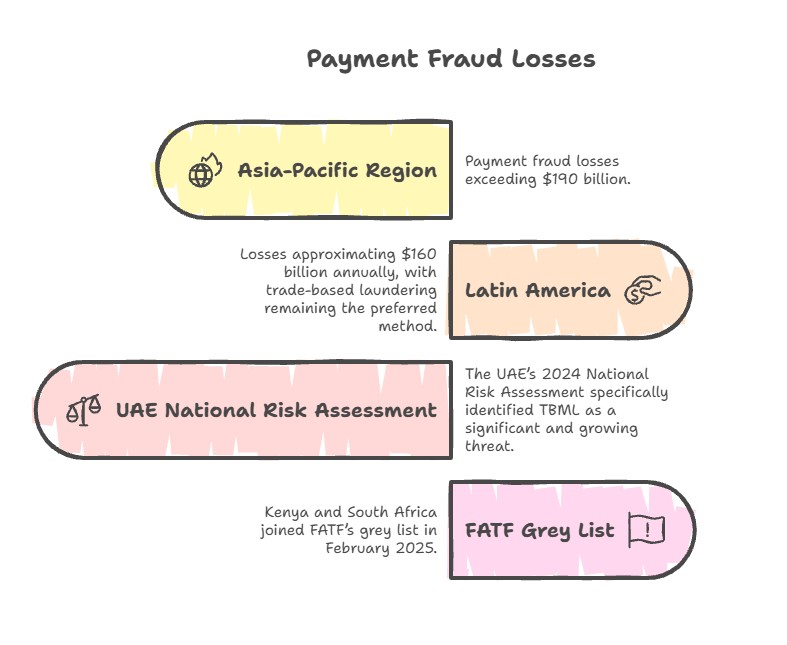
In the Middle East and North Africa, there are vulnerabilities despite enhanced monitoring, particularly in re-export activities. Kenya and South Africa joined the FATF’s grey list in early 2025.
Electronics and technology, chemicals for synthetic drug production, luxury goods, and precious metals like gold are high-risk sectors. They facilitate money laundering due to their value, transportability, and pricing opacity.
Exploiting tariffs, digital platforms, and cryptocurrency
The implementation of substantial tariff increases in 2025 created immediate arbitrage opportunities exploited by criminals through last-minute country of origin changes, transshipment via low-tariff jurisdictions, commodity code manipulation, and under-declaration of value.
Similarly, cryptocurrency use grew as criminals combined traditional trade documents and physical goods with crypto payments. This created blind spots in monitoring and complicated investigations.
Digital trade platforms further complicated detection, with rapid onboarding, minimal documentation, and platform-to-platform fund transfers circumventing traditional banking scrutiny.
The link between trade finance fraud and TBML
Trade finance fraud, estimated to affect up to 1% of all deals and representing over $50 billion annually, often serves as the mechanism enabling TBML. The document-intensive nature of trade finance, with numerous documents per transaction, creates multiple points of vulnerability to manipulation.
In 2025, the rise of AI-generated forgeries introduced a new frontier of risk. Falsified bills of lading, commercial invoices, and similar documents undermine traditional verification methods.
Documents that look “too perfect” raise suspicions due to their absence of typical revision history found in genuine paperwork.
Organisational silos between trade finance fraud teams and AML compliance units exacerbate detection challenges, creating blind spots where illicit activity may evade scrutiny.
Technology and detection: Progress and persistent challenges
By the first half of 2025, 62% of financial institutions had adopted AI and machine learning for AML activities, with projections of 90% by year-end.
Enhanced transaction monitoring systems achieved a 40% reduction in false positives and improved operational efficiency.
They provide advanced pattern recognition to detect complex layering and structuring schemes, conduct network analysis to map relationships among shell companies, and allow for real-time transaction evaluations with intervention times under 200 milliseconds.
However, there are challenges. Data quality issues, integration difficulties, regulatory transparency requirements, and inadequate staff training limit AI’s full potential.
Outlook for 2026: Heightened risks and regulatory evolution
The TBML threat landscape is expected to intensify in 2026 with increased cryptocurrency integration in trade settlements, including privacy coins and decentralised finance (DeFi) exploitation.
More sophisticated AI-generated deepfake documents will require advanced metadata and forensic analysis. Geographic shifts will utilise new trade corridors and free trade zones, while money laundering services will grow with turnkey schemes.
Regulatory bodies expect more developments, such as the U.S. moving forward with FinCEN’s proposed rule, increased DOJ criminal enforcement, and improvements in beneficial ownership registries.
The EU will expand AMLA supervision, fully implement 6AMLD, and enhance cross-border data sharing.
With FATF updates, Cross-Border Financial Crime Centers, and strengthened enforcement of the Travel Rule, International coordination will improve.
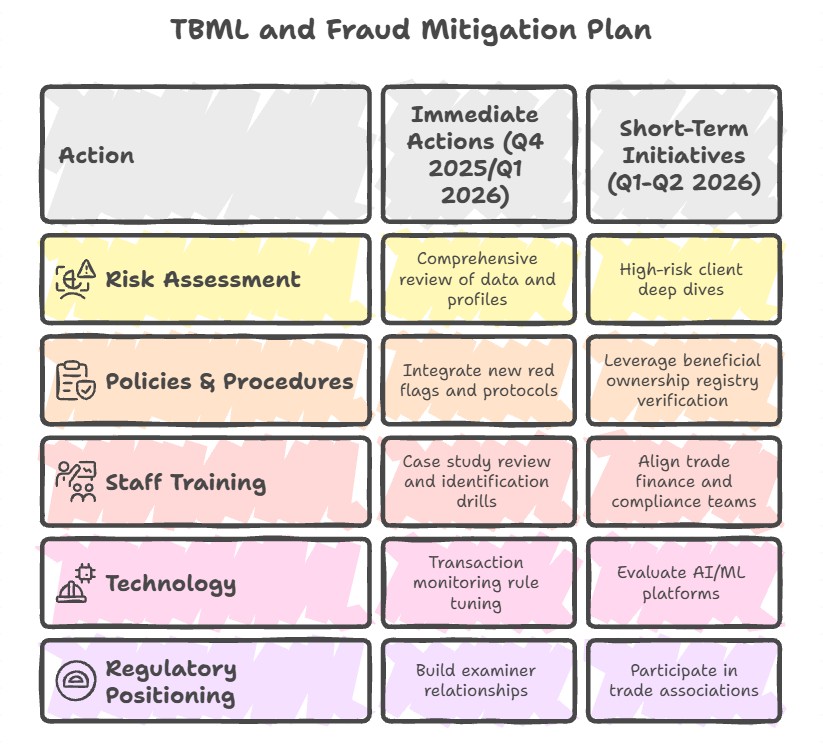
To navigate this, institutions need to prioritise comprehensive risk assessments incorporating 2025 incident data and regulatory changes. Policy updates should address new red flags, cryptocurrency interactions, and beneficial ownership verification.
Staff training would also become a key focus area for the use of emerging typologies and technology tools.
Technology investments in AI-powered network analysis, real-time monitoring, and predictive analytics are essential. Additionally, cross-functional coordination between trade finance, AML, legal, and compliance teams must be formalised. Active engagement with industry consortia and regulatory bodies is critical to maintaining compliance and competitive positioning.
The 2025 TBML report shows a turning point. Enforcement is tougher, transparency is better, and detection technology is more mature. The risks and stakes have never been higher. The choices made now will shape the future of global trade finance compliance.
Read the full report here.