

The BRICS grouping’s expanding membership and economic weight offer opportunities for deeper trade, development finance, and greater influence over global institutions. Yet divergent national interests, China’s dominance, and competing relationships with the US constrain collective action. As China prepares to assume the chairship in 2027, the grouping’s prospects rest on translating shared ambitions into practical benefits concerning evolving trade routes, local-currency settlement, and infrastructure investment.
Two months after India hosted the 18th BRICS Summit in New Delhi, the grouping remains the largest and most diverse non-Western coalition in the international system. However, its influence continues to rest primarily on its scale and convening power, with divergent member interests limiting the prospects for collective action. Members want deeper trade ties, greater influence over international institutions, and alternatives to Western financial systems. Yet some members remain cautious about undermining relations with the US and other Western partners in pursuit of these goals.
The unanimous adoption of the New Delhi Declaration demonstrated unusual consensus on several shared priorities. Members called for reform of the Bretton Woods institutions, supported World Trade Organisation (WTO) restructuring, and welcomed further development of the BRICS Global Value Chains Action Plan for 2026–2030. Yet the omission of Russia’s war in Ukraine and the declaration’s cautious wording on Middle East tensions and unilateral tariffs, which avoided explicit reference to US involvement, point to persistent divisions in tackling the more challenging issues within the expanding bloc. All members want greater influence over international institutions, but their appetite for challenging Western governments in doing so varies. India, the United Arab Emirates (UAE), Brazil, and several partner countries remain cautious about initiatives that could undermine their US and European relationships, requiring members to weigh collective ambitions against individual access to markets, finance, and security partnerships.
PANGEA-RISK assesses how far BRICS can translate its scale into collective influence, and what this means for countries and businesses navigating changes in trade, payments, and development finance.
An emerging pole with competing interests
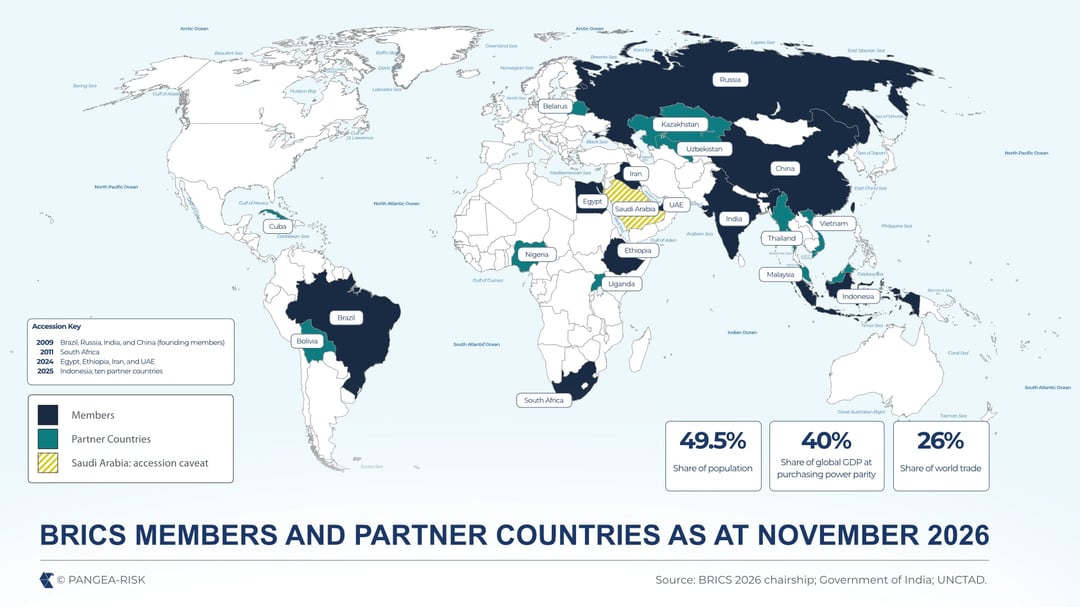
Founded as a Goldman Sachs investment thesis in 2001 and formalised as a diplomatic ‘BRIC’ bloc in 2009, BRICS has more than doubled in size since 2024. BRICS expanded beyond its original five members with the admission of Egypt, Ethiopia, Iran, and the UAE in 2024, followed by Indonesia in 2025. The partner category established at the 2024 Kazan Summit further extended the grouping’s reach to ten additional countries, including Belarus, Bolivia, Cuba, Kazakhstan, Malaysia, Nigeria, Thailand, Uganda, Uzbekistan, and Vietnam. More than 30 other states have also expressed interest in membership or partnership. Although Saudi Arabia has yet to formally confirm its accession, reflecting caution over the implications for its security partnership with the US, the Kingdom still played a prominent role during the New Delhi talks. Taken together, the bloc now represents 49.5 per cent of the world’s population, 40 per cent of global GDP based on purchasing power parity, and 26 per cent of world trade, underlining BRICS’ collective economic weight.
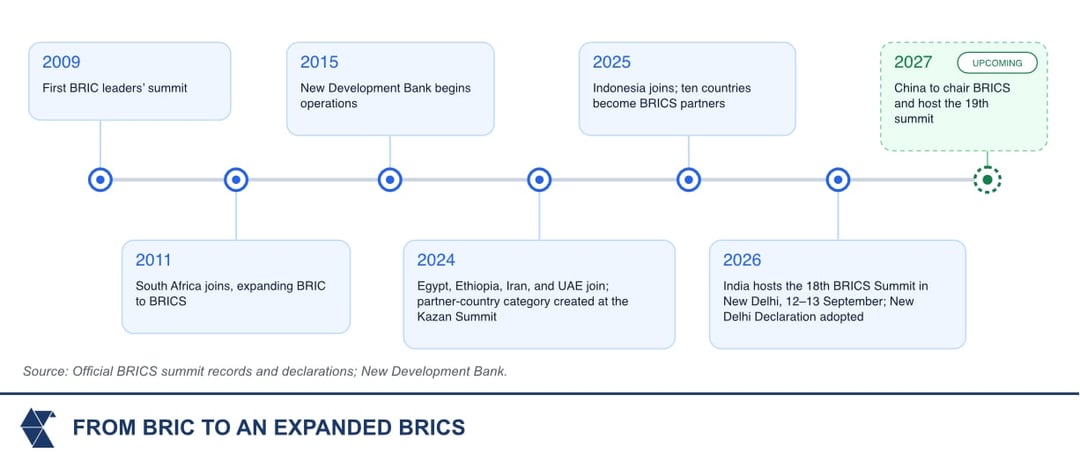
Beyond BRICS’ growing economic clout, the New Delhi summit on 12 and 13 September also underscored the grouping’s diplomatic reach. It marked Chinese President Xi Jinping’s first visit to India since 2019 and the first by an Iranian president in more than eight years. Xi and Indian Prime Minister Narendra Modi committed to pursuing a fair and mutually acceptable resolution of their boundary dispute and easing trade barriers, extending the gradual thaw following the 2020 Galwan clash. Iranian President Masoud Pezeshkian, meanwhile, met Abu Dhabi Crown Prince Sheikh Khaled bin Mohamed bin Zayed Al Nahyan in the highest-level known engagement between Iran and the UAE since the US-Israel war on Iran began in February. These exchanges illustrated the value of India’s approach to its chairship, using BRICS to advance practical cooperation and dialogue between members without requiring a common geopolitical alignment. Modi’s assertion that BRICS was “not against anyone” reinforced this positioning.
Whether this approach endures will depend partly on how China shapes the agenda when it assumes the chairship in 2027. Xi’s proposals on artificial intelligence, industrial cooperation, and supply-chain integration offer scope to build on India’s emphasis on practical cooperation. However, China could also seek to use the grouping’s growing economic and diplomatic weight to challenge Western influence more explicitly, testing the consensus India has sought to maintain. Members wishing to preserve relationships across competing centres of power would resist such a shift, making selective cooperation on shared economic priorities more likely than a unified geopolitical stance.
Deeper trade ties bring uneven benefits
Trade within BRICS has also expanded substantially despite the absence of a common free-trade agreement. According to the UN Conference on Trade and Development (UNCTAD), intra-BRICS merchandise exports rose from USD 84.2 billion in 2003 to USD 1.17 trillion in 2024, an average annual growth rate of 13.3 per cent. Over the same period, the members’ combined share of global merchandise exports doubled from roughly 12 per cent to around 24 per cent. Intra-BRICS trade nonetheless still represents only about 5 per cent of world trade and roughly 20 per cent of South-South trade, indicating substantial unrealised potential.
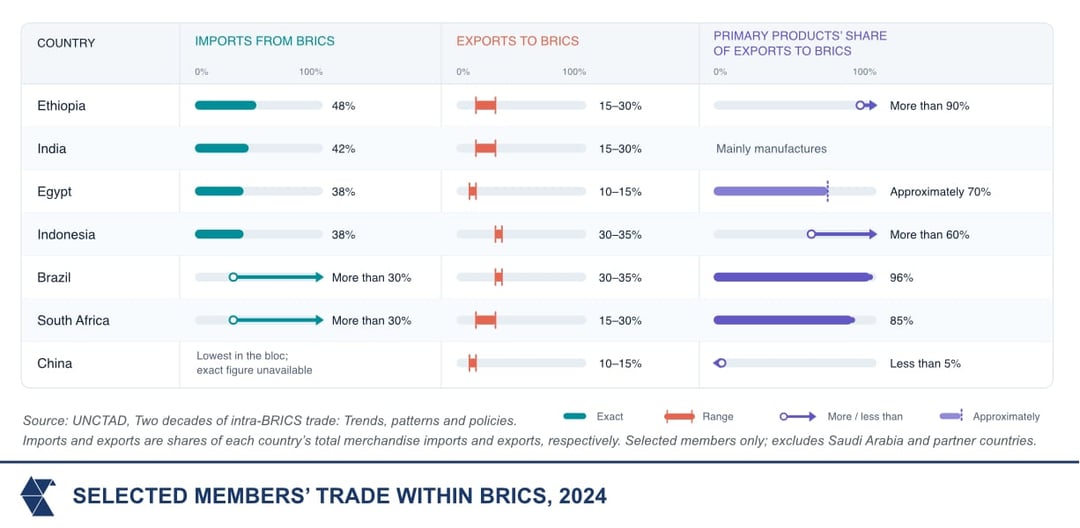
Although intra-BRICS trade is growing, its concentration on China means the benefits are unevenly distributed. UNCTAD data show that China exported around USD 497 billion to fellow members in 2024, roughly 42 per cent of all intra-BRICS exports, while remaining the member least dependent on the bloc for its own trade. By contrast, Ethiopia sources 48 per cent of its imports from fellow members and India 42 per cent, while around a third of exports from Brazil, Russia, Indonesia, and the UAE are sold within BRICS markets. These differing levels of dependence give China considerable leverage over the grouping’s economic relationships.
What members trade compounds this imbalance. Seven of the ten members covered by UNCTAD derive more than 60 per cent of their intra-BRICS export earnings from primary products, including Brazil at 96 per cent and South Africa at 85 per cent. China’s equivalent share is below 5 per cent. For many commodity exporters, deeper BRICS ties therefore offer alternative markets without necessarily expanding domestic processing or manufacturing capacity. Diversification away from Western markets can therefore deepen dependence on Chinese demand and manufactured imports without helping members move beyond primary exports into higher-value processing and manufacturing.
The New Delhi agenda sought to broaden these benefits through calls for technology transfer and domestic value addition, specifically in critical minerals. Delivering on these ambitions will require investment that strengthens productive capacity across member countries, alongside measures to ease trade barriers. UNCTAD has recommended a grouping-wide trade agreement, but divergent tariff regimes and the absence of WTO membership for Ethiopia and Iran make this unlikely in the near term. Progress is more likely through sectoral agreements and individual investment projects.
China’s 2027 chairship will provide an opportunity to advance this agenda, particularly through its proposed emphasis on industrial cooperation and supply-chain integration. Its success will depend partly on whether these initiatives help other members capture more value from their trade. Unless cooperation broadens the benefits beyond access to Chinese markets and finance, BRICS risks changing the geography of members’ dependence rather than reducing it.
Local currencies expand payment options without displacing the dollar
The New Delhi Declaration supports greater use of local currencies and continued work on cross-border payments. These initiatives could reduce transaction costs and dependence on intermediaries, but their commercial value will depend on implementation. The data confirm that dollar dominance is eroding only slowly. The dollar accounted for 56.70 per cent of allocated global foreign exchange reserves in the second quarter of 2026, according to the International Monetary Fund (IMF), down from above 71 per cent in 2001, while the renminbi held just 2.11 per cent against 20.60 per cent for the euro. The dollar was on one side of 89.2 per cent of foreign exchange trades in April 2025, up from 88.4 per cent in 2022, according to the Bank for International Settlements (BIS).
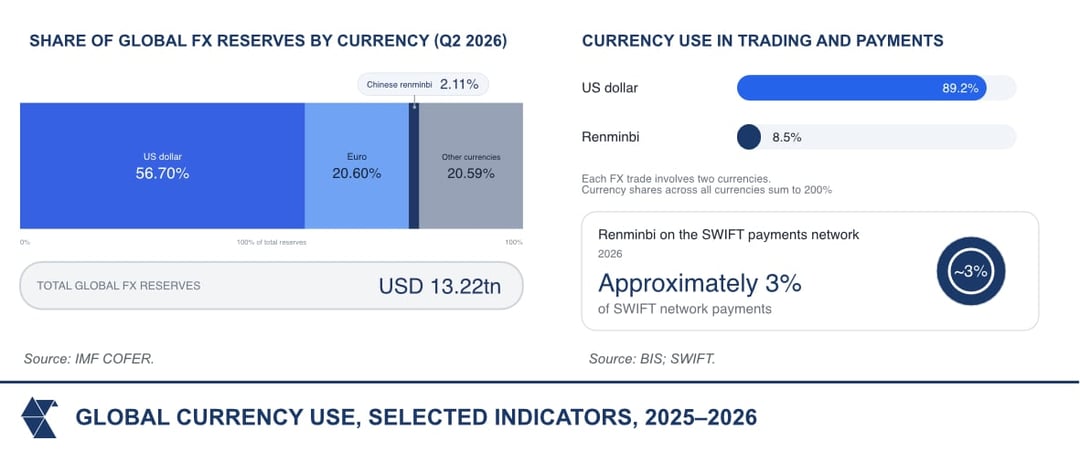
The renminbi has more than doubled its share of turnover since 2019 to around 8.5 per cent, and accounted for roughly 3 per cent of SWIFT payments in early 2026. The renminbi’s share of global reserves and international transactions remains small compared with those of the dollar and the euro, but it is growing. More meaningful shifts are taking place at the margins, where sanctions exposure is highest. Russia and China settle most bilateral trade in roubles and renminbi, India and the UAE have used rupee and dirham settlement for oil, and China’s Cross-Border Interbank Payment System (CIPS) processes a growing share of renminbi payments outside SWIFT. For Iran, now subject to a US naval blockade and “Operation Economic Outcast”, non-dollar channels within BRICS are a matter of economic survival.
The New Development Bank provides a more tangible measure of financial cooperation. By the end of 2025, it had approved 139 projects worth approximately USD 43 billion on a gross basis. Local-currency financing accounted for 46 per cent of that year’s approvals. These are approvals, rather than equivalent amounts already disbursed. Even so, they demonstrate an established financing mechanism with practical relevance for infrastructure and development.
Local-currency lending can reduce borrowers’ exposure where revenues are earned domestically and debt would otherwise be serviced in dollars. Its usefulness depends on pricing, maturity, availability, and the borrower’s circumstances. A higher local-currency share is therefore meaningful, but is not by itself evidence that BRICS is building a replacement international monetary system. The New Development Bank’s decision to put new Russian transactions on hold in 2022 illustrates the limits. Institutions associated with BRICS must still manage sanctions exposure, funding requirements, and investor confidence and the ability to offer alternatives depends partly on maintaining access to the wider financial system. This constrains how far financial cooperation can serve members seeking insulation from Western pressure. US hostility has also capped collective ambition. President Donald Trump has labelled BRICS “anti-American” and threatened tariffs on members that back an alternative to the dollar, giving India, the UAE, and Saudi Arabia strong incentives to avoid provoking the US.
Expansion complicates collective action
BRICS’ central challenge is political. Members share dissatisfaction with aspects of international governance, but disagree on the response. Russia and Iran have stronger incentives to seek alternatives to Western systems. India, Brazil, and several newer members want greater influence without sacrificing existing Western partnerships. China’s interests overlap with both approaches, while its economic dominance raises concerns among other members. The 2024 expansion has compounded this divergence. Consensus decision-making gives every member an effective veto, and adding states that are in open conflict with one another has made agreement harder. These positions can coexist within a diplomatic forum, but they become harder to reconcile when cooperation requires governments to accept material costs.
Institutional depth also remains limited. BRICS has no permanent secretariat comparable to a treaty-based organisation, and rotating chairships influence its priorities. China’s 2027 chairship is likely to tilt the agenda towards China’s own initiatives on payments, digital governance, and security, which could sharpen the anti-Western framing that India has worked to contain.
Insight
Over the next 12 months, BRICS will consolidate its position as the principal convening platform for non-Western states, but it will not evolve into a cohesive geopolitical bloc. Expansion will continue mainly through the partner-country tier rather than full membership, as existing members seek to preserve consensus and avoid importing further bilateral disputes. China’s 2027 chairship will push payments compatibility, digital governance, and New Development Bank expansion, and is likely to adopt sharper language on Western sanctions and tariffs than India did. India will resist an explicitly anti-Western turn while continuing to negotiate its own trade arrangements with the US and EU, keeping its BRICS engagement deliberately transactional.
Economically, intra-BRICS trade will keep growing faster than global trade as US tariffs and sanctions redirect commodity flows towards China, India, and the Gulf. However, China’s central role means that most of this growth will deepen dependence on a single partner rather than create a balanced network, and India’s widening deficit with the bloc will remain a source of friction. Dollar dominance will persist across reserves, foreign exchange, and trade invoicing, with de-dollarisation progressing through bilateral local currency settlement and New Development Bank lending rather than any common BRICS currency.
The principal downside risk across the bloc is a renewed escalation of the US-Iran war or the imposition of secondary tariffs targeting BRICS payment initiatives, either of which would expose divisions between members. The rise of BRICS is likely to influence business conditions through changes in trade flows, payment options, and development finance, but the dollar will remain dominant. Progress will vary by country, creating opportunities alongside the complexity of navigating different rules and financial systems. As such, the bloc’s real practical value will depend on whether cooperation makes trade and investment easier across member markets.