

TikTok Shop merchants can now buy business insurance without leaving Seller Center. A century ago, Prudential’s agents met customers, asked questions, and put their names to the answers. At ERGO NEXT, owned by Munich Re, the underwriting is entirely algorithmic. The seller still vouches for the answers, including the ones filled in for them.
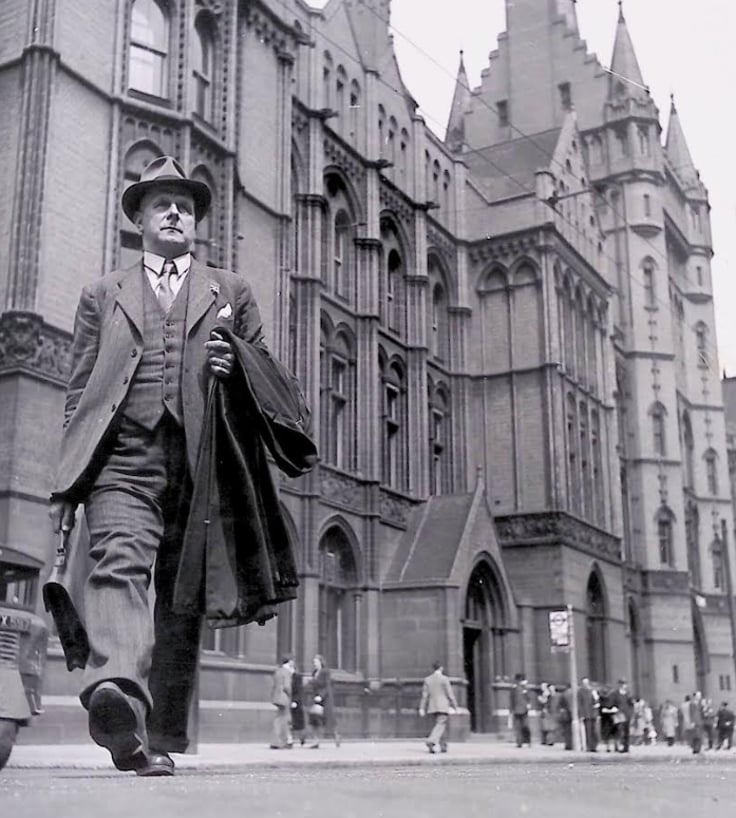
Fred Sawyer, Prudential agent. Image: Prudential PLC Archives
The walk was the point
In 1949, a magazine called Weekly Illustrated ran a feature on the working life of a Prudential agent named Fred Sawyer. Prudential’s publicity department saw the photographs and settled on one of Sawyer, mid-stride, walking away from its offices at Holborn Bars.
The man from the Pru was real. The character ran on and off for sixty-five years, Prudential finally retiring him for good in 2014.
Financial advertising usually sells a product, or a feeling about a product, or a majestic beast. What endured here was how the insurance arrived: on foot, weekly, at the door, carried by someone who lived on the same streets and would be back on Friday whether you had the penny or not.
The walk helped Prudential decide which risks to take. After all, an agent standing in the same hallway once a week for eleven years knew who had died, who was drinking, and which children were sickly.
The Prudential Archive holds an industrial branch proposal form from 1927. It warns that any untruth or concealment of a material fact may void the policy. Among its nine questions: Is the life proposed sober and temperate? Had a parent or relative died of consumption, tuberculosis, or another chest disease?
The customer supplied the answers. The agent had to sign to say he believed them.
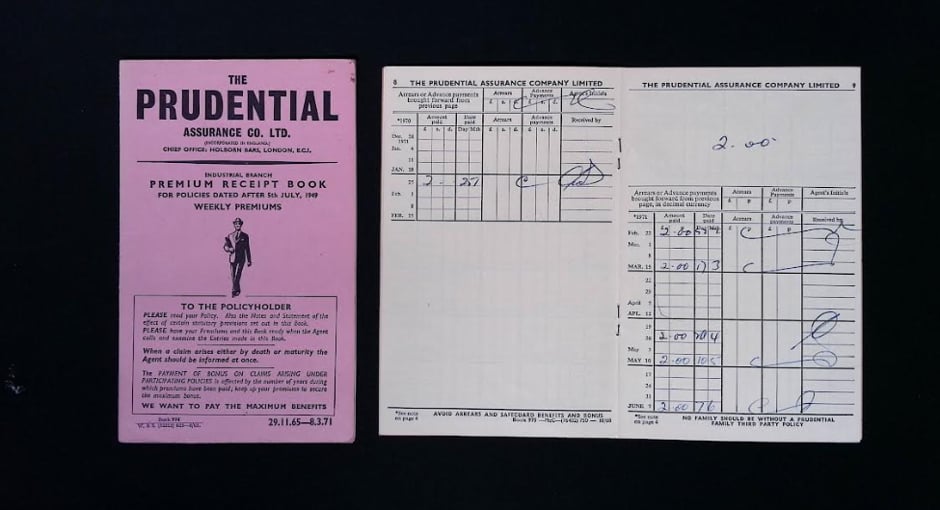
An industrial branch premium receipt book from 1965 to 1971, spanning decimalisation. Image: Prudential PLC Archives
Prudential’s own history claims ten thousand agents by the turn of the century, selling insurance to a third of the population. In the 1960s, its agents visited six million British homes from some five hundred district offices. One of those agents, in Weston-super-Mare, was John Cleese’s father, his son eventually taking the walk in a sillier direction.
But the maths that produced the man from the Pru hasn’t gone anywhere. Small businesses are numerous, scattered, and expensive to reach. The modern answer is embedded insurance. Cover sold inside a platform the customer is already using for something else.
How Munich Re reached the TikTok checkout
TikTok Shop is the app’s commerce arm, where businesses run storefronts and sell to viewers directly. Seller Center is the back office they use to manage it. On 20 May 2026, sellers there were offered general liability, professional liability, workers’ compensation, and cyber cover, quoted and bought without leaving the system. The insurer is ERGO NEXT.
ERGO NEXT was NEXT Insurance until January 2026. Founded in Palo Alto in 2016 to insure American small businesses, it had more than 600,000 customers. ERGO, Munich Re’s primary insurance arm, had held a stake since 2017 and agreed to buy the remaining shares in March 2025, in a deal valuing NEXT at $2.6 billion. The acquisition was completed that July.
Follow the insurance behind a TikTok seller’s storefront, and you arrive quickly at Munich Re. Its reinsurance business was built to operate at a distance from the customer. ERGO, meanwhile, writes primary insurance across Europe. Its acquisition announcement was headed “ERGO gains access to the US market”. The prize was NEXT’s American small-business customer base, proprietary technology, and a fully automated underwriting and pricing platform.
Marketplaces are already selling SMEs insurance at the point of purchase. GlobalData surveyed 2,054 SMEs across fourteen markets in Q4 2025. Of those, 39.1 per cent had been offered insurance while buying something else through a marketplace. Almost half of those offered it, 48.8 per cent, bought it.
Prudential spent a century assembling its customers one doorstep at a time. Embedded insurance starts with them already assembled.
Somebody had to vouch for the answers
Commercial insurance begins with questions. What does the business do? Where does it operate? What does it sell? How much does it turn over? The answers help the insurer decide whether it wants the risk and what to charge.
Prudential’s industrial life assurance was a different business, selling small policies to working-class households and collecting premiums at the door. But it, too, depended on what the applicant told the insurer, and its proposal forms recorded who supplied the answers.
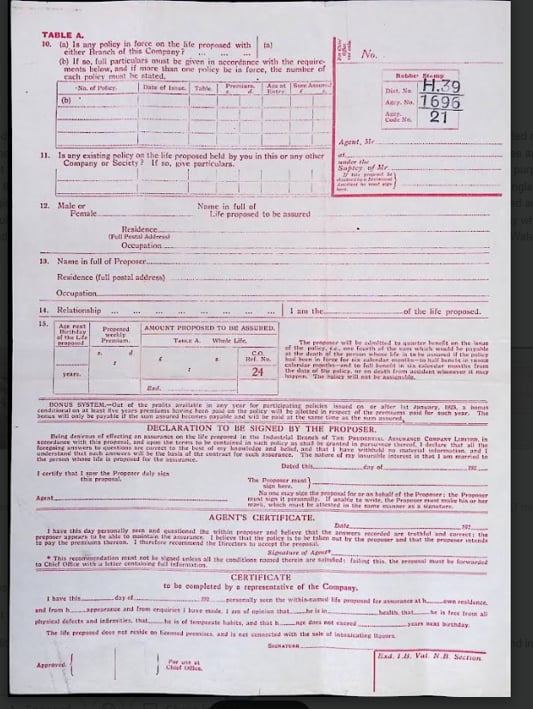
Reverse of a 1927 Prudential industrial branch proposal form, with the proposer’s declaration and the agent’s and company representative’s certificates. Image: Prudential PLC Archives
The reverse of Prudential’s 1927 form carries three certificates. The proposer declares that the answers are correct, that no material information has been withheld, and that the answers form the basis of the contract. Nobody else may sign for them. If they cannot write, they must make a mark.
The agent signs twice: first to witness the proposer’s signature, then to certify that he has personally seen and questioned them, believes their answers, and recommends acceptance. If he cannot satisfy every condition, he must refer the proposal to Chief Office with a written explanation.
Some proposals also required a superintendent’s certificate. He had to visit the applicant at home and, from their appearance and from enquiries made, give an opinion on their health, their temperate habits, and their apparent age, and confirm that they neither lived on licensed premises nor were connected with the sale of intoxicating liquors.
Prudential had written down when an agent’s word was enough, and when somebody more senior had to go and look for himself.
TikTok Shop has not removed the questions
Henry Tam, VP of Partnerships at ERGO NEXT Insurance, said TikTok Shop’s data helps with identity verification and reduces friction, but it doesn’t replace the applicant’s own representations. The seller completes ERGO NEXT’s quote flow and provides information directly, including business type, revenue, and employee count. Certain fields are pre-filled from verified seller account information, which Tam said can reduce the risk of typos or omissions compared with entering everything manually. If a pre-filled field is wrong, the seller reviews it before submitting. “The seller still attests to the risk information and is responsible for its accuracy,” Tam said.
Asked what triggers a referral for human review, Tam said the NEXT carrier uses entirely algorithmic underwriting and instant decisioning, so it doesn’t refer cases to a human underwriter. “We either write the policy or decline the customer.” Sellers whose goods fall outside the carrier’s appetite are passed to NEXT Agency, where licensed producers place them with other insurers.
Nobody certifies that they have personally seen and questioned the applicant. Nobody recommends that the directors accept. No superintendent goes to the premises and puts his name to what he finds.
The declaration survived. The people who vouched for it did not.
European rules stop short of liability cover
The offer is American, and so is the regulation that governs it. But European rules already recognise the insurance-at-checkout idea. The exemptions were designed around insurance that protects the thing being bought, which is what those marketplace offers mostly are. TikTok is offering insurance for the seller’s own business through the same kind of convenient purchase journey.
The Insurance Distribution Directive exempts certain ancillary insurance intermediaries: the travel agent selling cover with a holiday, the car hire desk selling it with a rental, the retailer selling cover on a washing machine. Under Article 1(3), the insurance must protect the goods or services supplied, with the premium generally capped at EUR 600 a year. Article 2(1)(4) separately restricts the kinds of insurance an ancillary intermediary can distribute, including liability cover unless it complements the intermediary’s principal goods or services.
General liability, professional liability, workers’ compensation, and cyber cover protect against risks arising from the seller’s business, rather than the breakdown, loss, or damage of something bought through TikTok. The exemption was written for a cracked screen and a cancelled holiday.
Asked how far the model can stretch, Beatriz Benito at GlobalData told TTP that embedded insurance is presently limited to simpler products. It is built on speed, frictionless transactions, and scale, she said, and current designs cover only low-value items and exposures.
GlobalData provided additional figures in response to TTP’s questions. Asked what most held SMEs back, concern about difficulties with the claims process came first, cited by 23 per cent of the 2,054 businesses surveyed. Lack of expertise or advice on coverage came second at 22.2 per cent. Among SMEs with 50 to 249 employees, concern about claims rose to 26 per cent.
Making insurance quicker to buy does not make either concern disappear.
There is no character for Seller Center and no mascot for the quote engine. Prudential spent sixty-five years advertising a man who signed. The seller still signs. Nobody signs beside them.