

Berne Union white paper says blended finance is held back by how risk is shared, not capital, putting $4 trillion of ECA and insurer cover at the centre.

Deepesh PatelManaging Director and Editor-in-Chief, Trade Treasury Payments
19 Nov 2026
Update
A new Berne Union white paper argues that blended finance is held back by how risk is shared, not by a shortage of money. It puts export credit agencies and private insurers, which as BU members hold about $4 trillion of cover, at the centre of the fix.
The Berne Union (BU) has launched Rethinking Blended Finance, a white paper that argues the main barrier to blended finance is how risk is allocated, not a lack of capital. Launched at the BU’s annual general meeting in Tokyo this week, it shifts the focus away from concessional and philanthropic money and onto the guarantees and insurance that export credit agencies (ECAs) and private credit and political risk insurers (CPRI) already provide at scale.
That matters for ECAs, insurers, commercial banks, multilateral development banks (MDBs) and borrowers in emerging and developing markets. The paper argues the instruments largely exist. The harder task is agreeing early who takes which risk, and in what order. It also widens the purpose of blended finance beyond the UN Sustainable Development Goals (SDGs) to economic resilience, through a framework it calls Transformational Impact on Global Economic Resilience (TIGER).
The paper was developed with partners AXA XL, Marsh, Momentus Global, Nippon Export and Investment Insurance (NEXI), PIDG and Sullivan & Worcester. It draws on the BU’s blended finance hackathon in London in March 2026, which followed a call for submissions in August 2025.
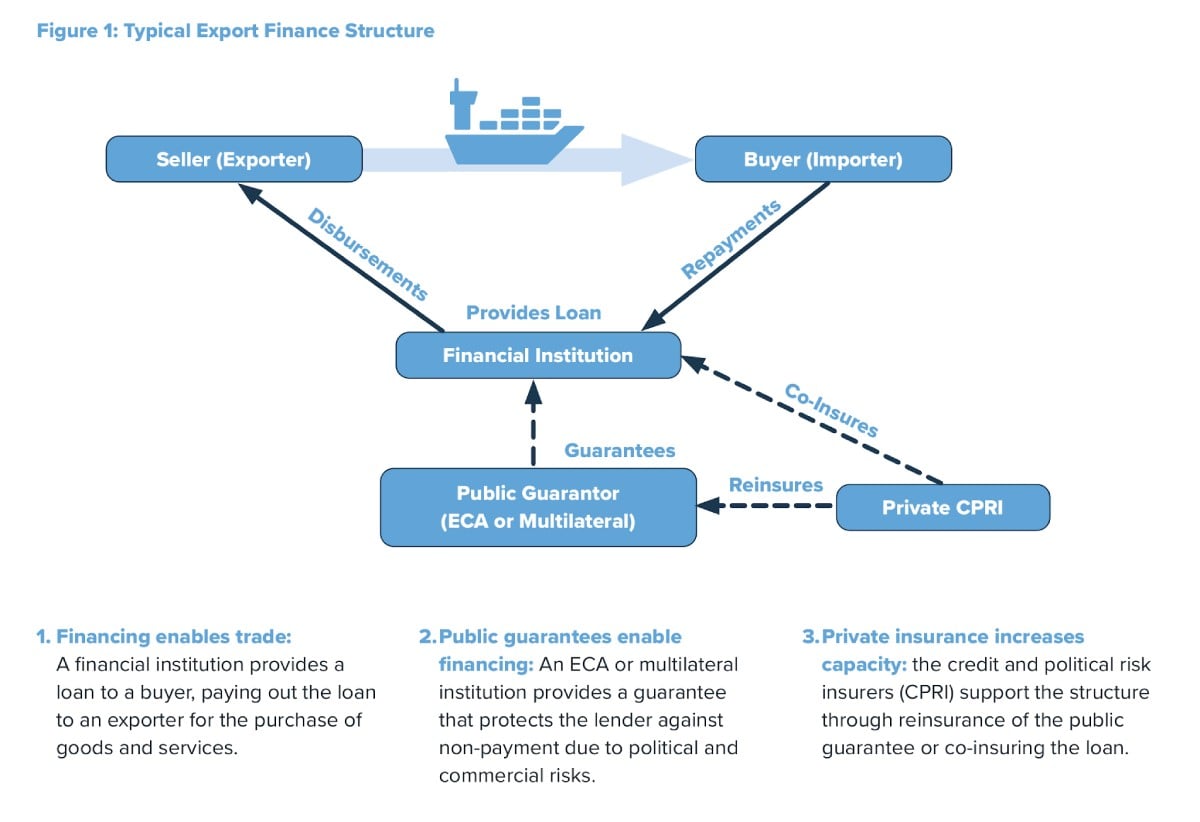
Traditional definitions from the OECD and the UN emphasise public or philanthropic money mobilising private investment. The paper separates concessional capital from catalytic capital, which it says “does not need to be concessional; commercially priced instruments can have a catalytic effect.” That brings commercial ECA and insurer cover inside the toolkit.
“The experience accumulated within export finance offers a practical blueprint for broader blended finance initiatives,” the paper says.
Source: Berne Union, Rethinking Blended Finance, November 2026
According to the paper, BU members held $4 trillion of active cover at the end of 2025, including exposure to all 44 least developed countries (LDCs). Of about $1 trillion in medium- and long-term cover, $711 billion went to developing countries and $128 billion of that to LDCs.
Private insurers are a growing part of that capacity. Deployed capacity by private CPRI providers has expanded by 79 per cent since 2019, the paper says. It concludes that guarantees and insurance “are already operating at a scale capable of materially influencing global capital flows”.
There is a caveat. New medium- and long-term commitments shifted towards developed markets for the first time in 2025. The paper says this reflects growing overall capacity, not declining support for developing economies.
Trade finance shows the model at work. In fiscal year 2026, the International Finance Corporation’s (IFC) Global Trade Finance Program (GTFP) supported $15 billion in trade, nearly 60 per cent of it in low-income and fragile countries. A new GTFP securitisation open to private insurers has an expected private capital mobilisation ratio of up to 1:19. That matters in markets where banks have little appetite for risk, as TTP has reported.
The paper sets out its main lesson: “Better risk orchestration – not more capital – is needed to scale blended finance.”
It also finds that “blended finance outcomes depend as much on sequencing and coordination as on instrument availability”. Practitioners made the same point to TTP in Who goes first? Blended finance and the problem of sequencing.
In his foreword, outgoing BU president Yuichiro Akita wrote that “blended finance is increasingly an exercise in risk orchestration”.
Contributors include Paul Heaney, secretary general of the BU and a member of TTP’s Global Advisory Panel.
Dr Rebecca Harding, chief executive of the Centre for Economic Security and a member of TTP’s Editorial Board, argues in the paper that market failures now have to be understood as “strategic market failures”. In these, “markets are operating efficiently according to commercial incentives while simultaneously failing to produce the capabilities essential to long-term national security and resilience”. “This is a Bretton Woods 2.0 moment,” she writes.
Other contributors include Christopher Marks, managing director at MUFG; Alexander Otten, senior project finance manager at Atradius Dutch State Business, whose Innovation Cover can cover up to 80 per cent of the credit risk on a commercial investment loan; and Chris Clubb, managing director of Convergence, who has discussed how development and trade finance can work together with TTP.
The paper proposes shared language and practical guidance, a repository of case studies and structuring examples, peer learning on ECA–MDB–insurer collaboration, and pilots for repeatable platforms, pooled risk-sharing or reinsurance.
“In many respects, blended finance is as much a human capital challenge as it is a financial one,” the paper says. The BU “can help create the conditions for collaboration, but it cannot substitute for the decisions that only its members can take within their own institutions”.
Members in Tokyo also elected Leah Gilbert Morris of Export Development Canada (EDC) as BU president for 2026 to 2028.