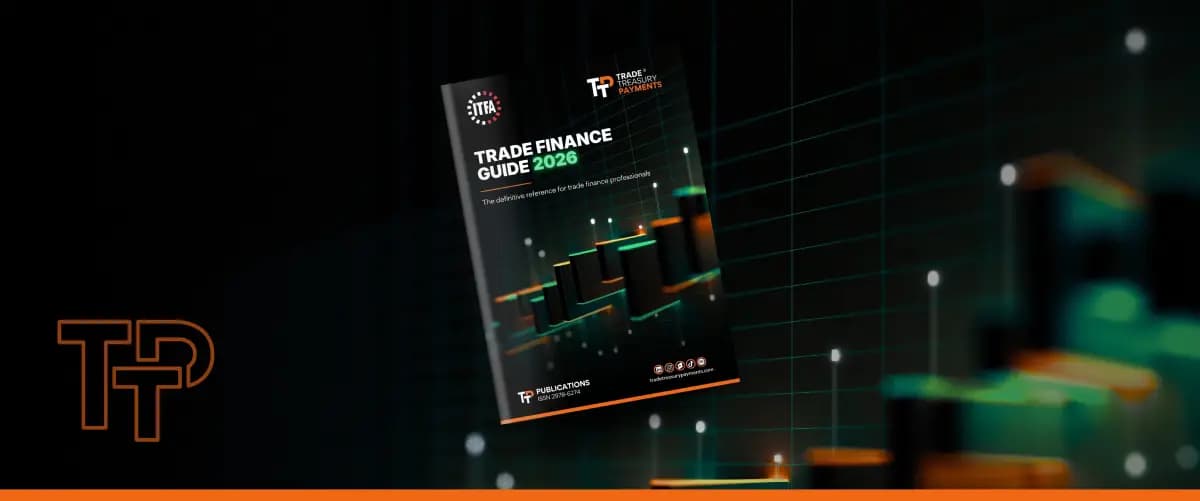
Trade Treasury Payments (TTP) and the International Trade and Forfaiting Association (ITFA) are excited to announce the launch of our updated Trade Finance Guide 2026.
Trade is one of the most important drivers of economic development and poverty reduction. It supports businesses, creates jobs, helps countries develop, and improves access to goods and services around the world. Though, it would seem, amidst the polycrisis of the current moment, the smooth movement of goods around the world can no longer be taken for granted. Conflict, sanctions, tariffs, shipping disruptions, and a more fragmented trade environment overall have all conspired together to expose how fragile global commerce can be. Nevertheless, at the heart of that vital and resiliently counter-cyclical system, and helping companies manage these rising risks, access fleeting working capital, and move goods across more protected borders, is trade finance.
But trade finance can be a complicated industry to understand, and with advancements in technology, it is changing fast. New electronic trade laws and frameworks, including UNCITRAL’s Model Law on Electronic Transferable Records (MLETR), Negotiable Cargo Documents initiatives, and the Commonwealth model law, are helping support the use of electronic trade documents, and technology is now being used to improve how information moves across supply chains.
The advancement of technology and, particularly, artificial intelligence, was one of the primary impetuses for revising this guide, as it is having an outsized impact on how trade information is processed, analysed, and shared across the industry. At the same time, existing trade finance techniques are evolving, with areas such as supply chain finance seeing significant growth and renewed attention being given to more traditional instruments such as documentary collections.
As the industry evolves, there is an increasing need for practical and accessible educational resources that help explain the many products and techniques used in the industry, but also how all of the seemingly disparate parts of the wider ecosystem fit together. Adding to the importance is the fact that the market is expanding beyond traditional bank-led financing models, with growing participation from non-bank investors, private credit providers, insurers, and institutional capital viewing trade finance as an investable asset class.
Deepesh Patel, Managing Director of TTP, said, “We are seeing trade finance change faster than at any point in recent memory. One of the goals of this guide is to make those changes easier to understand and more accessible to a wider audience.”
TTP and ITFA have partnered on this updated edition of the guide. For many years, ITFA has played an important role in supporting education, industry dialogue, and the development of market standards across global trade finance. This includes supporting important industry initiatives, such as TF COP and others, around digital trade, sustainability, financial inclusion, and the continued development of trade finance as an investable asset class. We hope this updated guide will be another pillar in that ongoing effort.
Sean Edwards, Chairman of ITFA, said, “Trade finance has always depended on collaboration and knowledge transfer. Particularly now, as new technologies and new participants enter the market, accessible education is even more important for supporting global trade.”
This guide is designed as a resource for both emerging and established professionals. Whether you are entering the industry for the first time or looking to better understand adjacent areas of the market, we hope it helps provide a clearer and more accessible overview of modern trade finance and the important role has in supporting global trade and the real economy.