


Global trade volumes hit a record $35 trillion in 2025 and continue climbing. The institutions financing this activity face mounting pressures, and that is changing how they compete, invest, and serve clients, says the International Chamber of Commerce’s(ICC) latest Trade Finance Pulse Check.
The 2026 ICC Global Trade Intelligence Report is based on surveys of over 100 trade finance practitioners from various banks. It shows an industry facing geopolitical challenges, technological changes, and evolving competition, all while dealing with shrinking profit margins.
The margin squeeze: Growth without prosperity
There is a gap between activity levels and profitability. Even though trade volumes are higher, strong competition is causing profits to decline in almost all product categories. Letters of credit are under the most pressure, with about 40% of respondents reporting lower profit margins. Supply chain finance and receivables finance are also affected, with around 35% of respondents noting similar declines.
Export finance shows some stability, with about 25% of businesses reporting declines and a similar percentage reporting growth. Despite this, profit margins are shrinking.
Geopolitical tensions and tariff volatility are increasing the need for financing and risk management products. This is a troubling sign because higher transaction volumes are not leading to better economics. It’s clear that banks are competing hard for market share in an environment where they can no longer have pricing power.
Geopolitical anxiety dominates risk perceptions
When asked about the threats, trade finance leaders point overwhelmingly to geopolitical conflict.
About 60% see geopolitical tensions as a major or severe threat, while another 30% view it as a moderate threat. It shows widespread anxiety about how changing tariffs, disrupted trade routes, and political instability are making trade and risk management more complicated.
The next biggest issues are risk and control pressures, which account for about 40%. Tariff volatility and regulatory shifts are close behind, each at around 35%.
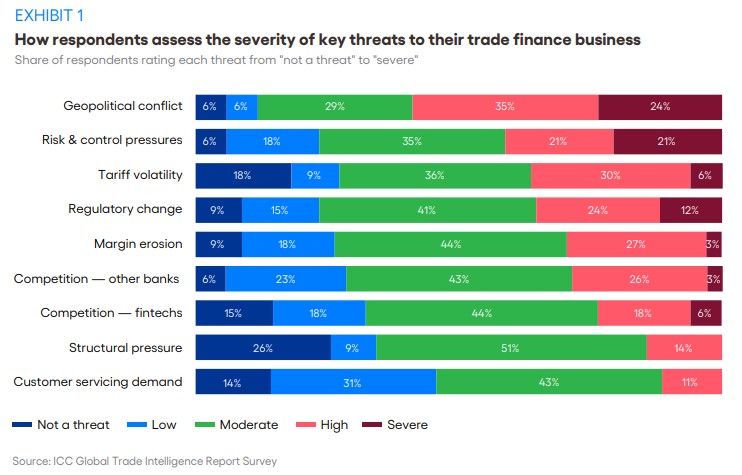
Banks are concerned about traditional competitive threats and margin erosion, while fintech competition, demand pressures, and customer service expectations are seen as less urgent risks. This suggests the industry is currently more focused on external shocks than on internal challenges.
The expertise economy: Why price no longer wins clients
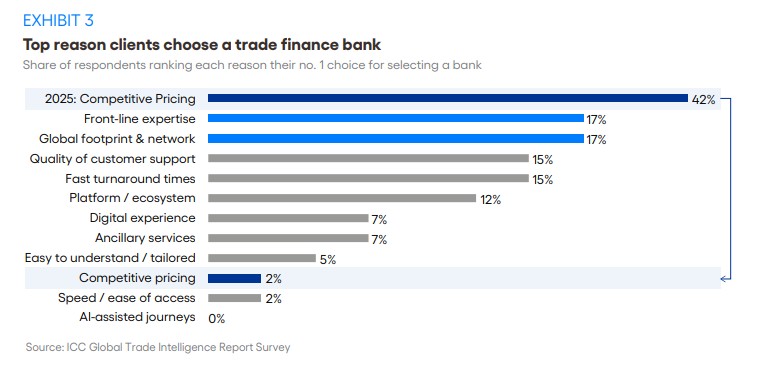
One of the report’s most revealing insights concerns how banks actually win business. Competitive pricing, long considered the ultimate differentiator in trade finance, has plummeted in importance. Only one respondent ranked it as the number one reason clients choose their bank.
Front-line expertise and a global presence are now equally important, with nearly 20% of respondents selecting them as their top criteria. Quality of customer support is the most common factor, appearing in about 55% of respondents’ top five choices. Competitive pricing ranks in the top five for only about 35% of respondents.
Fast turnaround times are crucial, with about 30% of respondents highlighting them as a top priority. Clients increasingly seek faster, transparent, and digital services, making service quality and execution capabilities key competitive advantages.
Digital transformation: Still priority one, but with a twist
Digital transformation and automation are the top priorities for the industry. About 75% of respondents list them among their five main strategic goals, which is higher than any other area tested.
As commerce migrates onto enterprise resource planning systems, marketplaces, and digital platforms, API connectivity and standardised data are becoming essential for embedding trade finance into third-party channels.
However, there’s a nuance here that matters – when forced to select a single top priority, customer experience enhancement edges ahead of digital transformation itself. This suggests banks are evolving beyond viewing digitisation primarily as a cost-reduction exercise and toward seeing it as an enabler of customer value.
Technology investment is becoming more tightly linked to specific outcomes, improving journeys, modernising platforms, and deploying AI, though legacy infrastructure continues constraining how quickly these capabilities can scale.
AI adoption: Real progress, uneven deployment
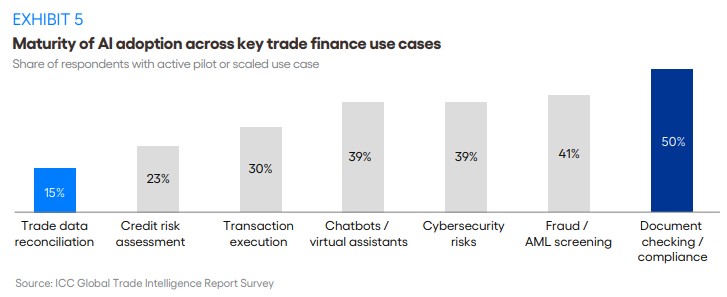
AI is playing an important role in trade finance, more than many people realise. Around 80% of institutions are testing proof-of-concept applications, with some already running generative AI in production environments. Automation can significantly reduce processing time and costs while allowing institutions to handle higher volume without increasing expenses.
Document checking and compliance screening lead adoption, with 50% of respondents either piloting or running it at scale. Fraud and anti-money laundering screening ranks second at around 40%. Yet adoption remains uneven: trade data reconciliation, despite being promoted as a game-changing solution to “digital islands,” lags significantly behind other use cases.
Sustainability’s surprising retreat
One of the report’s most unexpected findings is the decline in sustainability’s strategic priority. Only around 20% of respondents now include sustainability, climate-related regulation, and the Carbon Border Adjustment Mechanism among their top five priorities, down sharply from approximately 45% last year.
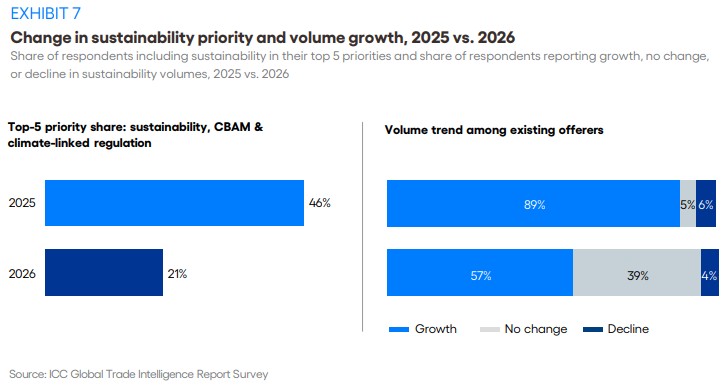
This doesn’t necessarily mean banks have abandoned sustainability commitments, but rather that more immediate pressures around geopolitics, tariffs, margins, and technology have crowded it out.
Even among banks already offering sustainable trade products, momentum has softened. While around 55% still report volume growth, roughly 40% see little change. Greater standardisation through the ICC Principles for Social and Green Trade Finance is building a more consistent foundation, but the sense of urgency has clearly diminished.
The 2026 ICC Global Trade Intelligence Report reveals that the path forward requires balancing immediate commercial pressures with long-term capability building, a challenge that will define winners and losers in the years ahead.
Read the full report here.