


By: Alan Koenigsberg
The next financial handoff is not only about assets. It is about whether the next generation, and the intelligent systems serving it, will inherit the judgment needed to use those assets wisely.
I was born in the late 1960s, which places me squarely in Generation X: the generation that has spent its life straddling the analogue and digital worlds, occasionally with one foot caught in each.
We were promised the paperless workplace, initially by machines with names such as the Apple II and the TRS-80. For the geeks among us – and I include myself proudly – 48 kilobytes of memory felt like the beginning of an extraordinary future. We believed computers would eliminate paper, simplify work, democratise information, and give us more free time.
We were right about some of that.
The paperless office now produces more documents than ever. Technology gave us more free time and then filled every available second of it with email, text messages, video calls, notifications, passwords, security codes, and calendar invitations to discuss why nobody has enough time.
But as technology advanced, Gen X found itself unusually well positioned. We understood the physical world because we grew up in it. We learned the digital world because we helped build it. We were young enough to embrace disruption, old enough to remember what it disrupted, and confident enough to believe we could innovate, dream, and invent our way forward.
And boy, did we.
Our parents often looked at the road ahead with understandable caution. We wanted to tear up the road, rebuild it, digitise it, connect it, and then create an app to tell us how much traffic we had caused.
Our overall grade is mixed, but the future is messy!
We helped build the internet economy, mobile commerce, digital banking, modern payments, social media, cloud computing, and the always-connected workplace. We made information faster, access broader, and intelligence cheaper. We removed friction, compressed distance, and placed capabilities once reserved for governments and global corporations into the hands of almost anyone with a smartphone.
But we also built systems that move faster than people can always understand them, platforms that reward productivity over human-centred nuance, and workplaces that are more connected – yet can be lonely talking to a screen. We created extraordinary capabilities and convenience; not necessarily wisdom. We scaled information, but not necessarily judgment.
Now, as Gen X grows older, many of us – and the generations before us – seem both captivated and slightly bewitched by artificial intelligence. There is excitement, certainly, but also a faint voice in the background calling out: “Danger, Will Robinson. Danger.”
That instinct should not be dismissed, but neither should it stop us.
Caution, yes… as you cannot put that toothpaste back in the tube. Better to embrace the journey, and bring everything we have learned with us. Gen X may now carry more responsibility than any other generation to get this transition right. We remember the world before digital systems became invisible infrastructure, and we understand the world now being built around AI.
That gives us a duty – not simply to participate, but to translate, govern, challenge, and pay forward the judgment we inherited.
We are no longer being asked only to invent the future. We are being asked to help make sure it is settled with care and good judgment.
The next financial handoff is not only about assets. It is about whether the next generation, and the intelligent systems serving it, will inherit the judgment needed to use those assets wisely.
The collision ahead
Artificial intelligence is no longer just a productivity story in finance. It is becoming a financial stability and commercial survival story. No industry will remain untouched. That warning lands at exactly the wrong, or perhaps exactly the right, moment. At the same time, the largest intergenerational wealth transfer in modern history is already underway.
The scale is immense… and it’s global. According to UBS, an estimated $83 trillion will shift globally over the next 20 to 25 years, in the form of roughly $74 trillion moving between generations and another $9 trillion passing first to spouses and others within the same generation. Within the United States alone, Cerulli Associates estimates $124 trillion will change hands by 2048: around $105 trillion to heirs and $18 trillion to charity, nearly $100 trillion coming from Baby Boomers and older generations. The estimates are based on different methodologies and time horizons, so they shouldn’t be combined, but they point unmistakably in one direction: The world’s largest transfer of private wealth in modern history is already underway.
And the pool of wealth in the system fueling that transfer has only grown larger. Allianz reports that global household financial assets reached a record €269 trillion at the end of 2024, with net financial assets totaling €210 trillion. North America continues to include roughly half of the world’s private financial assets, compared with China, which now accounts for around 15 per cent.
Those numbers are enormous, but they are still only the visible part of the story. The more consequential transfer is harder to measure: judgment, institutional memory, relationship equity, crisis experience, and the intellectual capital that tells leaders when the technically correct answer is still the wrong one.
We are simply not handing over money. We are handing over decision-making at the very moment decision-making itself is being massively disrupted by new systems. That is the collision. Wealth is moving from one generation to another, while intelligence is moving from human judgment into algorithmic infrastructure. If leaders miss that convergence, they will misunderstand the decade ahead.
When I first wrote about the Great Wealth Transfer, my argument was that this was never just about inheritance. It was about wealth, knowledge, and the human judgment required to administer both. That framing is still right, but I fear that it is no longer urgent enough. AI has accelerated the clock. (In case you missed Part 1, you can find it here).
If there is one thing I can say for sure, it is that the cost of intelligence is collapsing. Stanford’s 2025 AI Index found that the cost of querying a model performing around GPT-3.5 level fell from about $20 per million tokens in late 2022 to roughly seven cents by October 2024, a decline of more than 280-fold. Let’s take a moment to break this down and understand the impact. The cost of using advanced artificial intelligence has fallen so sharply that what once cost twenty dollars now costs less than a dime.
That changes everything. Why? Intelligence is no longer a scarce resource, nor is it particularly expensive or even specialised anymore. When intelligence is treated as a commodity, it becomes standard and used by all industries (think of the impact that mobile capabilities have had over the past two decades). The question is what context, accountability, and judgement will guide it.
McKinsey has estimated that generative AI could create $200 billion to $340 billion in annual value across banking alone.
Those statistics point to a deeper repricing of knowledge and point to the fact that what we are looking at it a series of great transfers. The first transfer is financial. The second is intellectual. The third is operational. The fourth, and potentially most dangerous, is the transfer of judgment from institutions into machines.
AI is doing extraordinary things and will impact everyone and every industry. It will continue its growth and accelerate research, write code, summarise documents, detect fraud, analyse risk, draft investment commentary, improve customer service, and compress work that once took weeks into minutes. The list of potential benefits is as limitless as the human imagination. That is not the concern. The concern is whether the judgment being built into those systems is complete, current, in context, and accountable.
A decision path can be replicated by an algorithm, but the lived memory behind that path cannot be assumed. In banking, payments, treasury, wealth management, law, investing, and financial infrastructure, serious decisions are rarely made with data alone. And they shouldn’t be. They can only be truly made with a full understanding of the human context.
Who is the client? What is the history of the relationship? What happened the last time the market moved violently? What model outcome just doesn’t sit right to someone who lived through the last crisis?
Those are real risk questions.
Financial assets are easy to see. They are audited, regulated, reported, transferred, measured, and tracked. The systems that make those assets productive (think things like judgment, trust, pattern recognition, institutional memory, and the ability to understand when efficiency could create fragility) are harder to see.
This has become all the more pressing because artificial intelligence is no longer an experiment or a tool that exists outside the financial system. Today it is itself redefining the very way that capital is distributed, risk estimated, advice given, markets analysed, payments circulate, and operations conducted. It is even redefining who gets to be included in the economy.
Not only are we transferring capital from one generation to another. We are also pushing decision-making from people into systems. That is a very different kind of handoff. Peter H. Diamandis, borrowing a line from Elon Musk, recently called the next five years a “supersonic tsunami” of technological change. It is an apt metaphor. The wave, in many ways, is already here. The danger of a tsunami doesn’t necessarily come from its size but from the fact that it overwhelms a system that has been built to be slower.
That is where the Great Wealth Transfer and AI acceleration collide.
Don’t automate away wisdom
After more than 30 years in global payments, banking, and financial infrastructure, I have learned that organisations are not built only on what gets written down. They are built on what gets absorbed, tested, challenged, remembered, and passed on.
I am not here to hold back the dam. AI, like every great technological advance, will not be held back. Railroads, steel production, automobiles, electricity, telephony, and aviation changed the world in less than a century. Semiconductors, satellites, personal computing, the internet, mobile technology, and social media transformed it again within a single generation. Cloud computing, payments technology, and biotechnology moved even faster. AI is now accelerating all of them, and we have not even begun to address quantum computing. That is a discussion for another day, but its impact should not be underestimated.
But let’s bring things back to the world of finance. In that world, we have policy manuals to describe how a loan is processed. We have workflows that can show how a payment exception is handled. We’ve built countless models to calculate risk and have to work within the bounds of regulation that establish the minimum standard. But the nuance of it all often lives somewhere else entirely.
Why did a senior leader hesitate when the model said yes? Why did one client receive flexibility while another did not? Why was a control put in place in the first instance? What lesson from the last crisis never made it into the manual? That knowledge is intellectual capital. In the age of AI, intellectual capital must become infrastructure.
This is a vulnerable point for many institutions. They are training systems on output without capturing the human logic behind those outputs. They are digitising processes without preserving the judgment that made those processes work. They are automating what happened without documenting why it happened.
That is not primarily a technology issue. It is a governance issue, a leadership issue, and increasingly, it is a generational issue.
The next generation will inherit tremendous capital. They will also inherit tools of unprecedented power. But if they inherit the tools without the judgment, the result may not be abundance. It may be fragility (and at scale). I am not saying there is a divide between generational intelligence, although many of us will have a “these kids do not realise how easy they are getting it” moment, laugh, and move on.
COVID-19 had many consequences, including profound human loss. Commercially, employers rapidly expanded work-from-home arrangements. Although many organisations have since adopted hybrid models or returned to earlier policies, the workplace has permanently changed. In an AI-adjusted world, companies must determine how to pass unwritten nuance to the next generation. Traditional on-the-job training, mentorship, shadowing experienced leaders, and learning by proximity must be redesigned to preserve context and judgment for the generations to come.
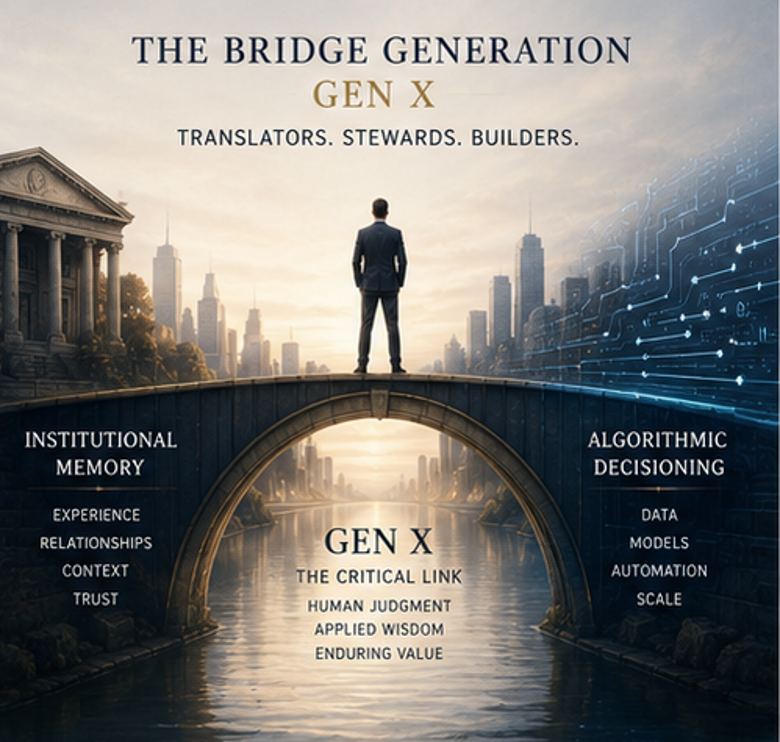
This is especially important for Gen X.
Gen X may be the last generation fluent in both analogue institutional experience and digital acceleration. We remember the apprenticeship model. We learned by sitting in rooms, listening to client conversations, watching negotiations, travelling with senior leaders, seeing decisions made under pressure, and observing what people did when the formal process only told part of the story.
We also understand the digital systems now reshaping commerce, banking, payments, work, and financial infrastructure. That bridge role comes with a lot of responsibility.
For the next decade, Gen X will influence enormous capital flows while still holding critical leadership roles across industries. Their role will require translating judgment before it disappears, not just occupying the middle seat between two very different generations.
If Gen X does not actively convert institutional memory into something usable, teachable, and compatible with a digital-first world, much of it will be lost. Once it is lost, AI systems will not magically recreate it. They will optimise around the data they have, not the wisdom that was never captured.
That is one of the uncomfortable truths of this moment. AI may accelerate knowledge, but it does not automatically create wisdom.
The pace of change is now moving faster than the traditional ways organisations transfer experience. Apprenticeship has weakened and remote work has changed how people learn. Digital communication has made organisations more efficient, but often more transactional. Younger professionals have more access to information than any generation before them, but in many cases, less exposure to the informal judgment-building moments that used to happen through proximity.
The hallway conversation mattered. The client dinner mattered. The difficult meeting mattered. The ride back after a failed pitch mattered. Watching a senior leader pause before answering a hard question mattered. You won’t find those moments written down in a training manual, but they shape how future leaders will make decisions.
That is why relationship equity matters.
I have always thought of relationships like bank accounts. Trust, collaboration, mentorship, credibility, and shared experience are deposits. Conflict, stress, miscommunication, and disappointment are withdrawals. A relationship survives pressure only if the balance is strong enough. In calm markets, relationship equity can look intangible. In stress, it becomes liquidity, flexibility, credibility, and time.
The more organisations automate, the more intentionally they need to preserve the human trust that allows systems to function under pressure. Digital tools can identify the what, but they do not automatically build the how or the why. Without those, institutions become brittle, and decisions are more likely to fragment. The systems may move quickly, but they do not necessarily move wisely.
History, the great teacher that it is, has shown this repeatedly. From the 1987 crash to the dot-com bubble to the 2008 financial crisis, periods of rapid innovation often expose gaps in institutional memory. The same mistakes that bedevilled our predecessors come back to haunt us yet again, only this time they are cloaked in new language. When experience is not transferred, risk simply reappears in another form.
Today, we are drowning in data.
Data without context is dangerous. Institutional memory gives data meaning. It helps leaders understand not only what is happening, but what it resembles, what it could become, and what may be missing from the model. When organisations cannot translate experience into something the next generation can understand, they lose more than knowledge. They lose judgment as well. Markets do not forgive that for long.
At the same time, financial behaviour itself is changing. Buy Now, Pay Later has altered how consumers think about credit, liquidity, and affordability. Instant-payment rails are compressing settlement windows, while tokenisation and stablecoins are changing how value may move. Embedded finance is placing financial decisions inside non-financial environments, and AI is changing advice, underwriting, fraud detection, risk scoring, and financial planning.
These innovations can reduce costs, expand access, improve speed, increase inclusion, and make financial systems more responsive. The opportunity is real. But lower friction also changes behaviour.
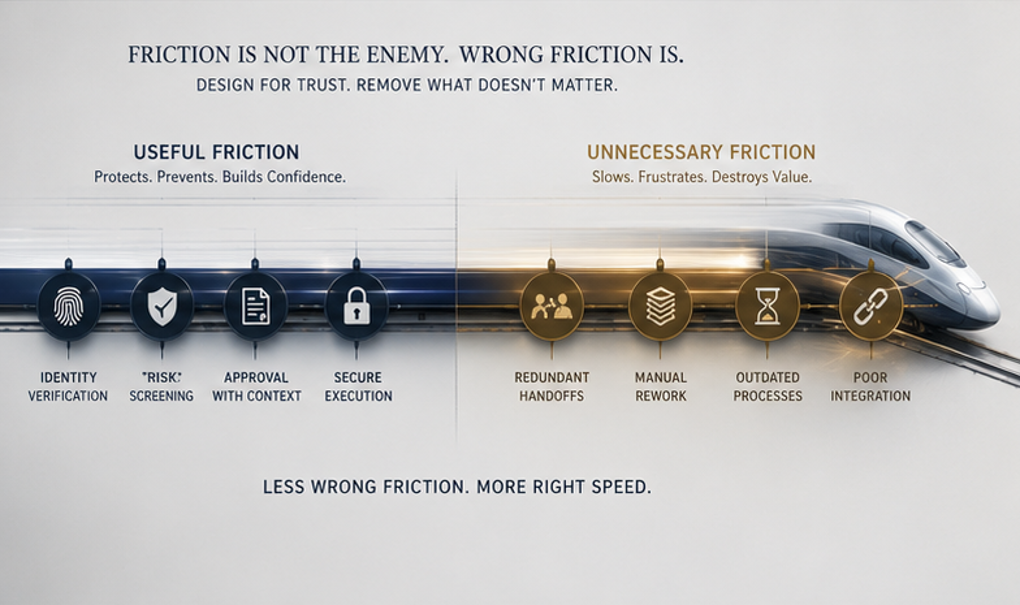
Some friction is inefficient and should be removed. Some friction is exclusionary and should be challenged. But some friction has historically served a purpose. It created a pause. It forced a review. It gave people and institutions a moment to think before they squeezed the toothpaste out of the tube.
Now we are building systems designed to move faster. The question is whether they are also becoming more thoughtful.
That question becomes even more important as agentic AI develops. We are entering a world where machines will not only analyse choices, but will increasingly shape, recommend, initiate, and execute them. The quality of the result will depend on the quality of the knowledge inside the system.
If that knowledge is incomplete, outdated, poorly governed, or disconnected from real-world judgment, the risks are liable to multiply. And quickly.
The Financial Stability Board has already warned that AI adoption in finance can create vulnerabilities around third-party dependencies, market correlations, cyber risk, model governance, and financial stability. The Bank of England has raised similar concerns about AI-related financial stability risks and the potential for AI to intensify cyber threats. None of this should surprise anyone. Financial systems are networks of trust, speed, incentives, and consequences. When intelligence becomes automated inside those networks, governance becomes ever more important.
There is a lot of discussion these days about how quickly we can adopt AI. Framing the question around speed, however, misses an important point. The better question that leaders need to ask is: what human judgment must be preserved, translated, and embedded before AI begins acting on our behalf?
Organisations need a new discipline of knowledge transfer. Not old-fashioned documentation alone, and certainly not just another generic training module.
The real work is capturing decision logic. Why was a deal approved? Why was a risk avoided? Why did a senior leader hesitate? Why did a relationship survive stress? Why did a treasury process evolve the way it did? Why was a payment control put in place? What did the last crisis teach that never made it into the official process?
The answers to all of these questions are institutional assets, though they are often not memorialised.
The companies that win the next decade will not simply be the ones that digitise fastest. They will be the ones that combine speed with memory, automation with accountability, and intelligence with judgment. They will train people and systems not only on outcomes, but on context. They will treat relationship equity as a balance sheet asset, even if accounting rules do not. And they will understand that AI is most powerful when it is pointed at the right questions by people who understand the consequences.
This is not an argument against AI. On the contrary. AI can be an incredible engine of productivity, participation, and growth. It can open access, lower costs, improve decision-making, and help solve problems that have constrained people and institutions for decades. But optimism is not a strategy. Hope is not a strategy. Governance is.

Leaders need to make three commitments.
First, preserve judgment before it exits. The people who lived through market cycles, payment failures, liquidity shocks, regulatory shifts, client crises, cyber incidents, and operational breakdowns hold knowledge that cannot be replaced by a chatbot or a policy manual.
Second, redesign apprenticeship for a digital-first world. Remote work, automation, and AI assistance are not going away. But younger professionals still need exposure to ambiguity, negotiation, trust-building, and decision-making under pressure. If they cannot learn by proximity, firms must create new forms of proximity.
Third, govern intelligence. AI systems must be trained, evaluated, and monitored with institutional context. The benchmark should not only be whether an output is accurate. It should be whether it is appropriate, explainable, resilient, compliant, ethical, and aligned with real-world obligations.
The Great Wealth Transfer is moving assets. Artificial intelligence is moving decision-making. Together, they will reshape participation, prosperity, and safety.
If managed well, this convergence could broaden access, improve financial systems, strengthen productivity, and create more inclusive growth. Handled poorly, however, it could weaken judgment, concentrate advantage, leave underserved groups behind, accelerate systemic errors, and leave the next generation with capital they can access but not administer well.
Technology will keep advancing. That is certain. The goal that we have to set for ourselves is to make sure speed does not outrun wisdom.
Efficiency cannot come at the expense of judgment. Speed cannot substitute for understanding. Access must be matched with responsibility.
Financial systems are not simply technological systems. They are human systems. Their resilience depends on the quality of the decisions made inside them. The institutions that make it through this transition will not simply be the fastest to digitise. They will be the ones that preserve wisdom while scaling speed.
Infrastructure determines participation. Participation determines prosperity. But judgment determines whether prosperity lasts.
“The future will not belong only to those who move fastest. It will belong to those who move with speed while preserving the judgment to understand why the decision matters.”
– Alan Koenigsberg
Bibliography and Sources
Peter H. Diamandis. “The Next Five Years: A Supersonic Tsunami.”The Next 5 Years: A Supersonic Tsunami
Elon Musk. “AI Is a ‘Supersonic Tsunami’ That Will Upend the Workforce.” Business Insider.Elon Musk: AI Is a ‘Supersonic Tsunami’ That Will Upend the Workforce – Business Insider
Cerulli Associates. “Cerulli Anticipates $124 Trillion in Wealth Will Transfer Through 2048.” December 5, 2024. https://www.cerulli.com/press-releases/cerulli-anticipates-124-trillion-in-wealth-will-transfer-through-2048
Stanford Institute for Human-Centered Artificial Intelligence. “AI Index 2025: State of AI in 10 Charts.” April 7, 2025. https://hai.stanford.edu/news/ai-index-2025-state-of-ai-in-10-charts
Stanford Institute for Human-Centered Artificial Intelligence. “The 2025 AI Index Report.” 2025. https://hai.stanford.edu/ai-index/2025-ai-index-report
McKinsey & Company. “Capturing the Full Value of Generative AI in Banking.” December 5, 2023. https://www.mckinsey.com/industries/financial-services/our-insights/capturing-the-full-value-of-generative-ai-in-banking
Financial Stability Board. “The Financial Stability Implications of Artificial Intelligence.” November 14, 2024. https://www.fsb.org/2024/11/fsb-assesses-the-financial-stability-implications-of-artificial-intelligence/
Financial Stability Board. “Monitoring Adoption of Artificial Intelligence and Related Vulnerabilities in the Financial Sector.” October 10, 2025. https://www.fsb.org/2025/10/monitoring-adoption-of-artificial-intelligence-and-related-vulnerabilities-in-the-financial-sector/
Reuters. “Bank of England Sees Growing Risks to Financial Stability from AI.” July 7, 2026. https://www.reuters.com/business/finance/bank-england-sees-growing-risks-financial-stability-ai-2026-07-07/
Federal Reserve Board. “Federal Reserve Announces that the FedNow Service Is Now Live.” July 20, 2023. https://www.federalreserve.gov/newsevents/pressreleases/other20230720a.htm
The Clearing House. “Real Time Payments.” Accessed July 2026. https://www.theclearinghouse.org/payment-systems/rtp/institution
Consumer Financial Protection Bureau. “The Buy Now, Pay Later Market.” December 10, 2025. https://www.consumerfinance.gov/data-research/research-reports/the-buy-now-pay-later-market/
Consumer Financial Protection Bureau. “CFPB Research Reveals Heavy Buy Now, Pay Later Use Among Borrowers with High Credit Balances and Multiple Pay-in-Four Loans.” January 13, 2025. https://www.consumerfinance.gov/archive/newsroom/cfpb-research-reveals-heavy-buy-now-pay-later-use-among-borrowers-with-high-credit-balances-and-multiple-pay-in-four-loans/
Bank for International Settlements. “Annual Economic Report 2025, Chapter III: The Next-Generation Monetary and Financial System.” June 24, 2025. https://www.bis.org/publ/arpdf/ar2025e3.htm
IOSCO. “Tokenization of Financial Assets.” November 2025. https://www.iosco.org/library/pubdocs/pdf/IOSCOPD809.pdf