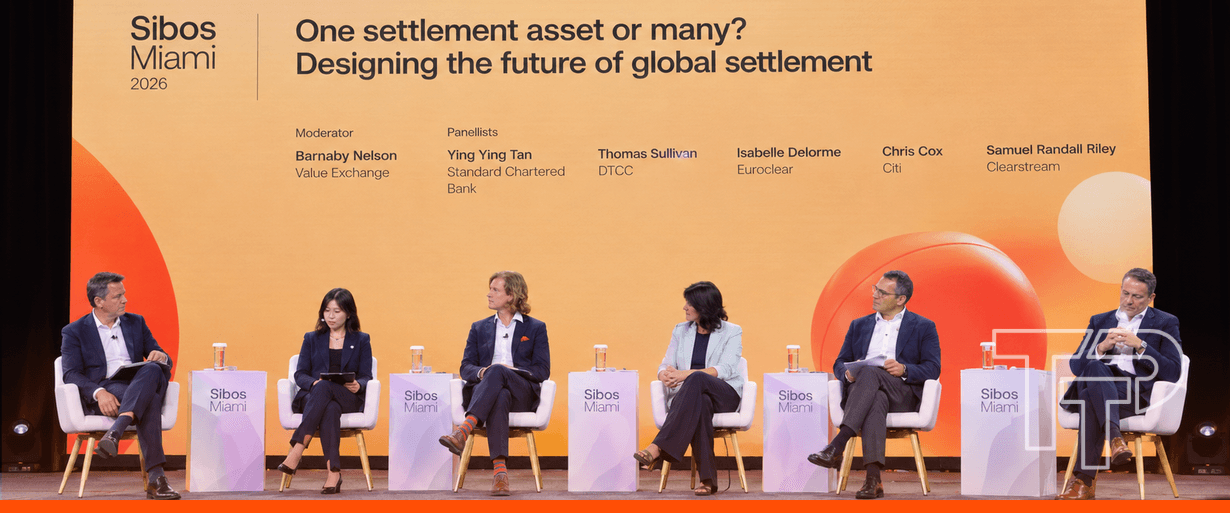
What does the future of settlement look like in a multi-asset environment? How can multi-asset settlement work logistically? How can institutions prepare for a world where traditional and digital settlement rails need to coexist? Will global settlement converge on a single, trusted asset?
These were the central questions moderator Barnaby Nelson of Value Exchange invited panellists Chris Cox of Citi, Isabelle Delorme of Euroclear, Samuel Randall Riley of Clearstream, Thomas Sullivan of DTCC, and Ying Ying Tan of Standard Chartered Bank to discuss as digital money took centre stage at Sibos in Miami.
We’re spoilt for choice
One question was answered immediately – it certainly does not look like we are converging on a single asset. As Nelson highlighted repeatedly in his moderations, the exercise for the industry is not really to even look for a single solution, but to ask the right questions.
Right now, these questions revolve around the proliferation of digital currencies. As Tan summarised, you cannot settle trade without cash. In contemporary trade, however, ‘cash’ appears to have rather a broad definition. There are a range of options available for settling matched transactions that are now being used in different markets.
Nelson provided figures from an ISSA survey that illustrated the growing adoption of such options: this year, 71% of the industry expect to be using stablecoins as part of their live transactional activity, 74% tokenised deposits, and 42% expect to be using Central Bank Digital Currencies (CBDCs).
The view around the world
In broad terms, the digital currency story around the world can be told by looking at three major markets: Europe, Asia, and the United States.
Europe is looking to accelerate public and private partnership around CBDCs. The key to adoptability is infrastructure. Infrastructure is also crucial to ensure digital currencies don’t simply make things more fragmented, trapping liquidity in pools and undermining the efficiency and advantages they offer.
The United States does not have a CBDC, but there has been wide private-sector deployment of dollar stable coins like USDT. The GENIUS Act helped offer regulatory clarity on stablecoins, which has encouraged subsequent adoption. As stablecoin is increasingly used for 24/7/365 transactions, the key consideration is ensuring these digital assets are compatible with traditional assets.
When it comes to Asia, we can’t really look at it like a single, cohesive market. As Tan points out, we’re dealing with 16 countries, different currencies, a mix of restricted and unrestricted currency stablecoins, and massive differences country-to-country in terms of technological and regulatory deployment. Singapore and Hong Kong are ahead of the game, for example, with tokenised deposits rigorously tested, while other countries are lagging by comparison, still very much in the sandboxing phase.
There is a need for greater regulatory and use case clarity when it comes to digital currency deployment across Asia. Instantaneous cross-border transactions and real-time settlement are a major goal for the region, which is why there is a lot of experimentation in the digital currencies space. But it is a marathon, not a sprint. It is perhaps better to start small and see how the problems can really be solved, then build from there.
The real driver of use cases
Forging the future of digital currency implementation is largely a matter of letting clients lead the way. In Cox’s words, Citi will be following client flows to learn the use cases that matter most to them. Sullivan was able to offer a microcosm of this approach in action.
Client demonstrations of DTCC’s Tokenisation Service were carried out in July, ahead of its upcoming deployment next month. Use cases for these demos were driven by client priorities, which arguably reflect market priorities. Two clients completed tokenised stock-versus-stock settlement, with no cash leg required.
This offers a glimpse of the possible future of how businesses might settle transactions with tokenised assets. Tokenisation services can be an enabler creating an ecosystem where the market can pick the best currency for itself – even if that isn’t a currency at all, but some other tokenised asset.
Where are we standing?
The use of digital currencies is only going to expand, and institutions need to adapt. People want 24/7/365 operation to be a reality – this means trading in stablecoins and cryptocurrency. But ultimately, these digital currencies need to be fungible with traditional assets.
So traditional rails are not going anywhere either. The worlds of digital and traditional are communicating more, but one world will not supplant the other.
While digital assets can help manage market conditions and risk more efficiently, particularly across borders, even the most optimistic predictions suggest only 10% of assets will be tokenised 10 years from now (still an exponential increase from the 0.001% currently).
Where are we headed?
The future looks to be a hybrid environment. This is certainly Riley’s view and the general consensus of the panel. For such a world to work effectively, digital currencies need to be interoperable with one another and with traditional rails.
The panel also highlighted the importance of different organisations keeping an eye on each other’s operations. Such collaboration is crucial not only to achieving interoperability but discovering and adopting best practice for this new hybrid frontier. There will be lessons to learn, and there is no reason these lessons cannot also be applied to how we operate the traditional rails in this hybrid environment moving forward.
Adoption also needs to be as simple as possible for clients. The client-centric perspective championed by Cox and Sullivan once again seems to be key – adopting new technology can be an expensive undertaking for an organisation, and only worth doing if there is a client appetite for it.
Clients will gravitate towards solutions that solve problems and make their ambitions like 24/7/365 operations or instantaneous settlement a reality. But such solutions need to be easy to engage with and not add operational complexity. On a practical level, these technologies need to be virtually invisible. When such simplicity is achieved, expect to see an increase in adoption and real scalability become possible.
What is the real benefit of all this?
A lot of ground was covered in this one-hour discussion. When it concluded, there was the distinct feeling that the panellists could’ve continued delving into digital currencies for many hours more.
The key takeaway, if it can be distilled to just one, is that when practical, simple adoption comes together with effective interoperability and regulatory clarity, we might achieve a hybrid ecosystem where the best asset class for a particular transaction is simply picked from the menu of available options.
Many commentators seem to feel that instant T + 0 settlement is the Holy Grail of such an ecosystem. This is perhaps a limited view of its true potential. Indeed, instant settlement across all asset classes can create liquidity management challenges and increase intraday credit risks.
Instead, what we might see is a future of intelligent settlement, in Delorme’s words. Technology – perhaps Distributed Ledger Technology interacting with AI – can power settlement that happens at the right time in the right asset to minimise counterparty risk, reduce liquidity drag, and optimise balance sheet efficiency.