By Deepesh Patel, Managing Director and Editor-in-Chief, Joy Macknight, Transaction Banking and Payments Editor
A real-time payments switch delivered between Friday and Monday, a super-app reaching millions in Uzbekistan, an €11 billion guarantee framework, and the receivables programme named Corporate of the Year.
The third article in our series on the inaugural TTP Corporate Excellence Awards covers the Corporate Payments Awards, Individual Recognition and the top corporate honour of the night.
The awards, held at The Lansdowne Club in London on Wednesday 7 October, drew 188 submissions. Corporate and individual categories were judged blind by TTP’s Global Advisory Panel.
Best Payments Modernisation Initiative
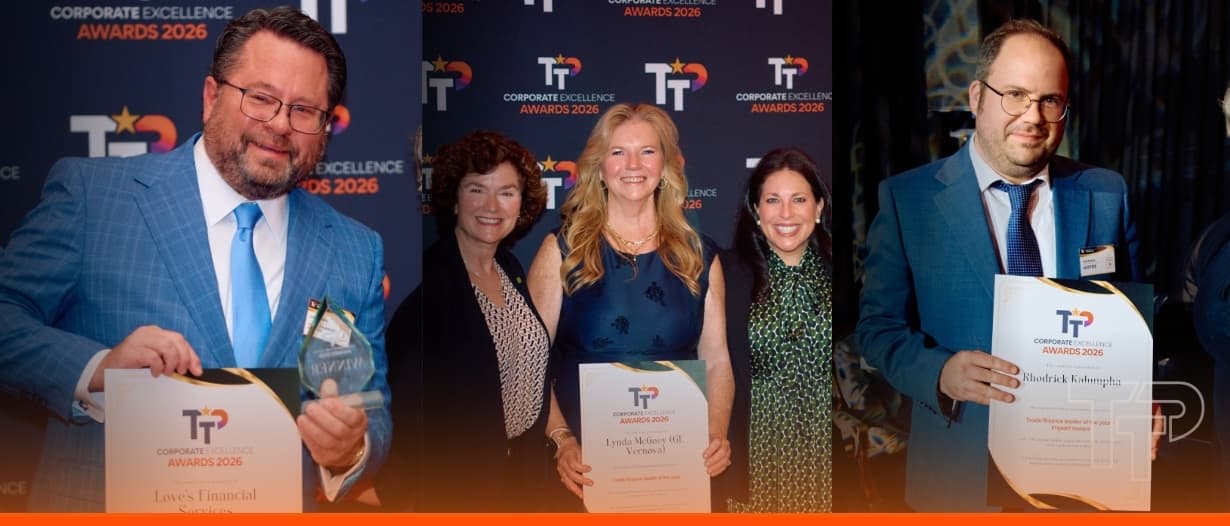
Winner: Love’s Financial Services
Love’s Financial Services, the financial services arm of Love’s Travel Stops, won for moving to real-time payments over a single weekend using Bank of America‘s CashPro API. Bank of America nominated the project.
Love’s provides freight factoring to owner-operators and fleets who depend on same-day funding. When it acquired a freight factoring portfolio, it inherited customers used to receiving funds instantly, including at weekends. The deal closed on a Friday evening, and a working real-time payments solution was needed by Monday morning. Love’s had never run real-time payments before, and slower rails would have put customer trust at risk.
Over one weekend, Treasury and IT built a payment workflow on CashPro API, using Bank of America’s sandbox to test connectivity, messaging and reconciliation before go-live. On Monday, operations resumed with full real-time capability, and no customer waited for funds they needed for fuel, maintenance and payroll.
Manual payment entry has gone, payments can run outside banking hours, and Love’s plans to use the same integration for future acquisitions. The judges highlighted the speed of the implementation: from no real-time payment capability on Friday to a working service on Monday.
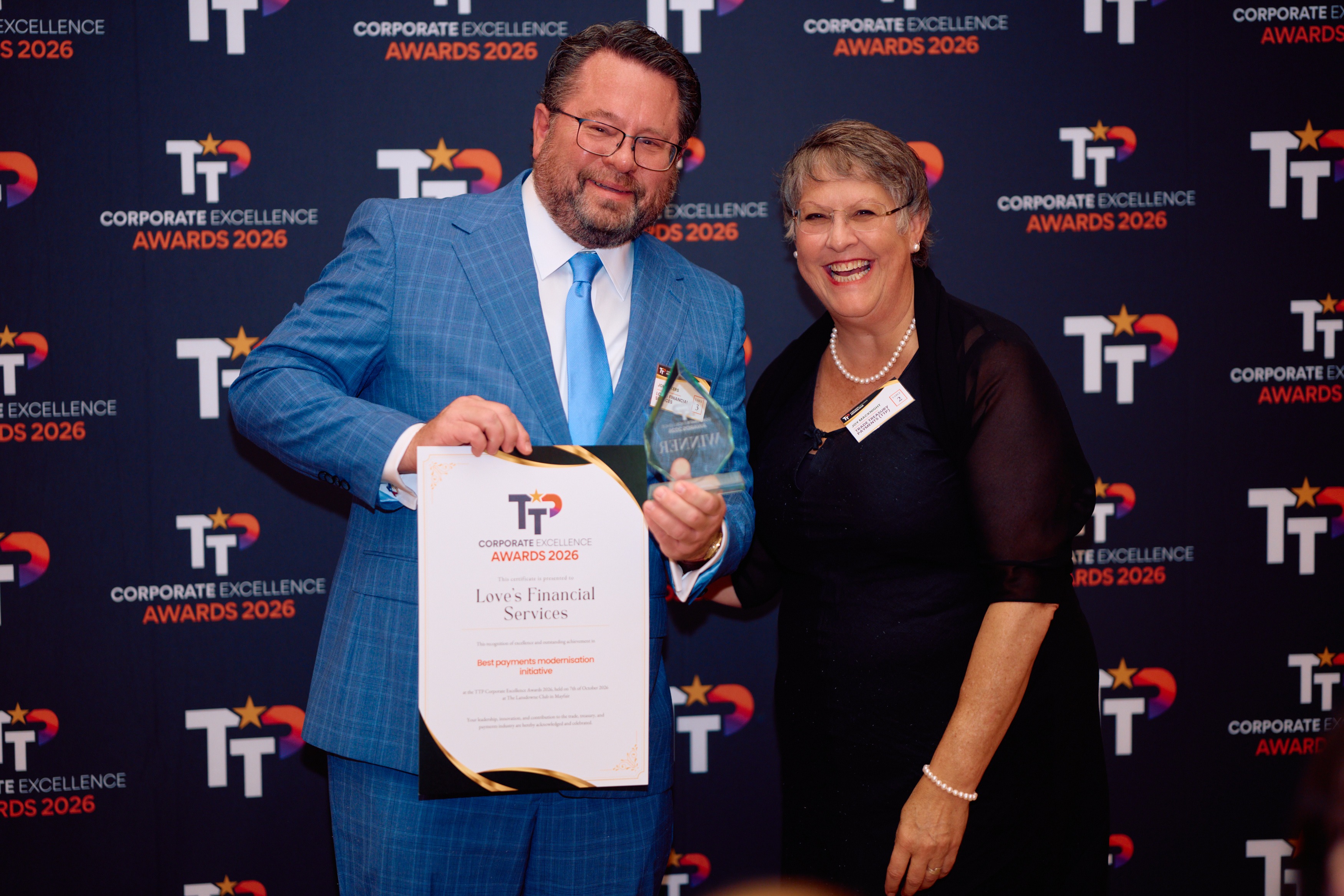
Love’s Financial Services, winner, Best Payments Modernisation Initiative.
Best Payments Strategy
Winner: UZUM
UZUM won for integrating payments into Uzum Market and Uzum Nasiya, its marketplace and buy now, pay later services, instead of building a separate banking app.
The rollout was sequenced. A Visa-powered card launched in late 2024, followed in 2025 by cashback, marketplace and public transport payments, and Visa Direct instant international transfers. Onboarding is fully online, virtual cards work immediately, and physical cards can be collected from more than 430 Uzum Market pickup points, including in communities far from bank branches.
The judges saw a platform-first strategy outcompeting a conventional banking app on reach and trust.
Corporate of the Year in Payments
Winner: Uzum Bank
Uzum Bank was named Corporate of the Year in Payments for building banking, payments and consumer finance into a single mobile experience in a market where much of the population has been unbanked.
Customers can open an account remotely, receive a virtual card within minutes, pay, transfer, borrow in instalments and earn cashback without switching apps. By the end of 2025 the bank had issued more than four million payment cards, and cardholders passed seven million in 2026. Customers made more than 37 million public transport journeys with Uzum Bank products in 2025.
Uzum Bank uses Uzbekistan’s existing e-commerce network to reach customers beyond the traditional branch network. Its more than 430 Uzum Market pickup points extend that reach into communities where access to banking has been limited.
Trade Finance Leader of the Year
Winner: Lynda McGoey, GE Vernova
Lynda McGoey, Treasury Executive Managing Director at GE Vernova, was nominated by TD Securities. The judges recognised her for architecting the trade finance strategy behind one of the most complex corporate separations in recent history: the split of General Electric into three independent, Fortune 500-scale companies, GE HealthCare, GE Vernova and GE Aerospace.
Leading Global Trade Finance alongside Cash Management, Risk, Pensions and Bank Relationship Management, Lynda designed independent banking structures, systems, governance and operating models for each company’s size, risk profile and commercial needs. That included three global uncommitted trade finance facilities. None of the three companies lost continuity of trade finance support through the transition.
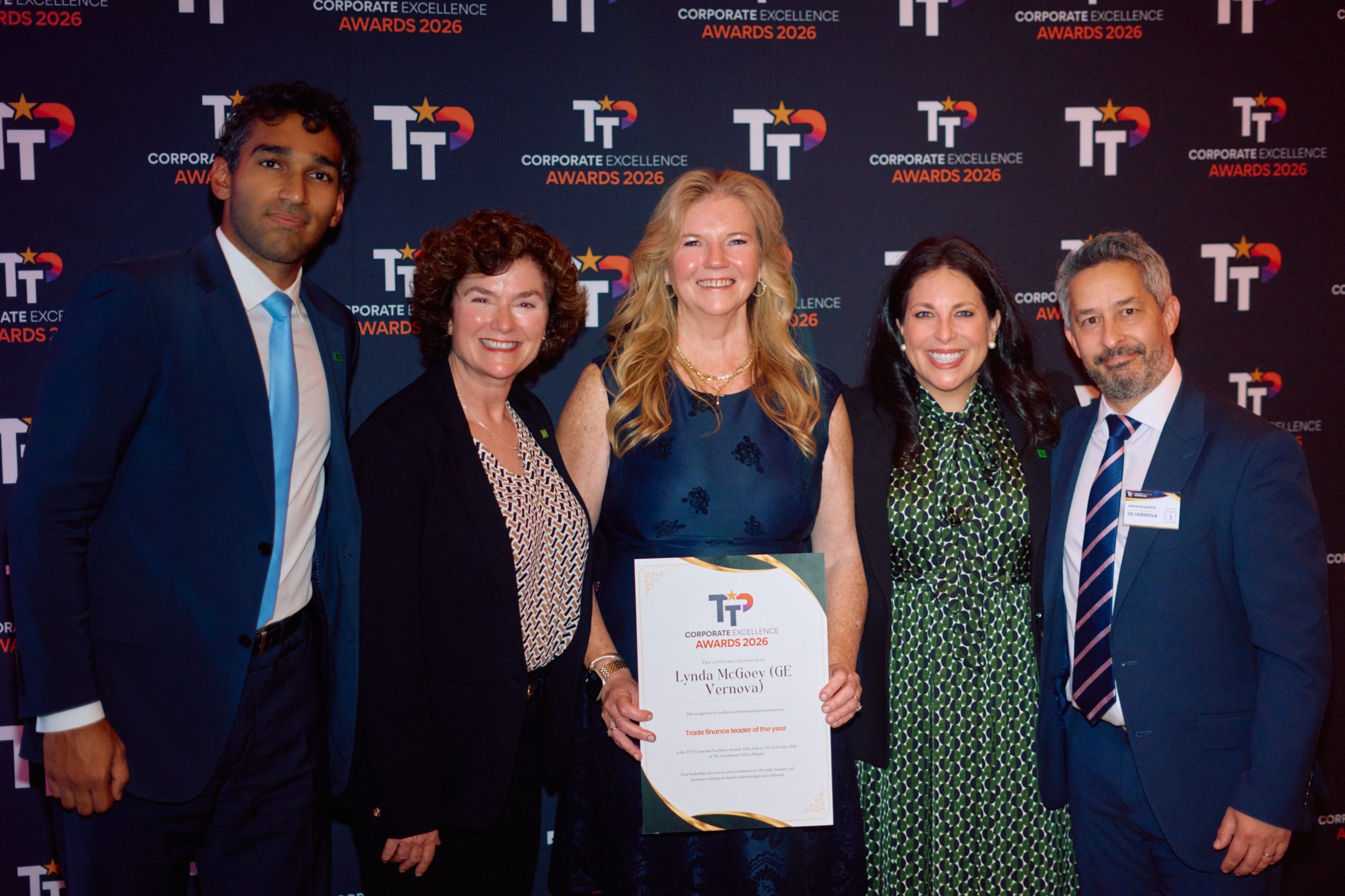
Lynda McGoey, GE Vernova, Trade Finance Leader of the Year.
Trade Finance Leader of the Year, Emerging Markets
Winner: Rhodrick Kalumpha, Global Tea and Commodities
Rhodrick Kalumpha, Group Finance Controller at Global Tea and Commodities, was nominated by Lloyds. He led the digitalisation of documentary collections for Kenyan tea exports, one of the most paper-intensive corners of African trade.
The work involved Global Tea’s teams in Kenya and the UK, ABSA and Lloyds, technology provider Enigio, shipping lines, freight forwarders and customers. Rhodrick introduced electronic trade documents and digital promissory notes using Enigio’s trace:original platform. Transactions that took up to a week now run in roughly 24 hours.
Jon Boran, Head of Future Products at Lloyds, credited Rhodrick with bringing “live digital trade flows to life alongside Lloyds Bank, Maersk and Enigio.” The judges also noted his openness: he has shared Global Tea’s experience across the industry, giving other corporates the confidence to follow.
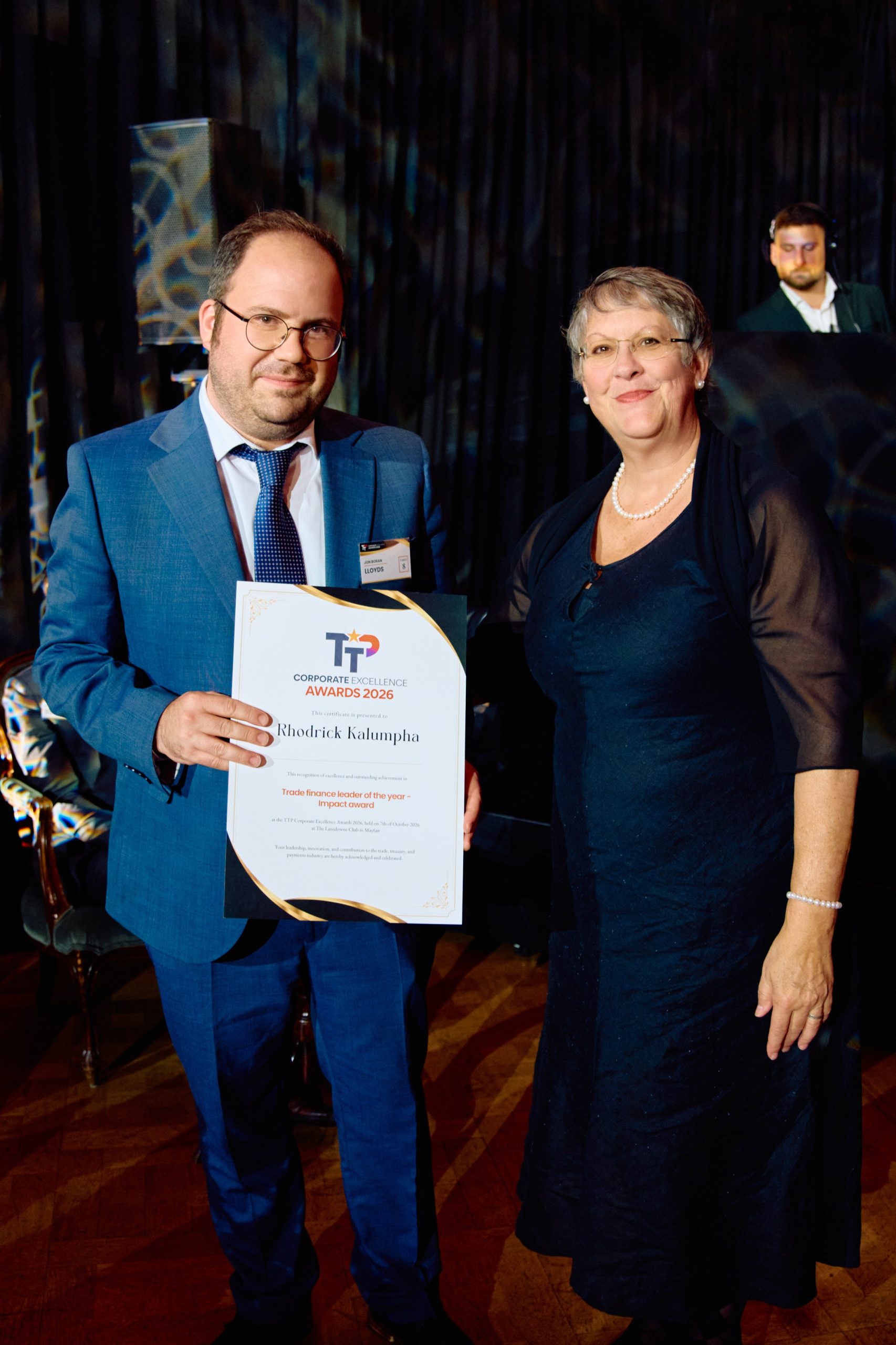
Global Tea and Commodities, Trade Finance Leader of the Year, Emerging Markets.
Corporate Treasurer of the Year
Winner: Robert McAnally, Siemens Energy
Robert McAnally, SVP and Head of Treasury and Corporate Finance at Siemens Energy, was nominated by BNP Paribas. Since joining in 2021, he has led a function spanning treasury, guarantees, corporate finance, pensions, insurance, project finance, ratings and banking relationships through a period of severe pressure on the business.
Siemens Energy’s model depends on performance and advance-payment guarantees for long-dated infrastructure projects. Robert’s team arranged a €11 billion government- and bank-supported guarantee framework that kept that capacity open. As performance recovered, he led the move to a €9 billion fully commercial, bank-backed facility several years ahead of schedule, oversubscribed by 44 per cent, allowing an early exit from government support.
He has also modernised the function: a refreshed leadership structure, around €29 million in efficiency savings, and a rolling forecast of guarantee demand that gives lenders earlier, evidence-based visibility. The judges highlighted his role in financing the company through the crisis and returning it to market-based funding several years ahead of schedule.
Corporate of the Year in Trade, Treasury or Payments
Winner: Vishay Intertechnology Asia
The overall Corporate of the Year went to Vishay Intertechnology Asia for a receivables programme, structured with J.P. Morgan, that does something rarer than free up working capital: it turns receivables into a strategic funding pillar for the whole business.
The off-balance-sheet purchase programme monetises receivables from 67 buyers across nine Asian markets, generating liquidity without adding debt. The proceeds are upstreamed through intercompany loans to fund Vishay’s global capital expenditure. Off-balance-sheet treatment preserved covenant headroom during a period of heavy investment, and credit insurance and a first-in-market auto-debit collection mechanism gave the structure resilience across nine jurisdictions and two currencies.
What earned Vishay the top corporate honour was the change in posture: treasury moved from reactive funding to proactive, programmatic liquidity management. Vishay’s CFO, Dave McConnell, credited the J.P. Morgan and Vishay teams for executing the programme “with exceptional creativity and professionalism.”
The final article in this series covers the Editor’s Choice awards.