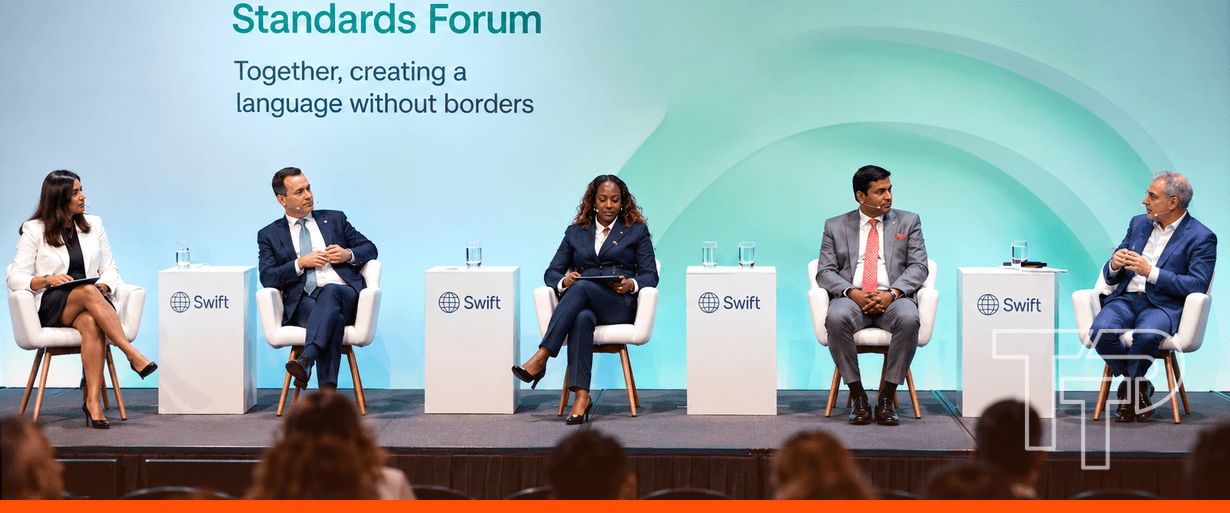
“Trade digitalisation is not about making sure those who are winning continue to win faster; it is about making trade inclusive for all.” This theme set the tone at the Sibos 2026 Standards Forum on Day 3.
Moderated by Swift’s Avanee Gokhale, the panel “Standards in trade: what’s next for the industry?” featured Steven Beck (Asian Development Bank), Ajit Menon (HSBC), Nompilo Mtshali (Standard Bank), and Florian Witt (International Chamber of Commerce), and discussed a critical question – as the industry moves past paper-based trade, what comes next for global standards?
The future is interoperability
The industry once pursued a goal of uniting all banks, corporations, and customs authorities on a single global platform. The panel agreed that this idea is no longer viable.
Instead, the future lies in interoperability. As Steven Beck said, with 35 main document types powering global import and export, forcing everyone to adopt the exact same software is impossible. Just as standardising shipping containers transformed physical commerce in the 1960s, digitising trade documents will be our next great leap. But forcing everyone onto a single platform doesn’t work.
The real breakthrough won’t come from forcing a single universal standard, but from establishing a standard for interoperability that allows different systems to talk seamlessly to one another.
Shielding end-users from systemic complexity
For corporates, global trade ultimately comes down to two priorities i) moving goods smoothly and securing timely funding ii) forcing end-users to navigate technical standards or system interoperability creates unnecessary friction.
Florian Witt stated that instead, the responsibility of solving cross-border friction rests entirely on ecosystem actors – banks, carriers, customs authorities, and tech vendors. Industry bodies like the ICC Banking Commission are stepping in to build these connections behind the scenes, such as providing standardised API protocols to trade application vendors to ensure fluid execution across different banking systems. The industry stakeholders across the value chain need to manage this complexity. The end user is not the one who should be confronted with it; they should just get the solution.”
Making standards an enabler for emerging economies
Global trade standards often overlook the needs of developing regions by requiring costly technology and strict deadlines that don’t consider local conditions.
When small businesses or regional banks are forced to be “standard takers” rather than “standard creators,” compliance and technology costs become an insurmountable barrier to entry.
Nompilo Mtshali emphasised that to drive true inclusion, standards must be flexible enough to integrate into existing, low-cost technologies like basic APIs, allowing a small bank in an emerging market to connect to global rails as seamlessly as a tier-one institution. By involving developing economies early in the conceptual stage and granting longer implementation lead times, standards can lower risk and compliance costs rather than creating new barriers.
Harnessing AI for data and interoperability
While AI offers immense potential to transform trade finance, its effectiveness relies entirely on the quality of underlying data—bad data inputs inevitably yield poor outputs. Rather than viewing AI as a total overhaul, institutions are using it as a targeted catalyst to accelerate core digitisation priorities and bridge system gaps.
Steven Beck noted that in practice, AI is already solving critical operational bottlenecks by converting unstructured paper documents into structured, machine-readable data while maintaining human oversight. Additionally, it is accelerating document interoperability by automatically scanning thousands of data fields across trade standards to identify discrepancies, such as conflicting date formats, and mapping technical solutions to make different systems communicate seamlessly.
He said that we try to break it down into bite-sized steps and ask how we can use AI to achieve our immediate priorities. For interoperability, AI helps us go through thousands of data fields within document types to spot discrepancies between standards and build the technical links to resolve them.”
Aligning traditional rails and tokenised value
The panel concluded with a discussion on tokenisation. As the financial industry builds new digital rails alongside legacy infrastructure, tokenisation cannot scale in isolation. Whether value moves via traditional bank transfers or digital tokens, foundational principles – interoperability, legal frameworks, and dispute resolution remain identical across both systems.
Ajit Menon stated that without shared standards, a token issued by one bank cannot be recognised, settled, or legally verified by another, causing transactions and trust to fail. He gave an example that if HSBC’s token is transferred to Standard Bank, but they don’t recognise that token, the transaction fails. The foundational principles, whether legislation, systems, or governing frameworks, must be put in place first so that trust and interoperability can be replicated as digital tokens scale.”
While digital token rails can accelerate the movement of money, true efficiency relies on eliminating the physical paper trail. Digitising trade documents and establishing a single, verifiable version of truth ensures that value and goods move at the same speed.