
For many years, inventory finance occupied a modest niche within the funding landscape. It was typically associated with smaller, less creditworthy businesses seeking to monetise physical goods or raw materials through asset-backed structures. The model relied on banks as lenders, carried inflated costs, and demanded intensive administration. From a treasury standpoint, the association with on-balance sheet debt meant higher capital employed and unattractive financial optics.
Unsurprisingly, many treasurers viewed the practice as peripheral if they encountered it at all. Historically, it was a difficult proposition to justify.
Today, however, the environment has shifted significantly. Structural supply chain shocks and advances in technology are reshaping the role of inventory and elevating inventory finance into a strategic capital tool for major corporates. Estimates suggest the total addressable market could reach into the trillions, with roughly $100 billion financed to date and individual transactions exceeding $6 billion.
Catalysts for change
Two forces have accelerated this transformation.
- Supply chain disruption.
The pandemic and geopolitical conflict exposed structural weaknesses in global logistics. Lead times for critical goods – from vehicles to semiconductors – extended dramatically, and competitive advantage shifted toward organisations that could guarantee physical availability rather than simply optimise procurement cost. - Technology-driven demand.
Rising dependency on specific raw materials in high-growth sectors has intensified competition for supply. Securing strategic inputs has become fundamental to protecting enterprise value. Traditional “just-in-time” strategies proved insufficient in volatile markets where availability, rather than efficiency, determined outcomes.
A new generation of inventory finance
Recent innovation reflects a shift in mindset: leading multinationals now treat inventory as a strategic asset to be actively managed, rather than a passive operational necessity. Emerging solutions in the market aim to support four core objectives:
- Securing long-term supply of critical materials.
- Locking in pricing and leveraging bulk purchasing efficiencies.
- Optimising balance sheet treatment through off-balance-sheet structures.
- Streamlining logistics and reducing operational risk.
Crucially, this innovative approach is not driven by liquidity need. These are highly rated businesses with broad access to capital. Instead, inventory finance is being used to create commercial advantage and financial flexibility.
Specialised structures and market participants
Specialist agents, such as Benteler, are emerging as intermediaries that purchase, finance, and manage inventory on behalf of corporate clients.
Goods are held within an independent structure, often through a standalone trading company, with risk and reward transferred away from the end-buyer. The absence of a contractual requirement to resell to the original client provides the critical separation required for off-balance-sheet treatment. The trading company effectively becomes the owner and manager of the asset, while the business secures priority access under agreed commercial terms.
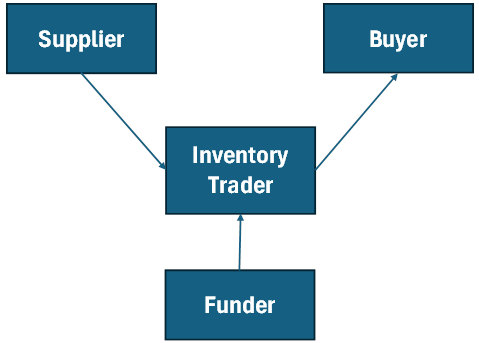
Figure one: an independent inventory trading company buys and manages the inventory without any contractual linkage to sell to the buyer
Economics of the model
While inventory finance pricing often sits between the cost of debt and equity, three drivers are materially reshaping the cost equation:
- Bulk procurement savings.
Significant discounts can offset financing costs when sourcing is aggregated over long horizons. - Operational efficiency.
Centralised logistics, risk management, and handling reduce unit-level operating cost for both funders and buyers. - Sophisticated funding pools.
Agents tap syndicated investor capital designed to support large, stable counterparties at returns marginally below the cost of equity.
When combined, these factors have the potential to produce a net economic outcome close to neutral, or in some cases, earnings-enhancing relative to traditional procurement models.
As David Rudd of Benteler notes, the underlying innovation lies in isolating inventory from the broader business and assigning a market-reflective cost to it. By optimising the real-economy cost of holding and funding inventory, value accrues across the chain.
A market structure where all parties benefit
When executed effectively:
- Suppliers secure committed and guaranteed demand.
- Buyers protect supply, stabilise cost, and reduce balance sheet burden.
- Funders access large-scale, asset-backed investments at attractive yields.
Modern inventory finance can therefore be viewed as an extension of efficient markets theory, arbitraging between the economics of physical supply and the cost of capital to produce a more rational allocation of risk.
Implications for treasury
The evolving model places treasury at the centre of multi-disciplinary decisions involving procurement, supply chain strategy, and structured finance. In doing so, it invites a broader question: how can organisations deploy capital, not simply to fund activity, but to reshape operational advantage?
For businesses operating in supply-constrained sectors, inventory finance is transitioning from a tactical funding instrument to a strategic enabler. As volatility persists, its role in supporting resilience, accessing cost efficiencies, and managing leverage is likely to expand.
As inventory finance moves from niche tool to strategic enabler, its evolution sits squarely on the fault lines reshaping global trade explore more in the latest Trade Treasury Payments magazine issue, Fault Lines, here