
FCI, the global representative body for factoring and receivables finance, has released its Annual Review 2026, offering a detailed examination of the industry’s activities, achievements, and market developments over the past year.
The publication, officially launched during the 58th FCI Annual Meeting held in Lisbon, Portugal, provides a comprehensive reflection on a year characterised by geopolitical uncertainty, rapid technological innovation, and shifting trade dynamics. It also reaffirms FCI’s dedication to fostering the growth and resilience of the global receivables finance sector.
The Annual Review includes messages from FCI Chair Chenyue Mao and Deputy Secretary General Betül Kurtuluş.
Betül Kurtuluş, FCI Deputy Secretary General, said, “The receivables finance industry continues to evolve rapidly. From artificial intelligence and digitalisation to regulatory developments and new market opportunities, our members are navigating a period of significant change.”
“This Annual Review highlights the key trends shaping our industry and reflects FCI’s commitment to supporting members through knowledge sharing, collaboration and advocacy.”
Regional Market Developments and Outlook
The Annual Review offers comprehensive regional updates, highlighting market trends, promotional activities, legal and regulatory changes, and challenges in the receivables finance industry worldwide.
Asia Pacific retains major player title
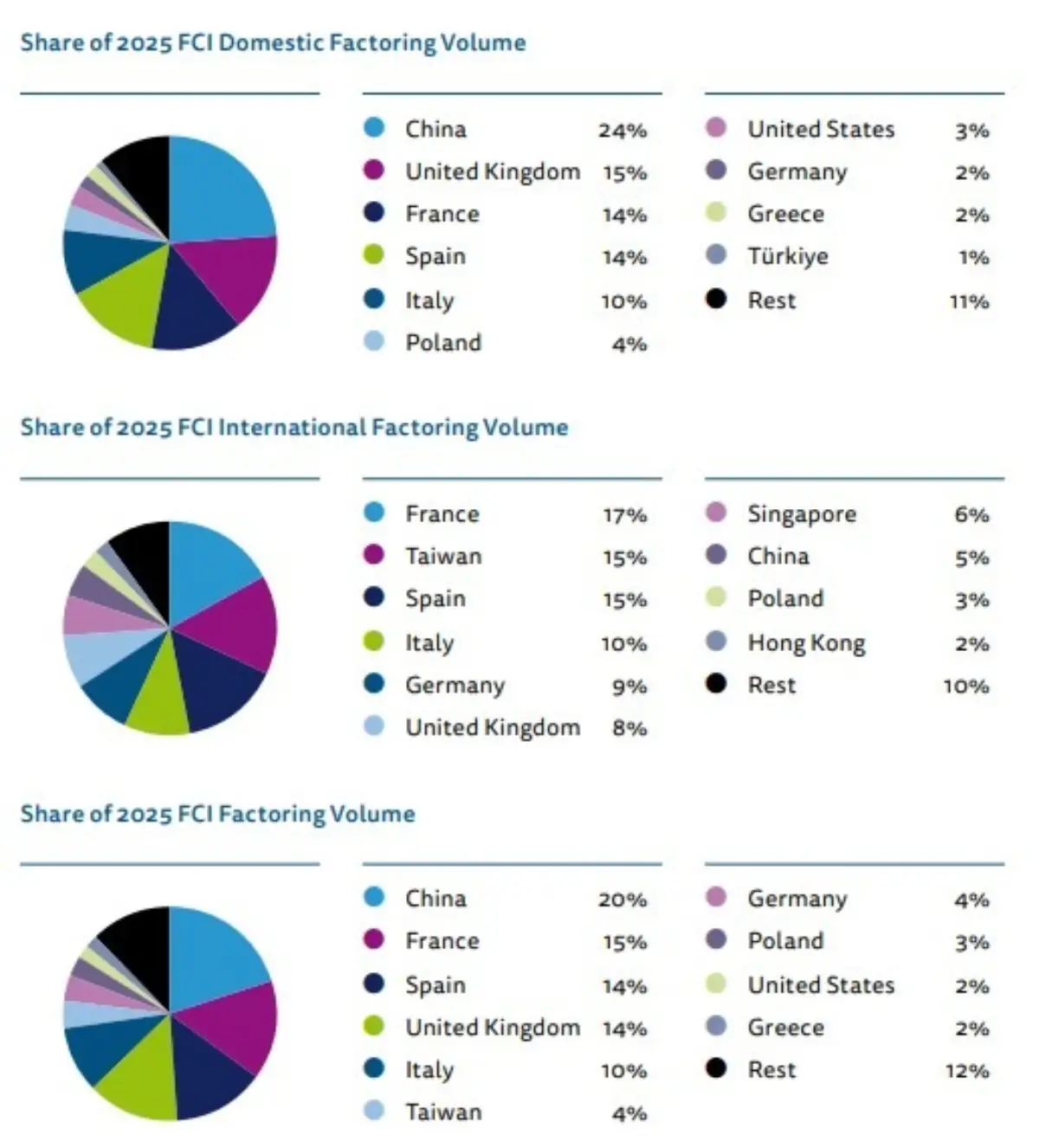
The Asia-Pacific region maintained its position as a major player in the global factoring market, accounting for approximately 25% of the global market share with a total volume of EUR 995 billion in 2025. Growth in the region reached 3.2%, slightly below the global average of 3.7%.
Mainland China remains the dominant market, contributing 72% of the region’s volume and posting steady growth of 5%. Singapore emerged as the fastest-growing major market with a 15.9% increase, followed by India at 13.9%.
Regulatory advancements, such as Japan’s Act on the Promotion of Cash Flow-Based Lending and China’s ‘look-through’ supervision, are driving market development and enhancing transparency and risk management.
Europe and Central & Eastern Europe’s (CEE & SEE) factoring market 11.5% of GDP
Europe continues to hold the largest share of the global factoring market, with a turnover of EUR 2,657 billion in 2025 and a growth rate of 2.2%. The region’s factoring market penetration exceeds 11.5% of GDP, reflecting the sector’s maturity and integration with the real economy.
The CEE and SEE regions saw an 8% growth in 2025, fueled by a demand for flexible liquidity solutions in a challenging macroeconomic environment.
The rise of non-banking financial institutions and fintechs has increased competition and innovation. This is especially true for digital onboarding and compliance.
Americas showcasing strong factor turnover growth
The Americas region shows significant variation in economic and regulatory environments. The United States and Canada reported strong growth in factoring turnover, with the US posting a 35.5% increase to EUR 156.5 billion.
Latin American countries, including Brazil, Mexico, and Chile, are progressing in electronic invoicing and regulations to enhance receivables finance. The region enjoys strong domestic markets that provide various working capital solutions.
The Middle East and Africa face uncertainties
The Middle East remains dynamic despite geopolitical uncertainties, driven by economic diversification and investments in digital infrastructure.
Countries such as the UAE and Saudi Arabia are advancing payables finance and invoice registration systems to enhance transaction security.
Africa faces many challenges, such as limited credit insurance, legal inconsistencies, and political risks.
However, initiatives like the African Trade Insurance Agency (ATI) and capacity-building programs are promoting market development and enhancing access to finance for SMEs.
Horizon spotting: Capitalising on AI in trade finance
A central feature of the 2026 Annual Review is the executive roundtable discussion titled “Horizon Spotting: Capitalising on the AI Opportunity in Trade Finance.”
Moderated by Pamela Mar, Managing Director of the Digital Standards Initiative at the International Chamber of Commerce (ICC), the discussion brings together industry leaders to explore how artificial intelligence is reshaping trade finance.
Participants include Renchun Zeng, CEO of IFS Capital (Singapore); Nergis Ayvaz Bumedian, General Manager at QNB (Türkiye); and Sergio Mendieta, Head of Trade & Working Capital Solutions at Santander (Peru).
The dialogue covers AI’s effects, including better risk management with predictive analytics, enhanced customer experiences through automation and personalisation, and changes in business models that utilise data for decision-making.
However, the discussion also acknowledges challenges related to data privacy, regulatory compliance, and the need for industry-wide standards to ensure ethical AI deployment.
The Annual Review also included the 2025 Global Industry Activity Report (GIAR), which showcases factoring trends and stats across industries.
Outlook for 2026
The factoring industry is experiencing growth, but not without challenges. Limited access to credit insurance and risk mitigation tools hinders market expansion, especially in emerging regions.
Regulatory complexity and inconsistent interactions with central banks and lawmakers hinder the adoption of necessary legal frameworks.
Geopolitical tensions and economic uncertainties, particularly in the Middle East and parts of Europe, increase risks.
Looking ahead, digital transformation, such as e-invoicing, real-time data analytics, and AI-driven risk management, is set to speed up market development.
The ongoing revision of regulatory capital requirements and advocacy for assignment bans removal in the EU could provide significant growth opportunities. FCI’s role as a catalyst for cooperation, education, and advocacy remains critical in navigating these challenges and fostering sustainable industry growth.